“Super Blood Wolf Moon” Lunar Eclipse Set To Amaze Night Sky Seekers on January 20-21
InstantWeather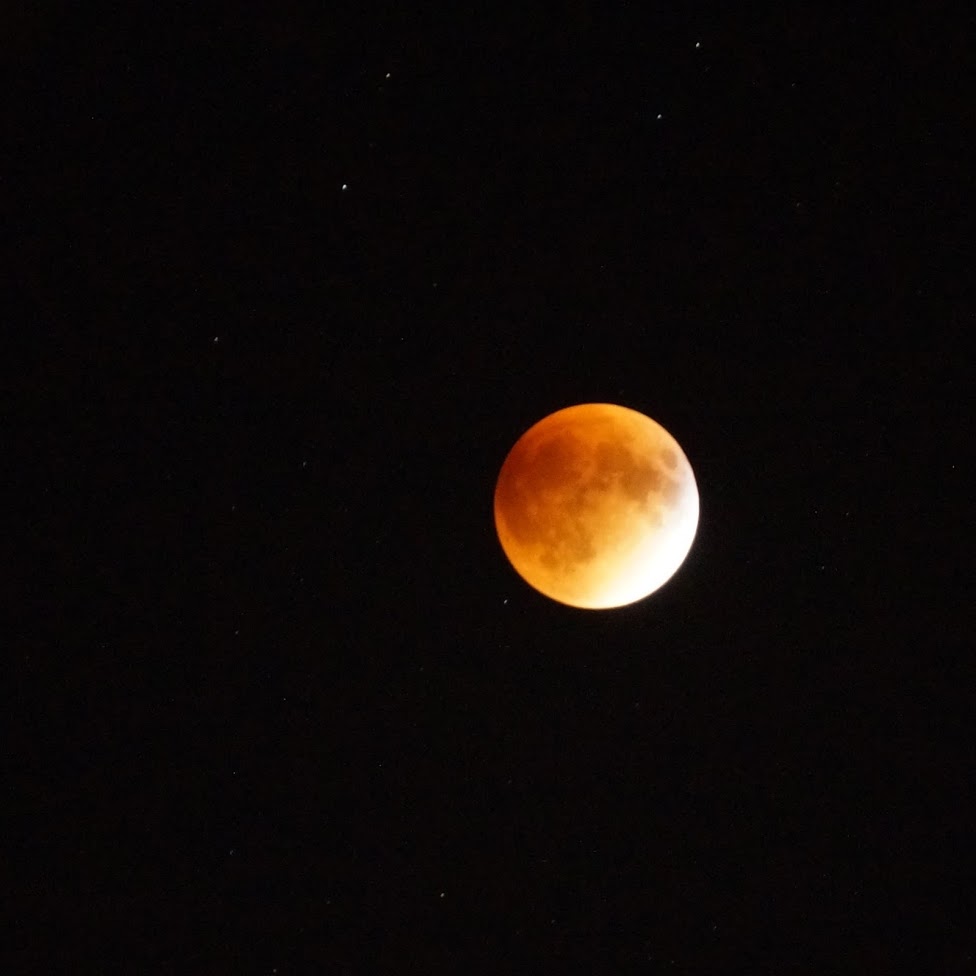
(Photo Credit: Joey Pothe)
On January 20-21, North Americans will experience the first and only total lunar eclipse of 2019.
A lunar eclipse takes place when Earth moves directly between the Sun and the Moon. When this occurs, the majority of the light from the Sun is blocked and the Moon is completely covered by the shadow of the Earth. This is very different from a total solar eclipse, where the Moon is between Earth and the sun and blocks out the complete disk of the Sun.
For this eclipse, you will notice the Moon taking on a reddish-orange tint. This is caused by the light of the Sun scattering when it enters the Earth’s atmosphere at a specific angle. According to NASA scientist Noah Petro for space.com, a lunar eclipse displays the colour of all the Earth’s sunrises and sunsets reaching the Moon.
So, why is this year’s lunar eclipse being called a “Super Blood Moon Lunar Eclipse”? Well, technically this event can be identified as simply a total lunar eclipse, however, when the Moon displays those reddish tints it has in recent times come to be referred to as a ‘Blood Moon’. The ‘Super’ part refers to the perceived large size of the Moon as it is at its closest distance to Earth in its orbit around our planet. The size of the Moon is not as significant as one would envision. Finally, the “Wolf” part refers to the purportedly indigenous name of the first full moon of the year when howling wolves are on the hunt. In other cultures, it is sometimes referred to as a Moon after Yule, Ice Moon or a Snow Moon.
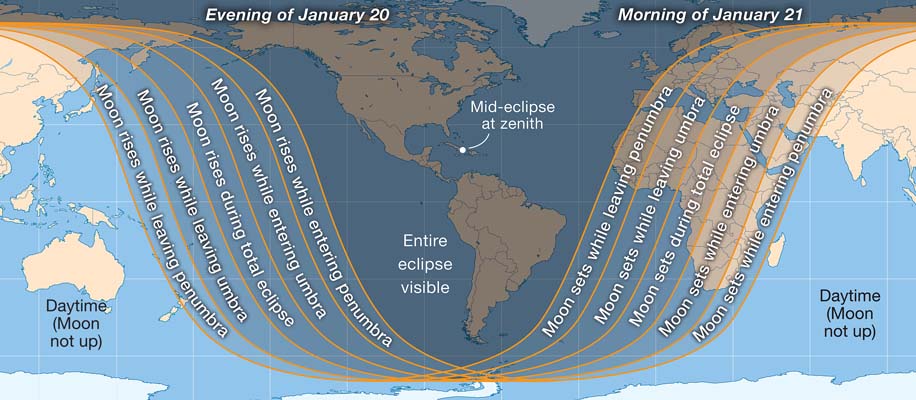
(Credit: Leah Tiscione / S&T; Source: Fred Espenak from Https://www.skyandtelescope.com)
Hopefully, skies will be clear for night sky seekers, as this year’s total lunar eclipse will officially be the last one visible across Canada until May 2021. Unlike the dangers of viewing a solar eclipse, you will be able to safely view the lunar eclipse with the naked eye.
Here are the eclipse viewing times in Canada according to earthsky.com:
Atlantic Time Partial umbral eclipse begins: 11:34 p.m. (January 20, 2019) Total lunar eclipse begins: 12:41 a.m. (January 21, 2019) Greatest eclipse: 1:12 a.m. (January 21, 2019) Total lunar eclipse ends: 1:43 a.m. (January 21, 2019) Partial umbral eclipse ends: 2:51 a.m. (January 21, 2019)
Eastern Time Partial umbral eclipse begins: 10:34 p.m. (January 20, 2019) Total lunar eclipse begins: 11:41 p.m. (January 20, 2019) Greatest eclipse: 12:12 a.m. (January 21, 2019) Total lunar eclipse ends: 12:43 a.m. (January 21, 2019) Partial umbral eclipse ends: 1:51 a.m. (January 21, 2019)
Central Time Partial umbral eclipse begins: 9:34 p.m. (January 20, 2019) Total lunar eclipse begins: 10:41 p.m. (January 20, 2019) Greatest eclipse: 11:12 p.m. (January 20, 2019) Total lunar eclipse ends: 11:43 p.m. (January 20, 2019) Partial umbral eclipse ends: 12:51 a.m. (January 21, 2019)
Mountain Time Partial umbral eclipse begins: 8:34 p.m. (January 20, 2019) Total lunar eclipse begins: 9:41 p.m. (January 20, 2019) Greatest eclipse: 10:12 p.m. (January 20, 2019) Total lunar eclipse ends: 10:43 p.m. (January 20, 2019) Partial umbral eclipse ends: 11:51 p.m. (January 20, 2019)
Pacific Time Partial umbral eclipse begins: 7:34 p.m. (January 20, 2019) Total lunar eclipse begins: 8:41 p.m. (January 20, 2019) Greatest eclipse: 9:12 p.m. (January 20, 2019) Total lunar eclipse ends: 9:43 p.m. (January 20, 2019) Partial umbral eclipse ends: 10:51 p.m. (January 20, 2019)
Author: Suzanne Pothe
References:
https://www.cbc.ca/news/technology/total-lunar-eclipse-1.4932126
https://www.theverge.com/2019/1/18/18186751/total-lunar-eclipse-super-blood-wolf-moon-january-20
https://www.space.com/42830-supermoon-blood-moon-total-lunar-eclipse-2019.html
https://earthsky.org/?p=295245
https://www.timeanddate.com/astronomy/moon/wolf.html
https://www.skyandtelescope.com/observing/your-guide-to-januarys-supermoon-total-lunar-eclipse/