Ice Storm Threat for Hamilton and Kitchener as Toronto and Barrie Face Snow and Icy Blast on Wednesday

NOTE: YOU CAN CLICK ON THE MAP TO OPEN A ZOOMABLE IMAGE

Get 20% off on stays until April when you book online with code: 20years


A significant and potentially high-impact winter storm is set to take aim at Southern Ontario throughout the day on Wednesday, bringing a messy and complicated mix of freezing rain, ice pellets and heavy snow.

This is shaping up to be a true multi-hazard event, and depending on your exact location, the impacts could look very different. Some communities will be dealing with hours of relentless freezing rain and dangerous ice buildup, while others will see bursts of heavy snow mixed with ice pellets.

While the specific precipitation type will vary substantially from region to region, the one thing that is nearly universal is the timing. This storm is expected to peak during the height of both the morning and afternoon commutes. That alone will be enough to create widespread travel headaches across highways, city streets and rural roads alike.

The main story with this system will likely be the corridor of significant freezing rain focused south and west of the Greater Toronto Area. This includes Hamilton through Kitchener and Guelph, along with Perth, Wellington, Dufferin, Grey and Bruce counties. These areas are in the prime zone for prolonged icing.

Six to twelve hours of freezing rain beginning in the early morning and continuing into the late afternoon will allow ice to quickly accumulate on untreated roads, sidewalks, driveways, trees and power lines. In some communities, total ice accretion could approach 10 to 15 mm. That is more than enough to create dangerous travel conditions and begin causing infrastructure issues.

To make matters worse, wind gusts are expected to range from 40 to 60 km/h, with some areas potentially seeing localized gusts of 70 to 80 km/h through the morning and afternoon. When you combine strong winds with heavy ice accumulation, the risk of power outages increases significantly. Ice weighing down tree branches and power lines does not need much additional force to snap, and scattered to potentially widespread outages are possible in the hardest hit areas.

Unlike some freezing rain events where temperatures eventually rise above zero and help melt some of the ice, this system is not expected to feature a meaningful warmup. Cold air at the surface is likely to remain locked in place until at least Thursday, and possibly even into Friday. That means once surfaces are coated in ice, they may stay that way for an extended period of time. This could prolong power outages and keep travel conditions poor well beyond Wednesday.

Freezing drizzle may also linger through the later part of Wednesday and into early Thursday across parts of Southwestern Ontario and the Golden Horseshoe. Even light drizzle can add a fresh glaze on top of existing ice, further worsening conditions and increasing the risk of slips, falls and vehicle collisions.

Further north and east, from around Lake Simcoe through Toronto, Peterborough and into Kingston, the focus shifts more toward a messy mix of ice pellets (sleet) and snow. While snowfall totals are not expected to be extreme, generally in the 5 to 15 cm range, the presence of ice pellets and occasional freezing rain will still make for slick and hazardous conditions.

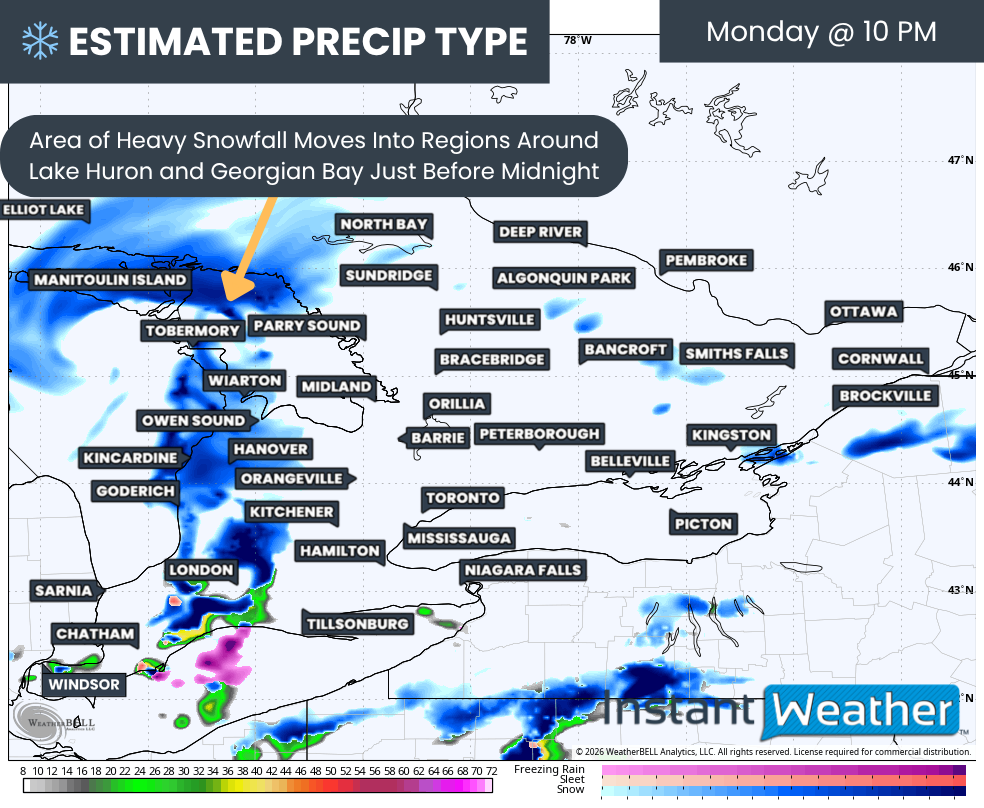
PRECIP TYPE - MAP FROM WEATHERBELL

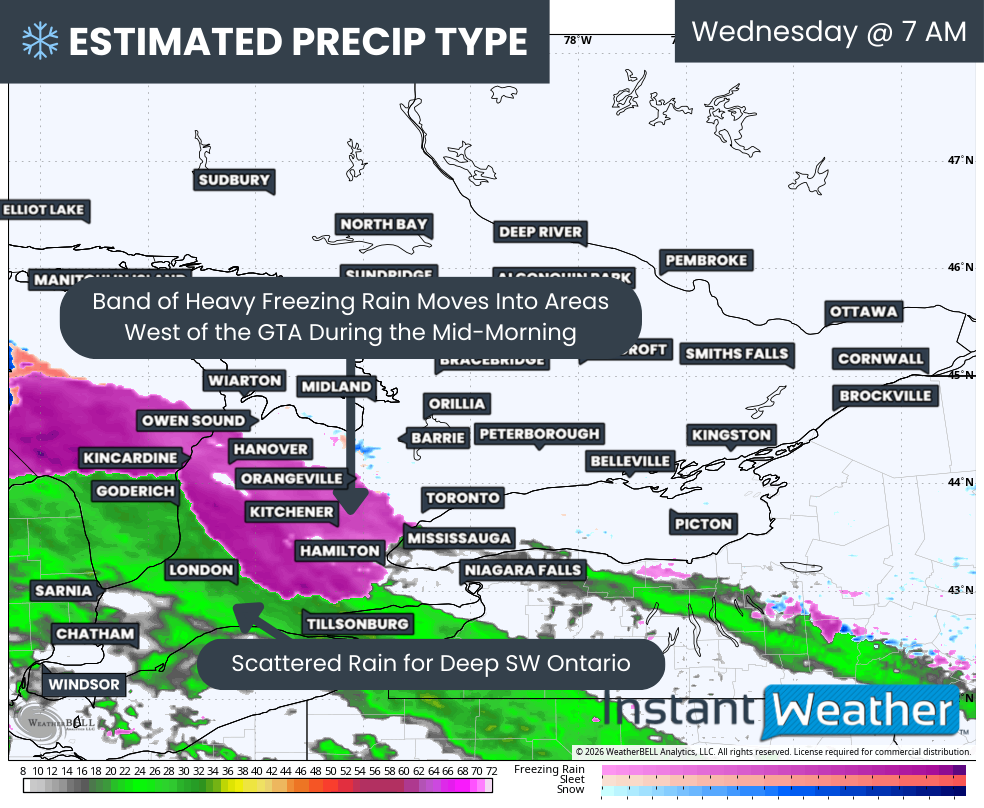
Based on the latest model guidance, the first band of precipitation will arrive in Deep Southwestern Ontario during the early morning hours. Areas like Windsor, Sarnia and Chatham will be well above freezing, so precipitation here will fall mainly as rain.

As that precipitation spreads northeast through the morning, it will encounter below-freezing temperatures at the surface. That is where the transition to freezing rain will occur, with rain freezing on contact with cold surfaces. This swath of freezing rain is expected to expand as additional bands of precipitation move in through the mid-morning hours.

Conditions are likely to deteriorate quickly around Hamilton, Kitchener, Hanover and Owen Sound during the mid to late morning as steady freezing rain sets in. Roads may become icy in a short period of time, especially on untreated surfaces and elevated roadways such as bridges and overpasses.

By late morning, the freezing rain may edge into portions of Peel and York Region, along with Toronto. However, there remains some uncertainty with the temperature profile in these areas. It may begin as freezing rain but could quickly mix with or change to ice pellets and snow as colder air near Lake Simcoe resists the push of warmer air aloft. Even a few hours of freezing rain in the GTA during rush hour would be enough to cause significant delays and collisions.

PRECIP TYPE - MAP FROM WEATHERBELL

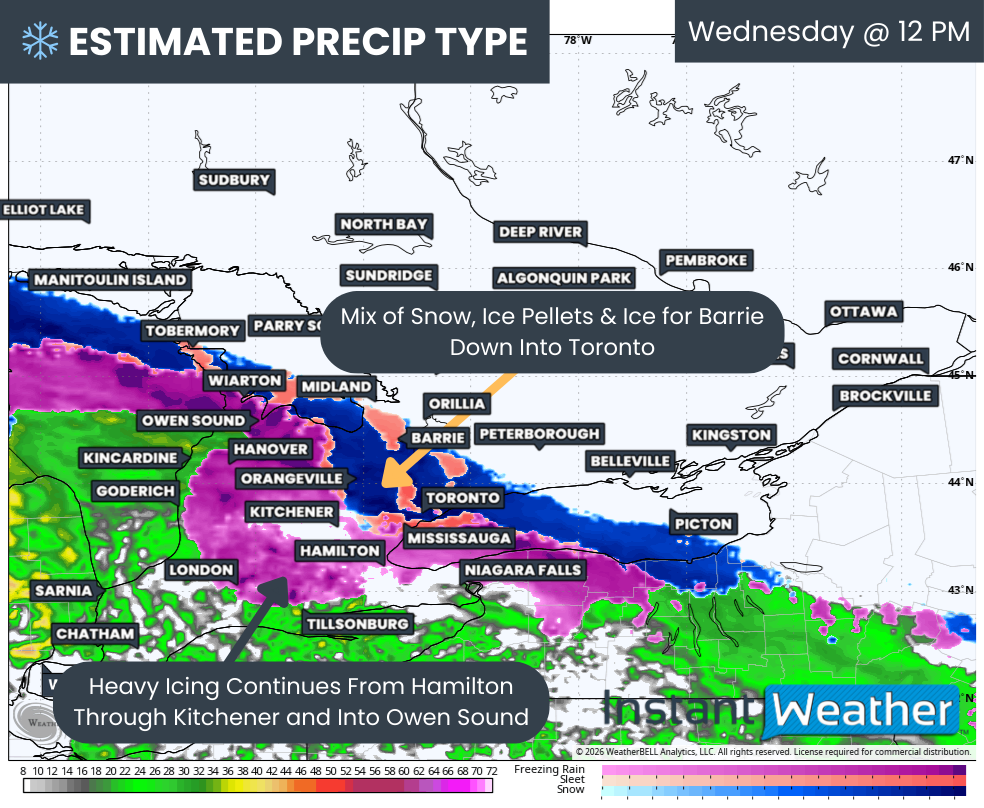
By around noon, snow and ice pellets are expected to reach Barrie, with that messy mix extending into Toronto. Meanwhile, freezing rain will likely remain steady and relentless from Hamilton through Kitchener and Hanover, continuing to build ice on trees and power lines.

One key factor we will be watching closely is the potential for temperatures to actually drop slightly through the morning in some areas. If that happens, communities around Niagara and into London could briefly dip below freezing and transition from rain to freezing rain, increasing the icing risk in those areas.

PRECIP TYPE - MAP FROM WEATHERBELL

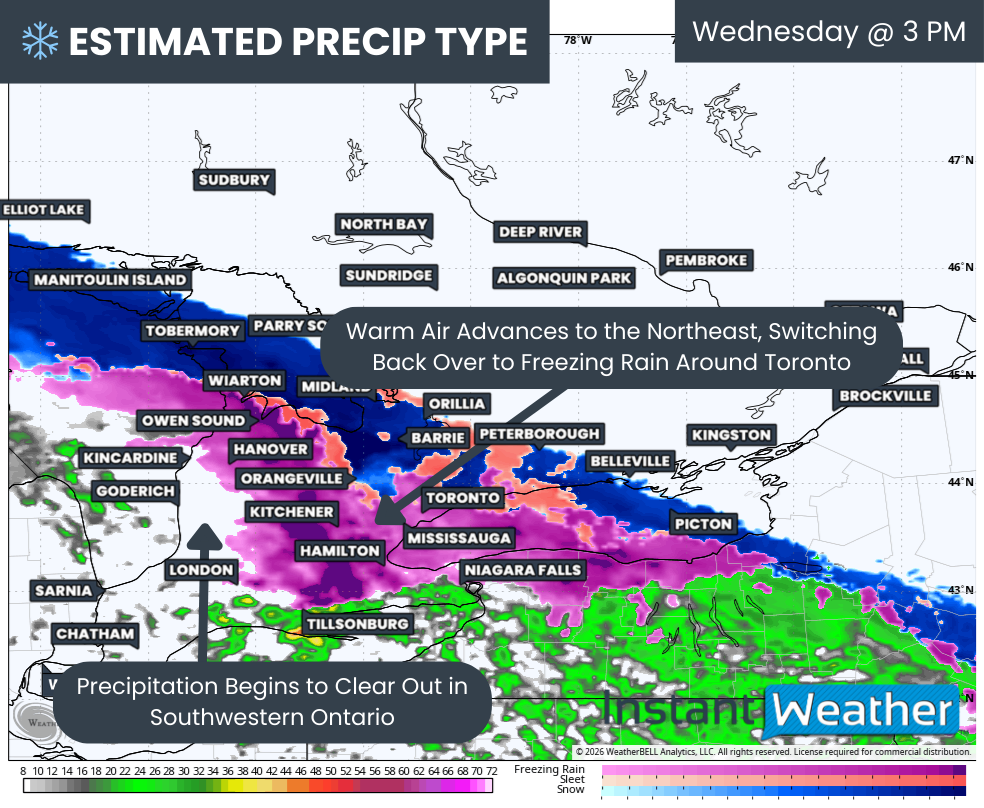
Through the early afternoon, the corridor of freezing rain is expected to remain largely locked in place. By this time, ice accretion on many surfaces could be reaching significant or even crippling levels in the hardest hit communities.

Additional bursts of moderate to heavy precipitation during the afternoon could further add weight to already stressed trees and power lines. If damage is going to occur, it is most likely to ramp up during this period.

There is some good news as precipitation should begin to clear out of Southwestern Ontario by mid-afternoon. Areas that experience the worst of the freezing rain should see it taper off by late afternoon, although the impacts will linger.

By mid-afternoon, the leading edge of the heavier snow is expected to reach Orillia and Peterborough. There remains some uncertainty on how far north and east the steadier snow will extend before weakening. Some model guidance pushes it as far as Muskoka and Kingston, while others keep the bulk of it closer to Lake Simcoe.

Heavy snow and ice pellets with localized blowing snow will continue through the afternoon in these areas. Closer to Toronto, warmer air aloft may briefly push back in, potentially causing a switch back to freezing rain late in the event. Unfortunately, this could line up closely with the afternoon commute, leading to significant travel disruptions.

If possible, it would be wise to delay travel during both the morning and afternoon peak periods. Icy roads, reduced visibility and the potential for downed branches or power lines could make conditions dangerous in a hurry.

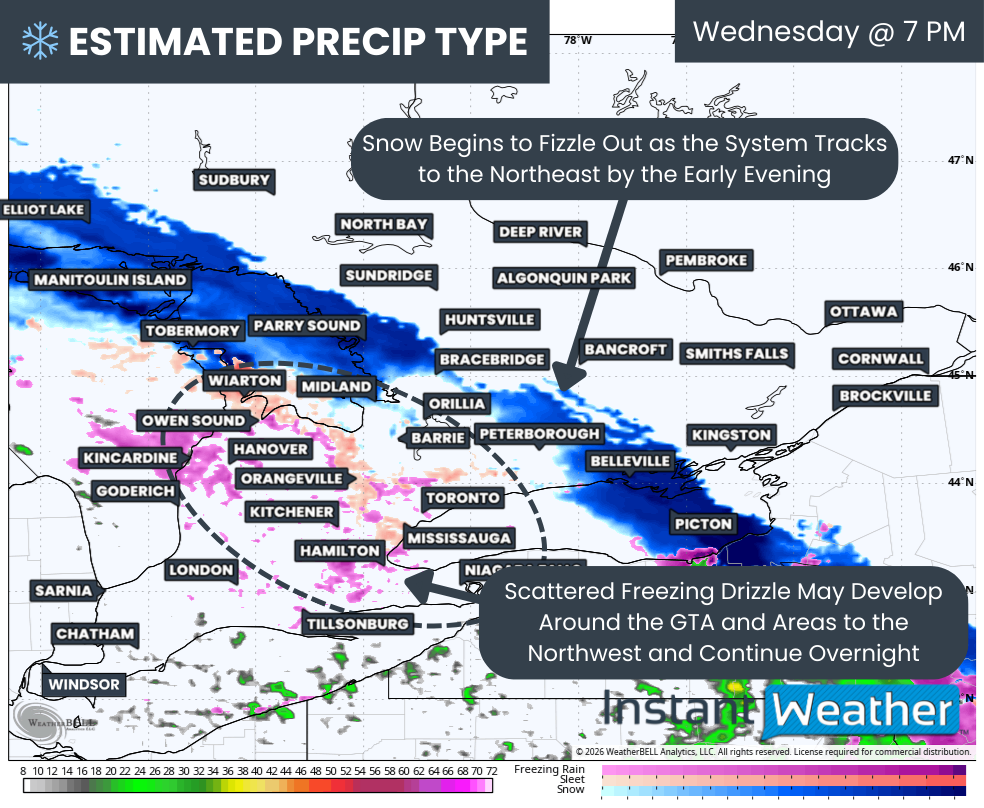
PRECIP TYPE - MAP FROM WEATHERBELL

As the system weakens and begins to break apart over Central Ontario during the early evening, we may still see pockets of patchy freezing drizzle develop around the Golden Horseshoe and into Southwestern Ontario.

This includes many of the same areas hardest hit by earlier freezing rain. Even light drizzle could add additional ice and prolong impacts into Thursday morning, increasing the risk of school bus cancellations for a second consecutive day.

NOTE: YOU CAN CLICK ON THE MAP TO OPEN A ZOOMABLE IMAGE

Get 20% off on stays until April when you book online with code: 20years


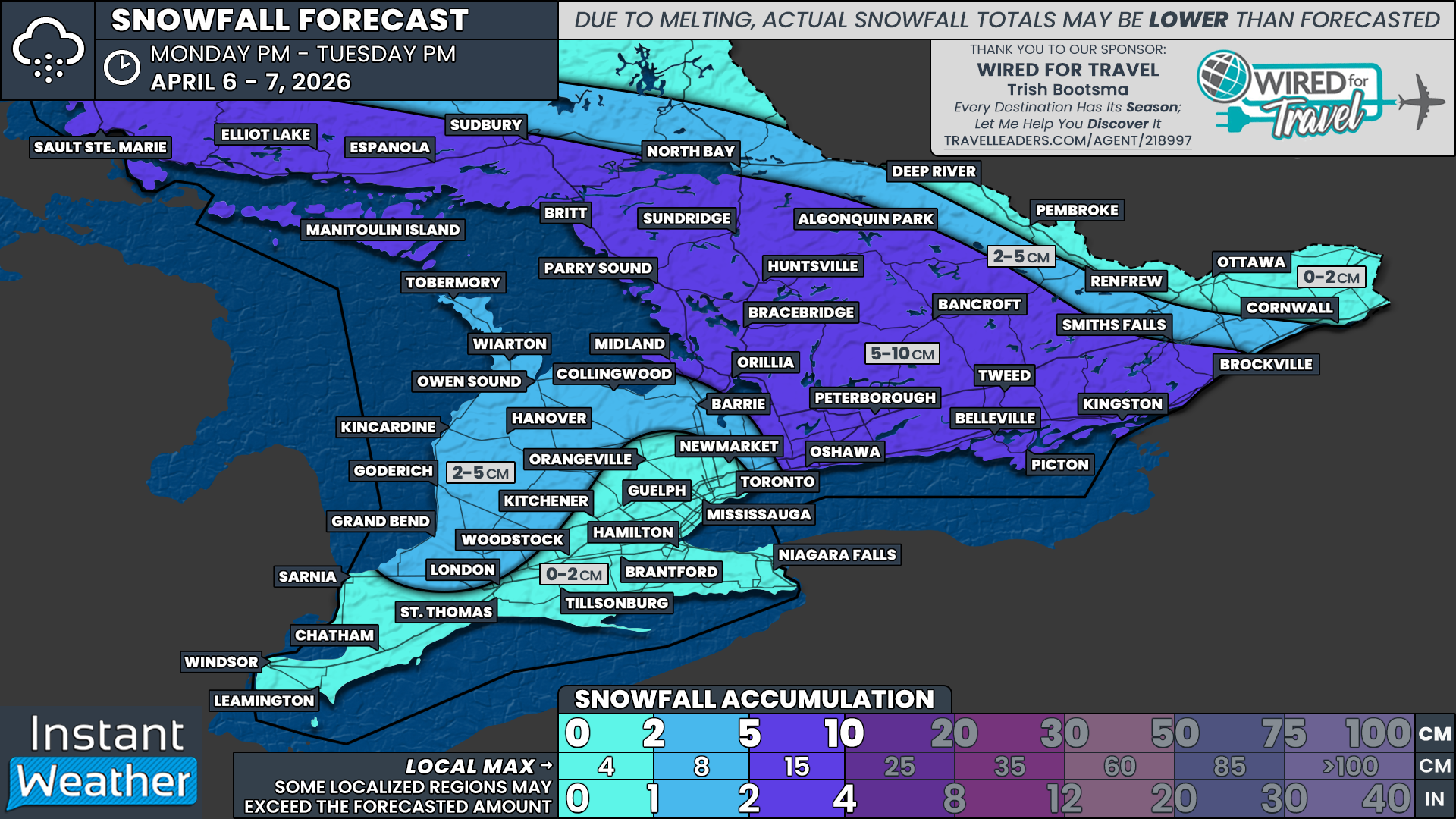
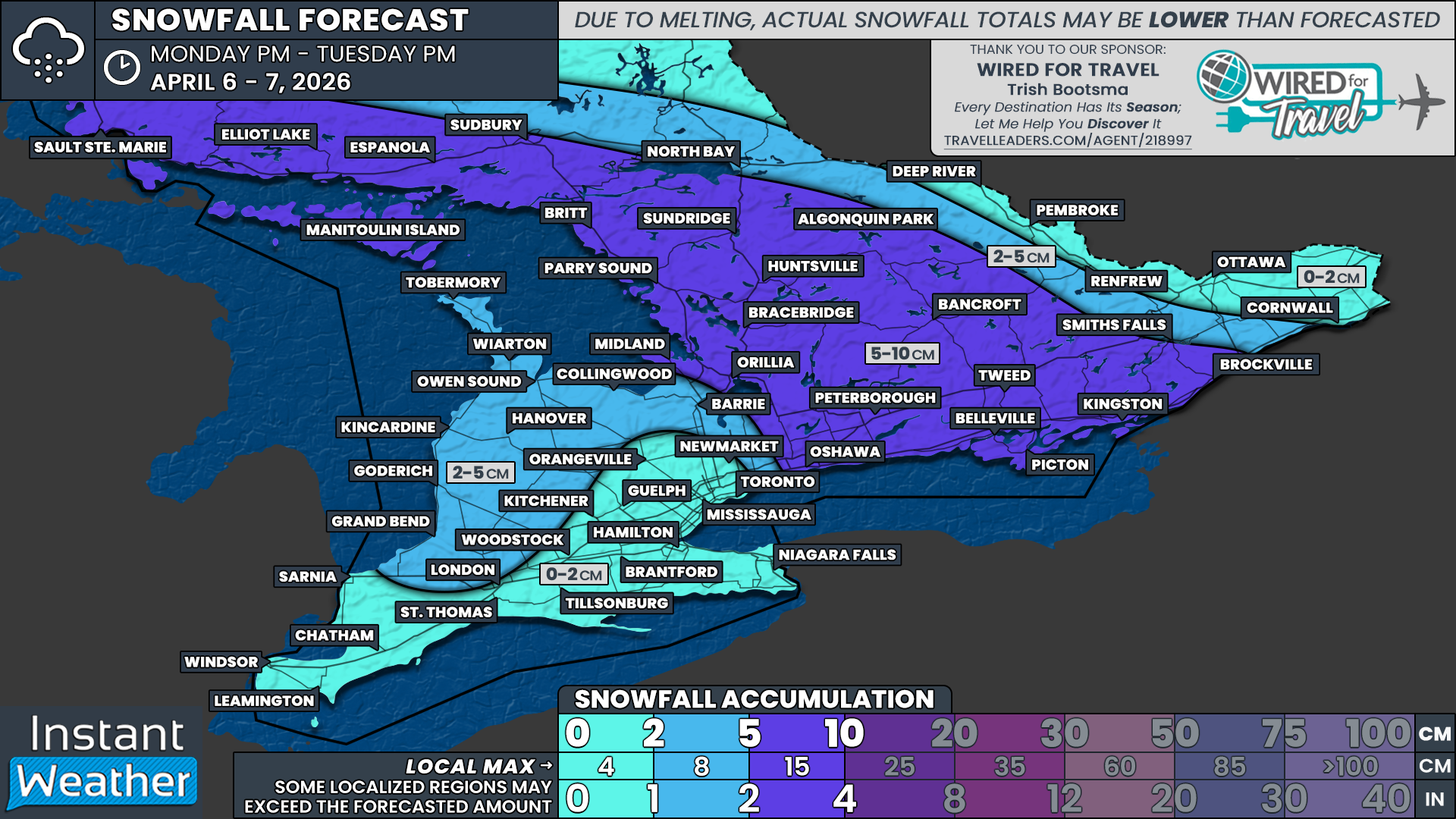
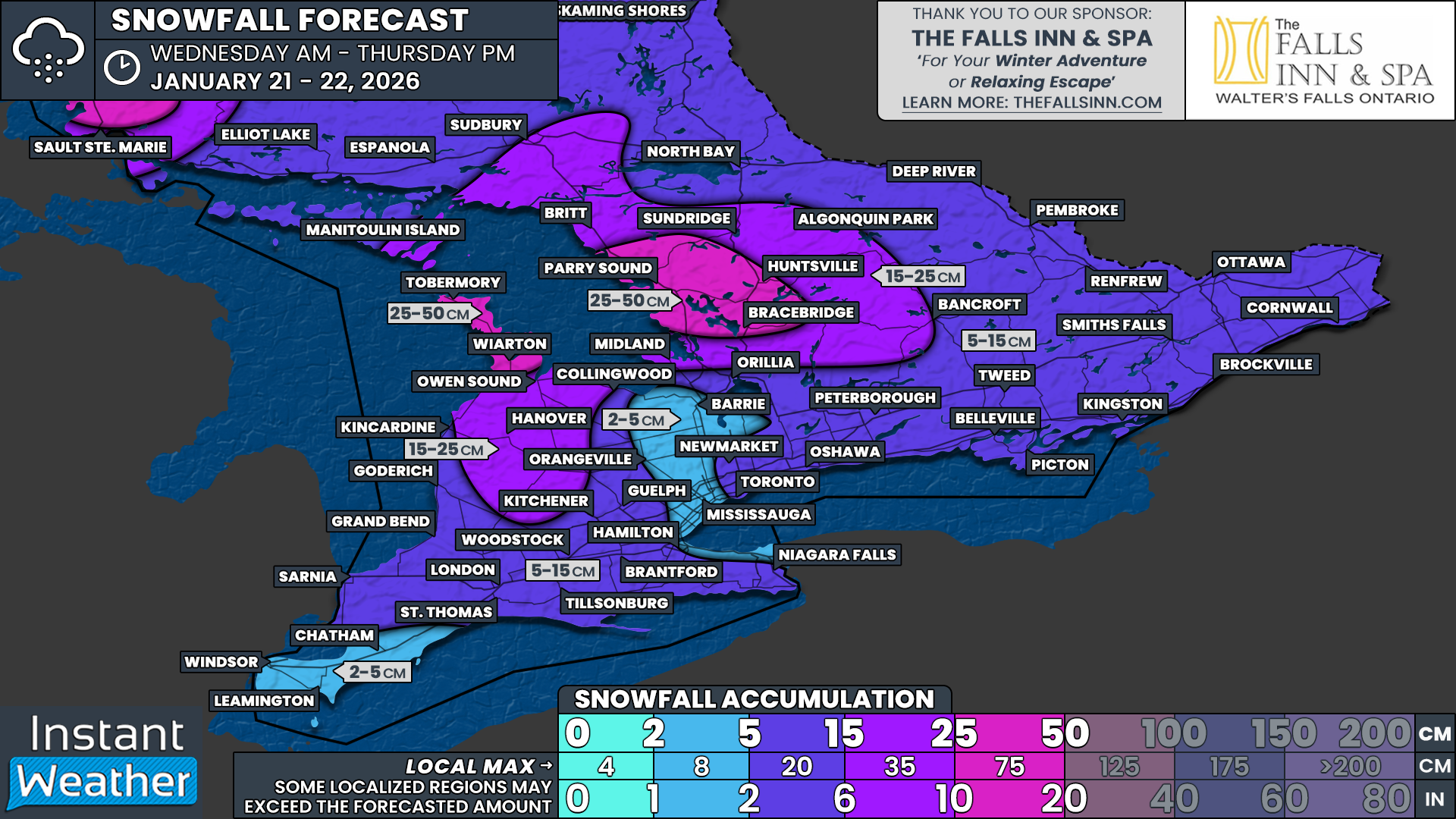
When it comes to snowfall totals, there is some uncertainty due to the mixing with ice pellets. The heaviest swath of snow is most likely to extend from the northern tip of the Bruce Peninsula through Simcoe County and Southern Muskoka into the eastern GTA, Peterborough and Belleville area.

We are forecasting a general 5 to 15 cm for Barrie, Orillia, Gravenhurst, Lindsay, Port Perry, Peterborough, Cobourg, Belleville and Picton, with localized totals up to 20 cm possible if the system overperforms.

A similar 5 to 15 cm is forecast for Collingwood, Angus, Vaughan, Bradford, Newmarket, Toronto, Pickering and Oshawa. However, more mixing with ice pellets is expected in this zone, so totals may trend closer to the lower end of that range in many communities.

For Parry Sound, Huntsville, Haliburton, Tweed and Kingston, snowfall totals are expected to range from 2 to 5 cm. There is also a chance that some of these areas see very little accumulation if the storm weakens faster than currently projected.

Less than 2 cm of snow is expected across much of Eastern Ontario, including the Ottawa Valley.

To the west, snowfall totals will decrease as ice pellets and freezing rain become the more dominant precipitation types. We are forecasting 2 to 5 cm for Wiarton, Shelburne, Orangeville and Oakville, with less than 2 cm further southwest.

NOTE: YOU CAN CLICK ON THE MAP TO OPEN A ZOOMABLE IMAGE

Turning back to the freezing rain threat, the worst impacts are expected west of the Golden Horseshoe along the Hamilton through Kitchener to Owen Sound corridor.

Highest ice accretion is likely in Hamilton, Burlington, Cambridge, Kitchener, Listowel, Minto, Wingham, Mildmay, Port Elgin and Hanover. Ice storm conditions are possible here with 6 to 12 mm of icing, and localized pockets of 15 mm cannot be ruled out.

A zone including Owen Sound, Chatsworth, Arthur, Fergus and Guelph is also at risk for 6 to 12 mm of freezing rain accretion. There is some uncertainty here due to the potential mixing with ice pellets at times, especially late morning into early afternoon, which could limit totals somewhat.

Lower amounts of freezing rain are expected both to the southwest and northeast for different reasons.

To the southwest, more rain will mix in, limiting the duration of icing. Niagara on the Lake, St. Catharines, Woodstock, Clinton and Kincardine could see 2 to 6 mm of freezing rain, mainly during the latter part of the event as temperatures gradually slip below freezing.

Southern Niagara through Simcoe, Tillsonburg, London, Lucan and Goderich can expect less than 2 mm of freezing rain, with precipitation falling mainly as rain.

To the northeast, mixing with ice pellets will limit freezing rain totals. That includes Wiarton, Meaford, Orangeville, Brampton, Oakville, Mississauga and Toronto, where around 2 to 6 mm of freezing rain accretion is expected.

Less than 2 mm of icing is forecast for York Region and into Simcoe County, where snow and ice pellets should be the main precipitation types.

This is a complex and high-impact storm with significant variation over relatively short distances. We will continue to fine-tune these details as new data comes in, but now is the time to prepare for difficult travel, possible power outages and extended icy conditions across parts of Southern Ontario.

Snowy One-Two Punch Targets Southern Ontario Starting Wednesday as Alberta Clipper and Squalls Dump Up to 25 to 50 cm of Snow

NOTE: YOU CAN CLICK ON THE MAP TO OPEN A ZOOMABLE IMAGE

The story of the week so far across Southern Ontario has been the relentless snow squall activity that has been hammering the region, bringing treacherous travel conditions as a surge of Arctic air continues to sit overhead. These squalls have been anything but minor, producing frequent whiteouts, rapidly deteriorating road conditions, and dangerous travel at times.

The worst of the impacts on Tuesday was when intense snow squalls forced the closure of multiple stretches of Hwy 11 between Bracebridge and Orillia. Whiteout conditions combined with rapidly accumulating snow led to several accidents, leaving many drivers stranded and highlighting just how dangerous these squalls can become when they lock into place.

While the snow squalls are far from finished, the threat zone is expected to shift over the next few days as winds gradually turn more westerly. This change in wind direction will push the most persistent squall activity away from areas that were hit earlier this week and refocus it further west and north.

As a result, locations such as the Bruce Peninsula, Muskoka, Parry Sound, and even areas further inland like Haliburton and Bancroft are expected to see the most significant impacts through the second half of the week.

Snow squall activity will briefly weaken during the day on Wednesday, but this will not be because the atmosphere is calming down. Instead, an Alberta Clipper is expected to move into Southern Ontario beginning Wednesday morning, temporarily disrupting the lake effect setup.

This clipper will spread a shield of steady light to moderate snow across Southwestern Ontario, extending through the Golden Horseshoe and into Eastern Ontario as the day goes on. While this system is not expected to produce extreme snowfall amounts on its own, it will still have notable impacts due to its timing and the already poor road conditions in many areas.

Compared to the storm some locations experienced last week, snowfall totals with this system will be more modest. However, the combination of falling snow, reduced visibility, and slick road surfaces could still make both the morning and evening commute hazardous in spots.

At this point, we are expecting a general 5 to 10 cm from the Alberta Clipper. As is typical with these systems, snowfall will not be uniform. Alberta Clippers are often moisture-starved, which can lead to dry pockets where snowfall totals underperform, while narrow bands of heavier snow can locally boost amounts closer to 15 cm.

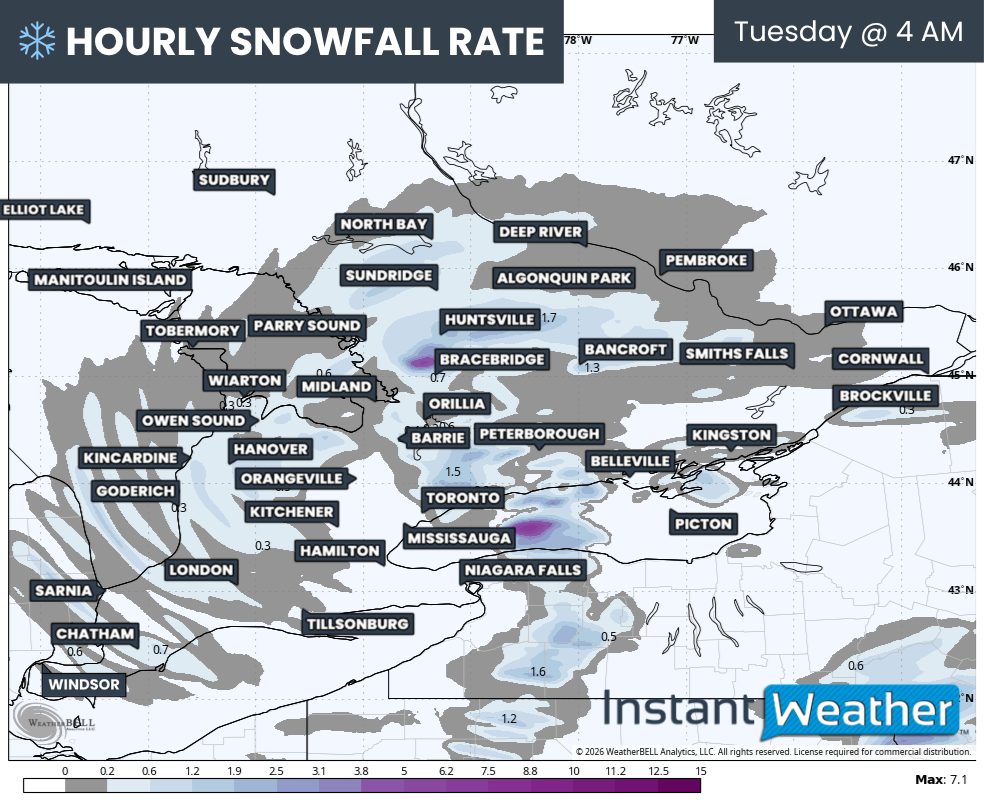
Hourly snowfall rates (cm) - MAP FROM WEATHERBELL

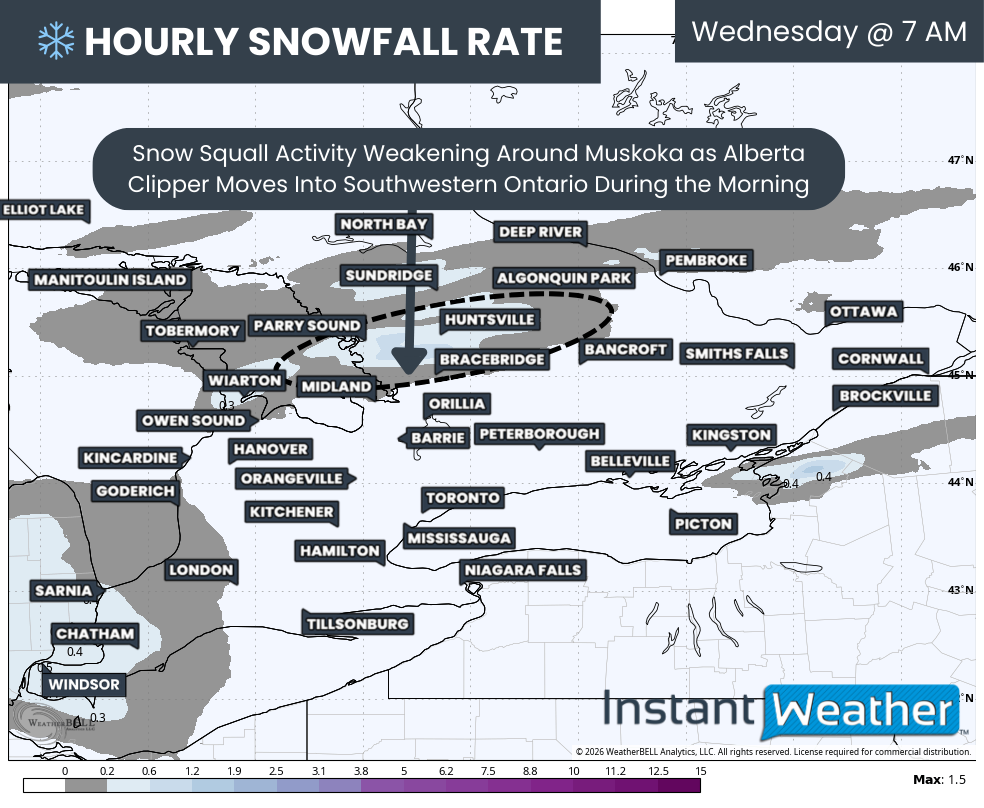
Snow squalls that are already developed east of Georgian Bay will continue to impact the Parry Sound and Muskoka region through the overnight hours and into Wednesday morning. Travel conditions in these areas will remain poor early in the day, especially where bands remain persistent.

As the clipper approaches, winds will begin to shift by mid-morning, weakening the squalls and temporarily shutting down the lake effect snow machine. This will offer a short-lived improvement in conditions for areas east of Georgian Bay before the next phase of the pattern kicks in.

The outer bands of snow associated with the Alberta Clipper will begin to move into Deep Southwestern Ontario around sunrise, affecting areas such as Windsor, Sarnia, and Chatham. From there, the snow will steadily expand northeastward through the late morning hours.

Hourly snowfall rates (cm) - MAP FROM WEATHERBELL

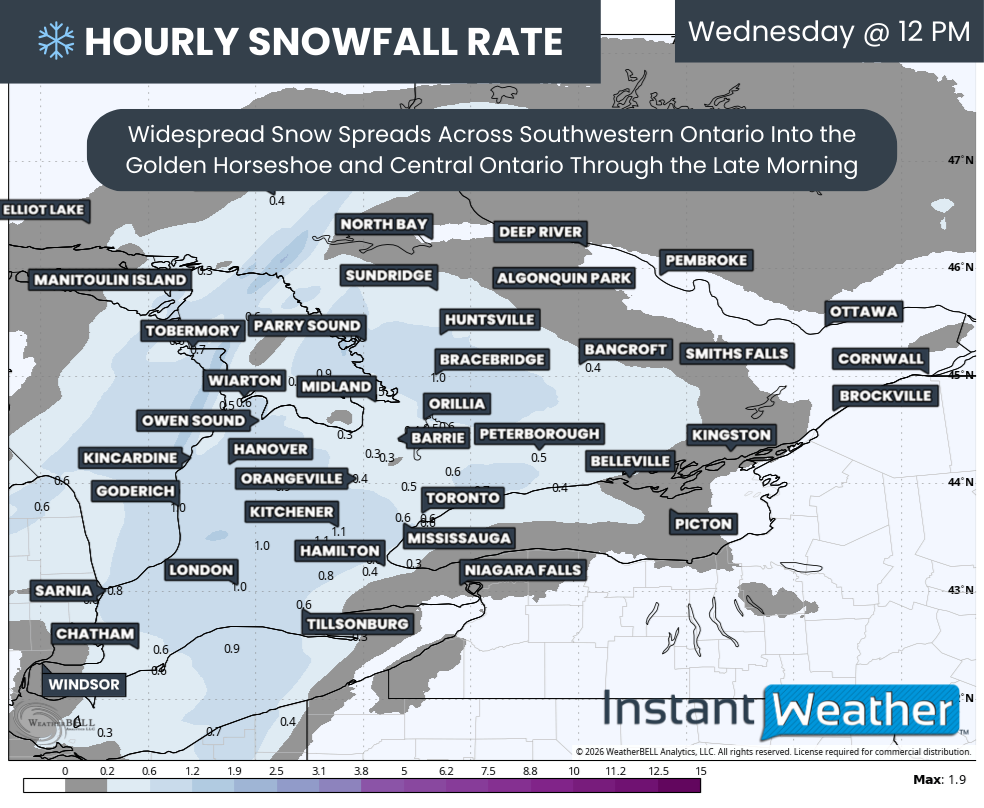
By midday, snow will be falling across much of Southwestern Ontario and into the Golden Horseshoe and Central Ontario. Snowfall rates are not expected to be overly intense, generally topping out around 1-2 cm per hour, but wind gusts of 40 to 60 km/h could still lead to areas of blowing snow and reduced visibility.

Model guidance is also hinting at the development of a dry slot north of the GTA, particularly around Lake Simcoe. This includes areas such as Collingwood, Barrie, and parts of York Region, where snowfall rates could be noticeably lower.

This is a common issue with Alberta Clippers. While the Great Lakes can often help enhance snowfall by adding moisture, regions around Lake Simcoe may miss out when winds are predominantly southerly. In this setup, they sit outside the direct influence of Lake Erie and Lake Ontario moisture feeds.

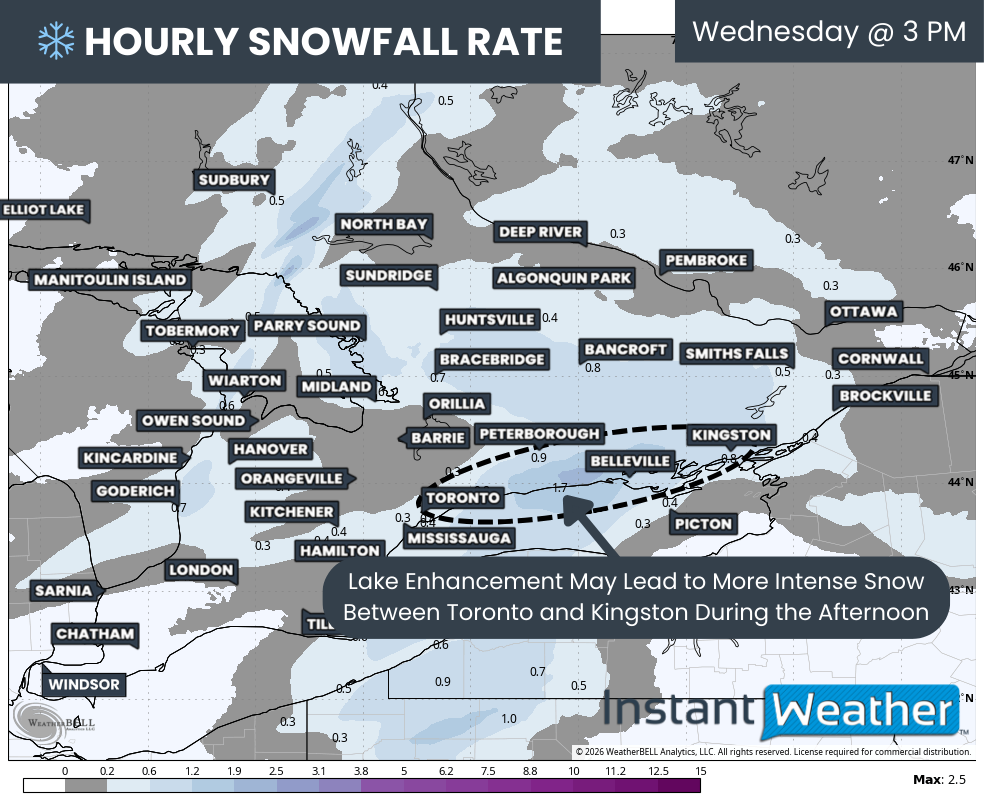
Hourly snowfall rates (cm) - MAP FROM WEATHERBELL

On the flip side, the Toronto to Kingston corridor is expected to benefit from Lake Ontario enhancement. This added moisture could push snowfall totals closer to 10 to 15 cm in this zone, slightly higher than surrounding areas.

This enhanced snowfall is also expected to coincide with the evening commute, particularly along Hwy 401 east of Toronto toward Kingston. Drivers should be prepared for rapidly changing conditions, with visibility dropping quickly at times as heavier bursts of snow move through.

Light snow will also spread into the Ottawa Valley by early afternoon. However, snowfall totals will likely taper off the further north you go as the influence of Lake Ontario weakens. Ottawa itself may only pick up a few centimetres by the time the snow winds down Wednesday evening.

Snow from the clipper is expected to gradually taper off from west to east by the late afternoon or early evening as the system exits Eastern Ontario. Unfortunately, this break will be brief for snowbelt regions.

Hourly snowfall rates (cm) - MAP FROM WEATHERBELL

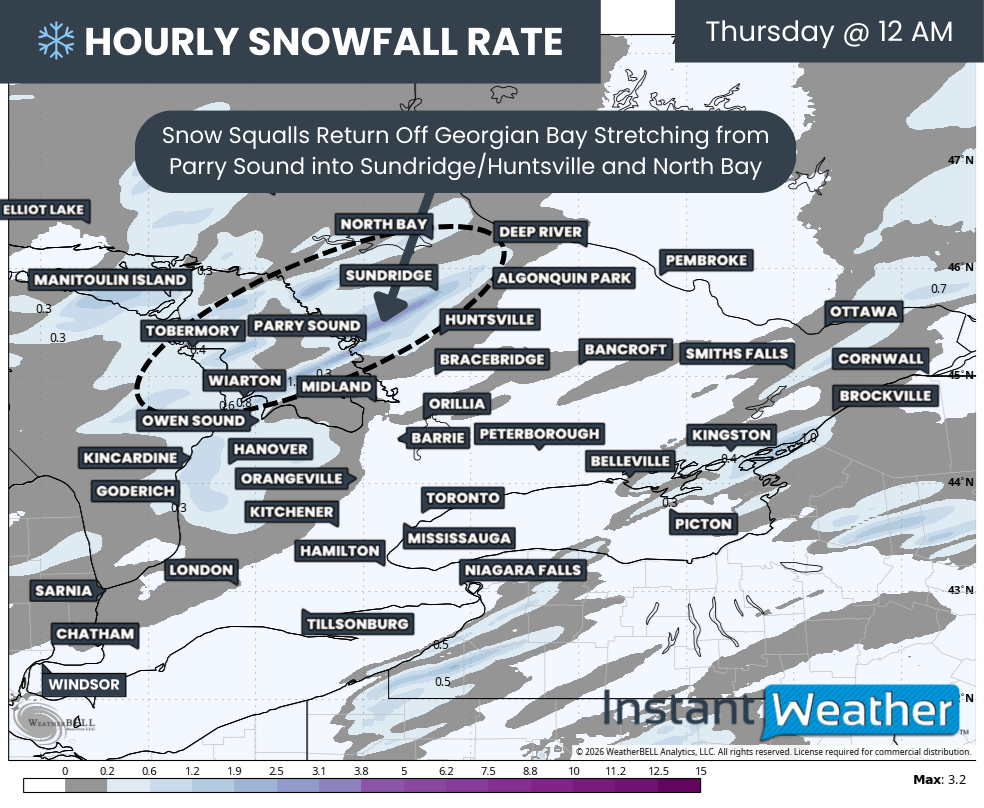
As the system departs, lake effect snow is expected to rapidly redevelop overnight Wednesday as winds settle into a southwesterly direction. This will allow the lake effect machine to roar back to life.

The brunt of the snow squall activity overnight will be focused on the Bruce Peninsula, Parry Sound, and North Muskoka. At times, these squalls could stretch further inland toward areas like Sundridge and even North Bay.

Travel conditions overnight into Thursday are expected to be very poor. Snowfall rates may become intense within the strongest bands, and it is quite possible that sections of Hwy 400 or Hwy 11 could see temporary closures if snow accumulates faster than crews can keep up. Travel in these areas is highly discouraged.

Hourly snowfall rates (cm) - MAP FROM WEATHERBELL

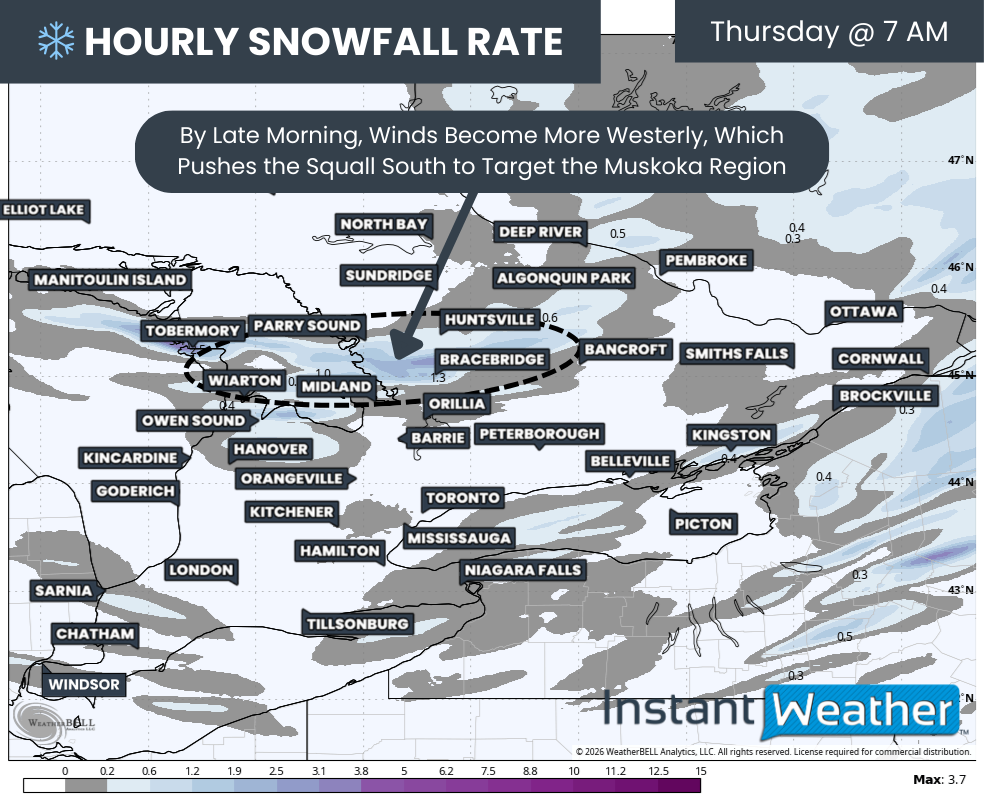
By sunrise Thursday, winds are expected to gradually turn more westerly. This shift will cause the main squall to sink southward into Muskoka, targeting locations such as Bracebridge, Port Carling, Baysville, Port Sydney, Rosseau, and MacTier.

Some model guidance suggests this squall could become nearly stationary through much of the day Thursday. If this scenario verifies, snowfall totals could quickly climb, with some areas potentially exceeding 50 cm by the end of Thursday.

Other models suggest a more oscillating band that shifts north and south throughout the day. While this would limit extreme totals in one single location, it would spread significant snowfall across a broader portion of Muskoka and Parry Sound.

Hourly snowfall rates (cm) - MAP FROM WEATHERBELL

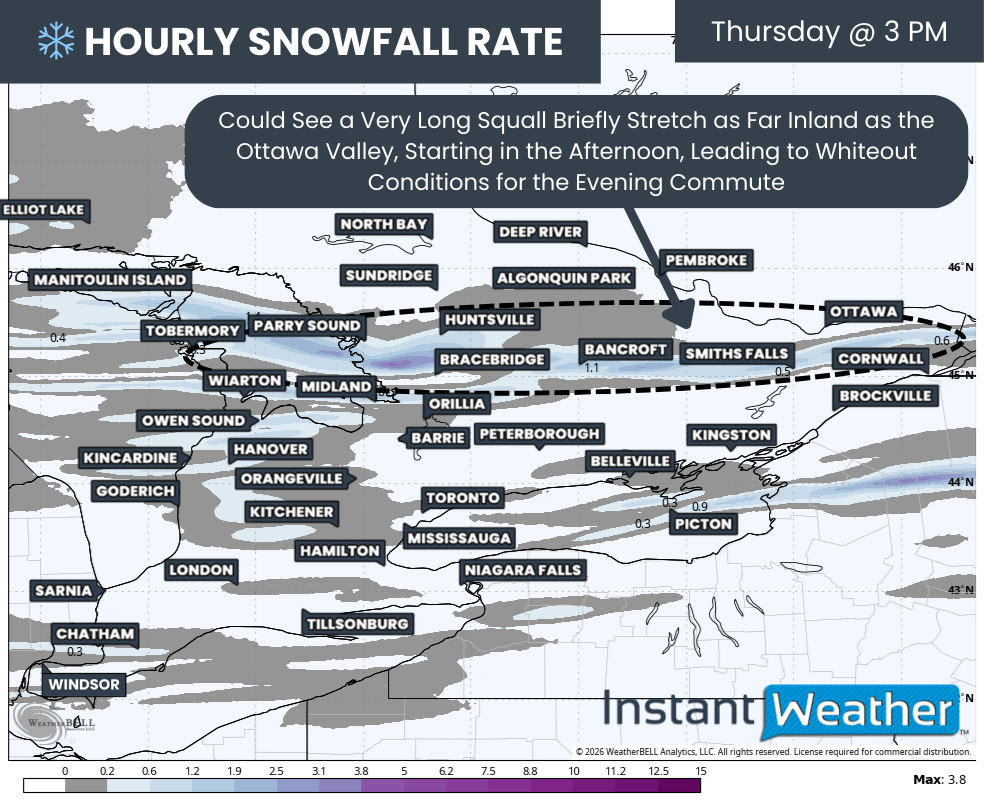
As we head into Thursday afternoon, the impacts of the Georgian Bay squall may extend beyond the typical snowbelt. Strengthening winds could allow the band to push further inland, potentially reaching parts of Eastern Ontario and even the Ottawa Valley.

Locations such as Bancroft, Smiths Falls, Renfrew, and Ottawa could see several hours of heavy snow, leading to sudden whiteout conditions right during the evening commute. These whiteouts can occur with very little warning, making it critical for drivers to remain alert and be ready to adjust their driving immediately.

It could also bring a quick 5-10cm to the Ottawa Valley, which, combined with the Alberta Clipper, puts them in the 5-15cm range despite missing the worst of the clipper.

Additional lake effect snow is also possible east of Lake Huron during the day on Thursday, affecting Grey Bruce, along with parts of Huron and Perth Counties. While models are not showing a well-organized band at this time, wind gusts near 60 km/h could still lead to blowing snow and reduced visibility.

Snow squall activity is likely to persist into Thursday night and possibly into Friday morning. This forecast cuts off at the end of Thursday, with a separate update planned to cover Friday and beyond.

NOTE: YOU CAN CLICK ON THE MAP TO OPEN A ZOOMABLE IMAGE

In terms of snowfall totals, most areas away from the lake effect are expected to see around 5 to 10 cm from the Alberta Clipper alone. Some pockets will fall short of that, while others may exceed it slightly, depending on lake enhancement.

That is why regions not expecting lake effect snow are generally placed in the 5 to 15 cm range. This includes much of Eastern Ontario, parts of the eastern GTA, and most of Southwestern Ontario.

Exceptions include areas northwest of the GTA, such as Barrie, Keswick, Bradford, Orangeville, and Angus, as well as Deep Southwestern Ontario, including Windsor, Leamington, and Chatham. These locations are expected to see less moisture and may remain below 5 cm. The same applies to the western GTA and Hamilton.

Once lake effect snow is factored in, totals increase quickly east of Georgian Bay. This includes snowfall from early Wednesday before the clipper arrives and the more intense squalls that follow on Thursday.

Snowfall totals of 25 to 50 cm are expected for the Bruce Peninsula, including Wiarton, Lions Head, and Tobermory, as well as areas east of Georgian Bay such as Bracebridge, Huntsville, and Parry Sound. Muskoka in particular has the potential to exceed 50 cm if the squall becomes stationary on Thursday.

Further south and east, areas such as Midland, Gravenhurst, Minden, Haliburton, and Bancroft can expect around 5 to 10 cm from the system, with an additional 10 to 15 cm from lake effect snow. This puts totals in the 15 to 25 cm range, with locally higher amounts possible.

Southern Grey-Bruce, extending into portions of Huron and Perth Counties, including Owen Sound, Meaford, Hanover, and Listowel, is also expected to end up in the 15 to 25 cm range by the time all is said and done.