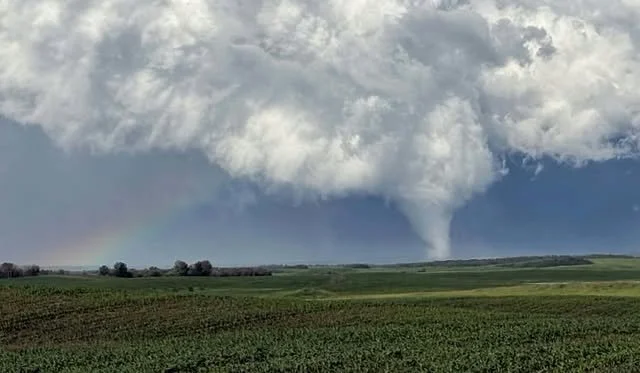
Potential Derecho Combined with Threat of Baseball Hail and Tornadoes Marks the Return of Extreme Risk in Saskatchewan and Manitoba Tuesday

NOTE: YOU CAN CLICK ON THE MAP TO OPEN A ZOOMABLE IMAGE

It was a very busy weekend for severe weather in Southeastern Saskatchewan and Southwestern Manitoba. From the two day span, there have been countless reports of massive hail, wind damage, flooding from across the region, as well as a few tornado reports that are awaiting confirmation. Unfortunately, the calmer conditions we saw on Monday will come to an end when strong severe thunderstorms once again impact Southern Saskatchewan and Manitoba today.

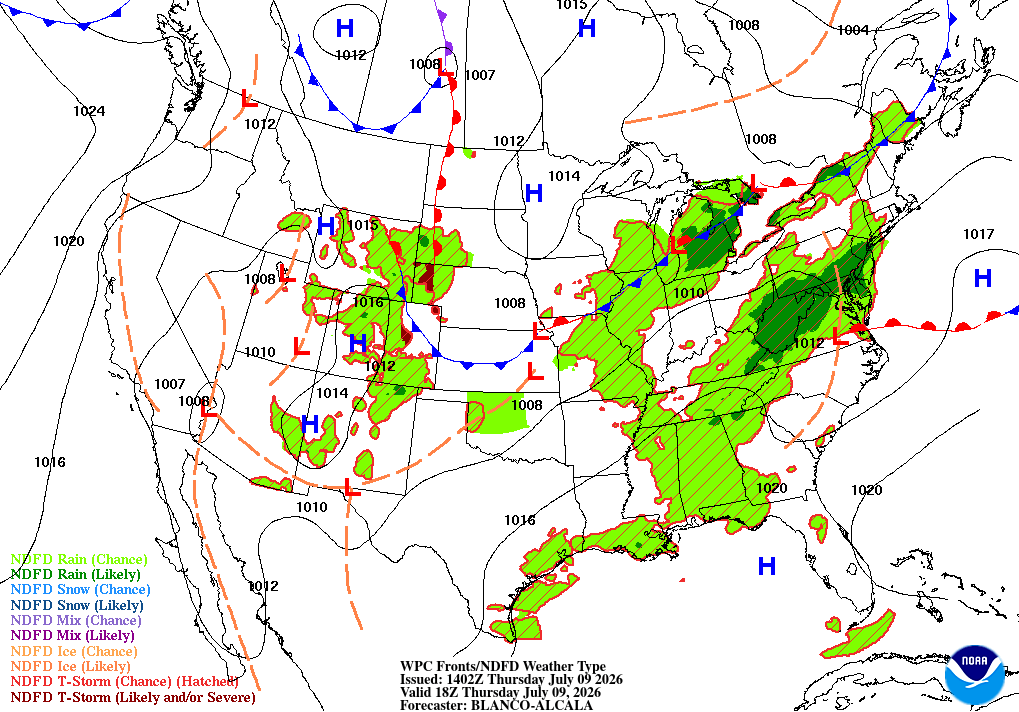
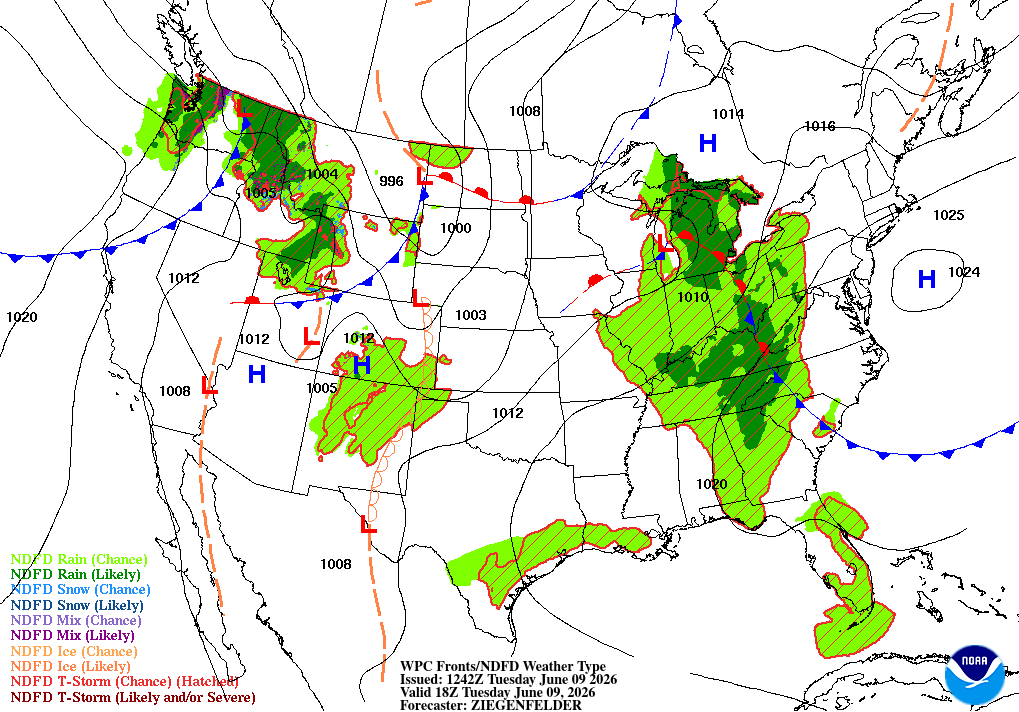
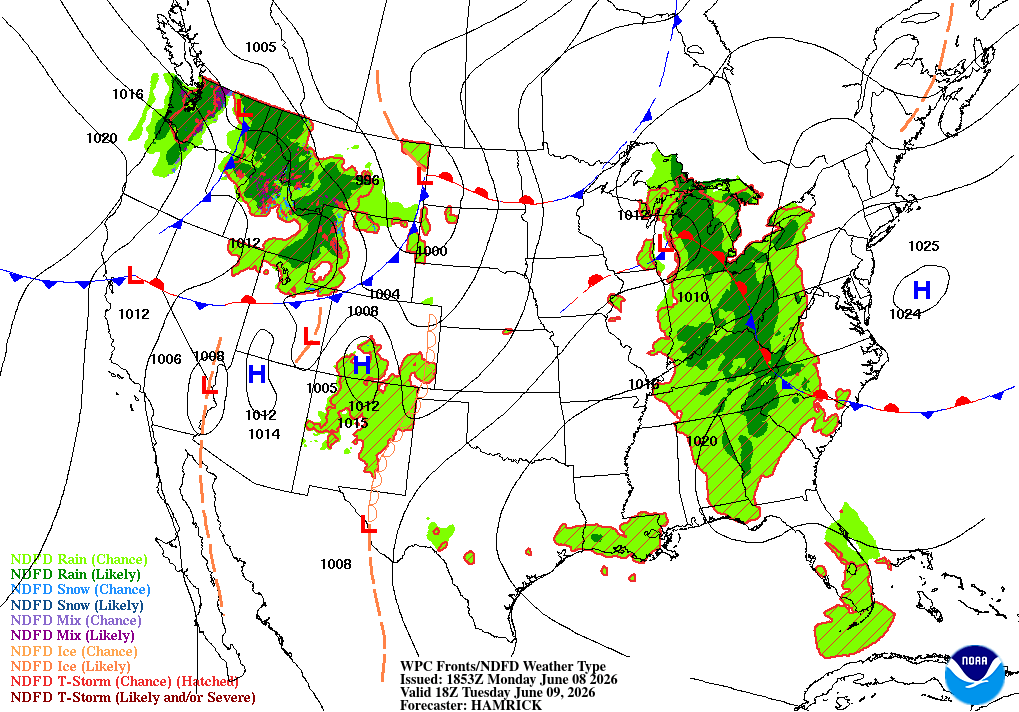
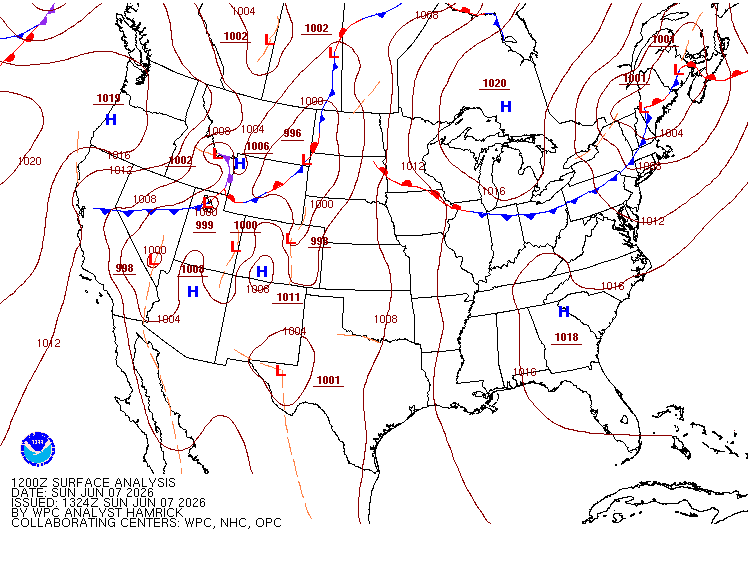
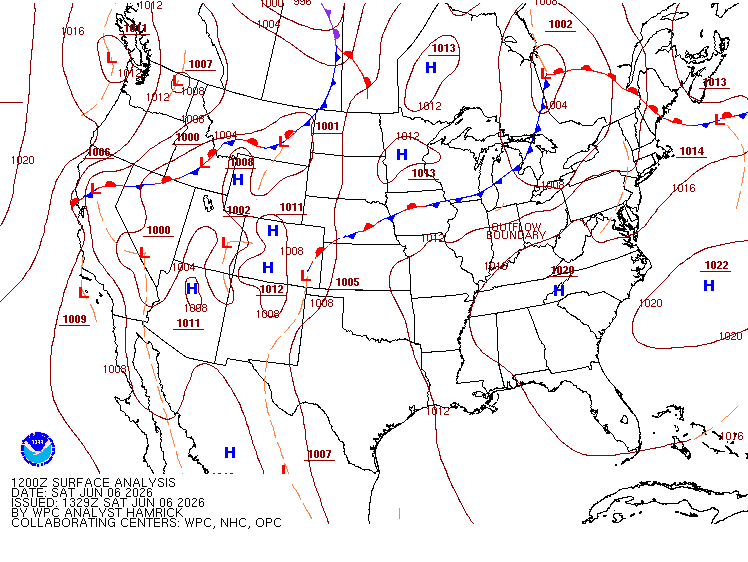
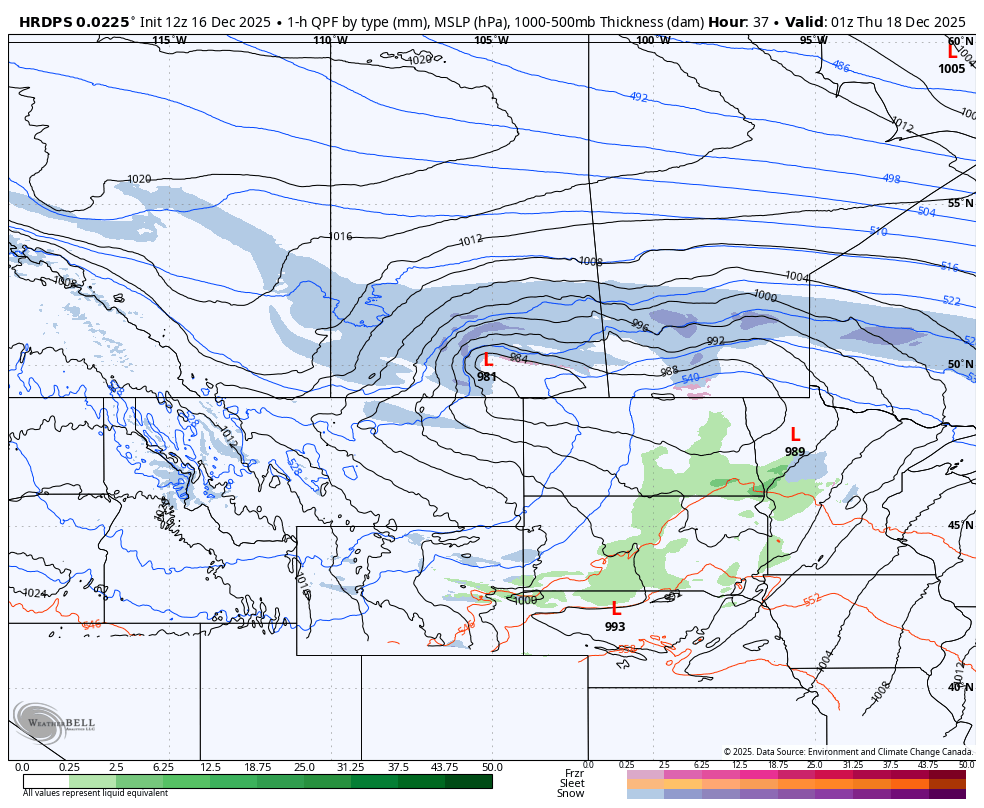
Through the day, a low pressure system will strengthen as it moves from Southeastern Montana into Western North Dakota and then into Southeastern Saskatchewan and Southwestern Manitoba by later this afternoon. A warm front will extend eastward from the low pressure center, which will help draw lots of heat and moisture northward into Southern Saskatchewan and Manitoba.

Future Surface weather map with the positions of highs, lows, and fronts displayed for 12pm cst/1pm CDT on Tuesday, courtesy of the national weather service.

Temperatures are slated to climb into upper 20s and low 30s across the region this afternoon and with dewpoints expected to be in the upper teens, there will be plenty of fuel for thunderstorm development. Weather models are showing upwards of 4000J/kg of CAPE in some areas, which will support the development of supercell thunderstorms. Veering winds will also create a significant amount of shear to maintain large supercell thunderstorms and support tornado potential.

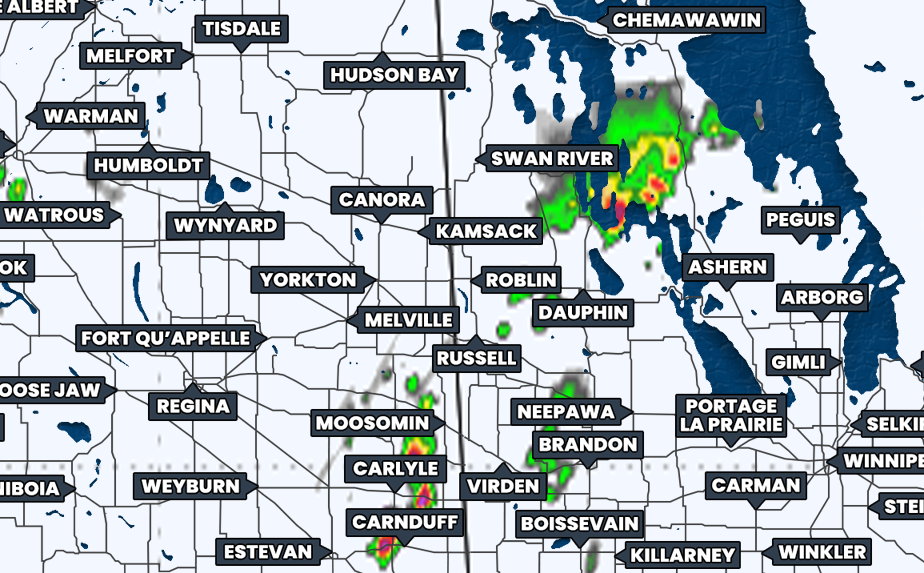
Through the morning, there is a chance that some thunderstorms could develop in Southeastern Saskatchewan which would track northeastward into Southwestern Manitoba during the early afternoon. These storms could possibly become severe and produce some small hail and strong winds, but they won’t be as strong as the storms expected later in the day.

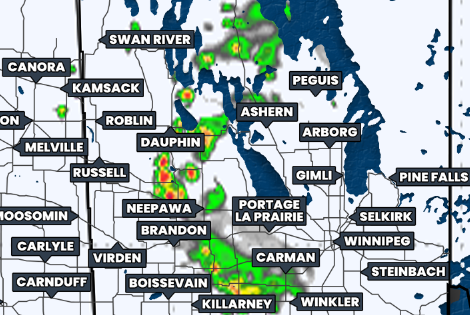
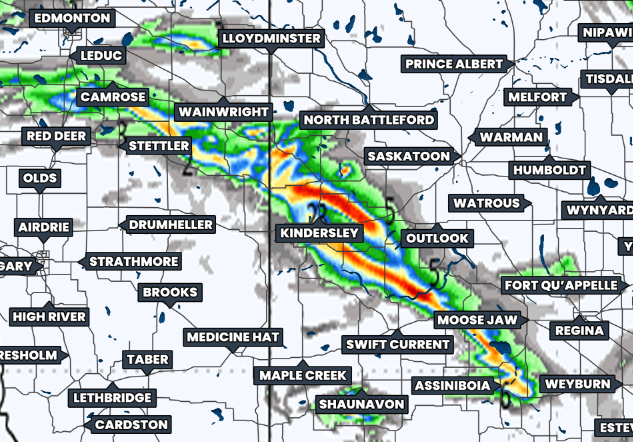
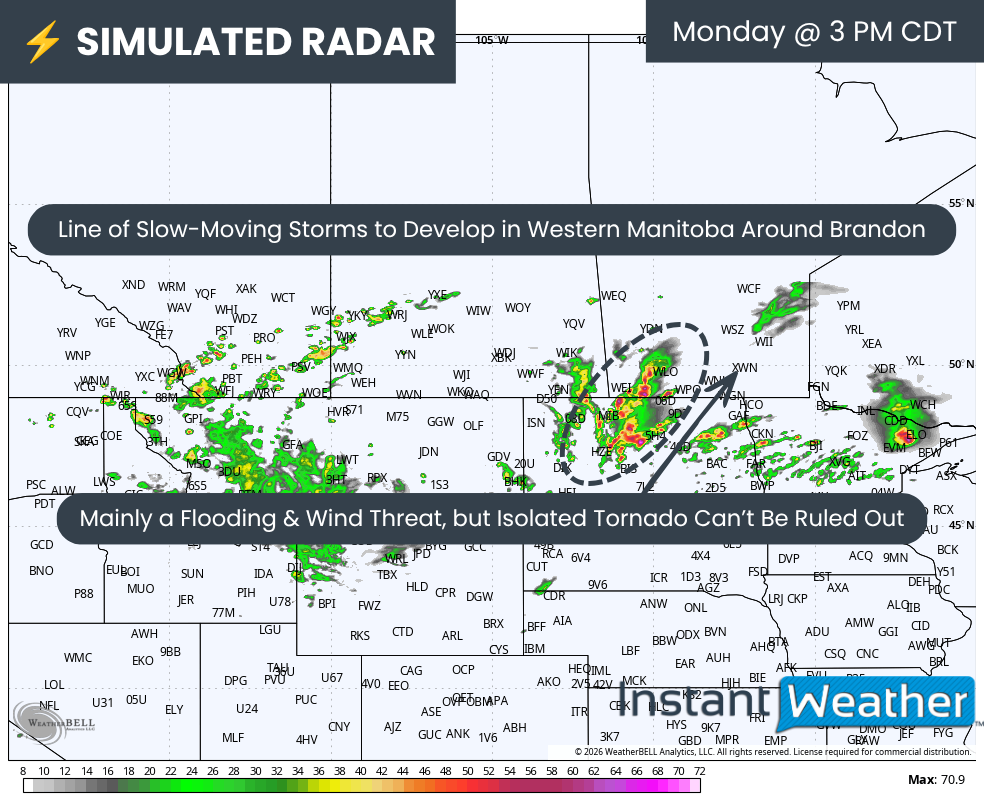
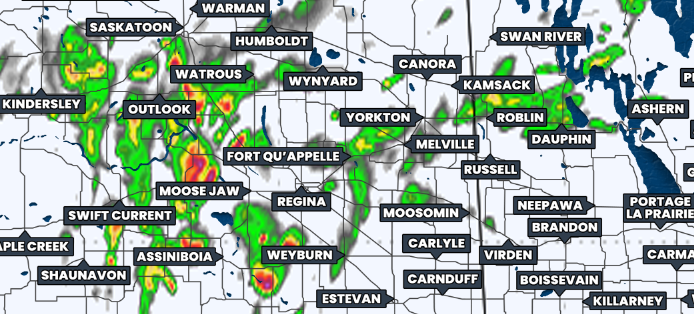
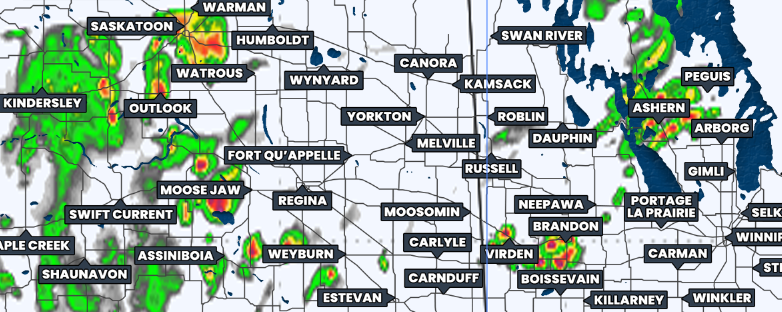
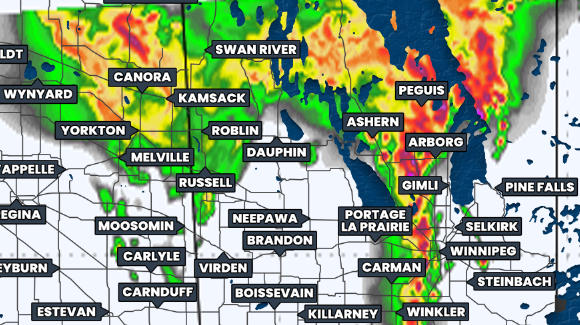
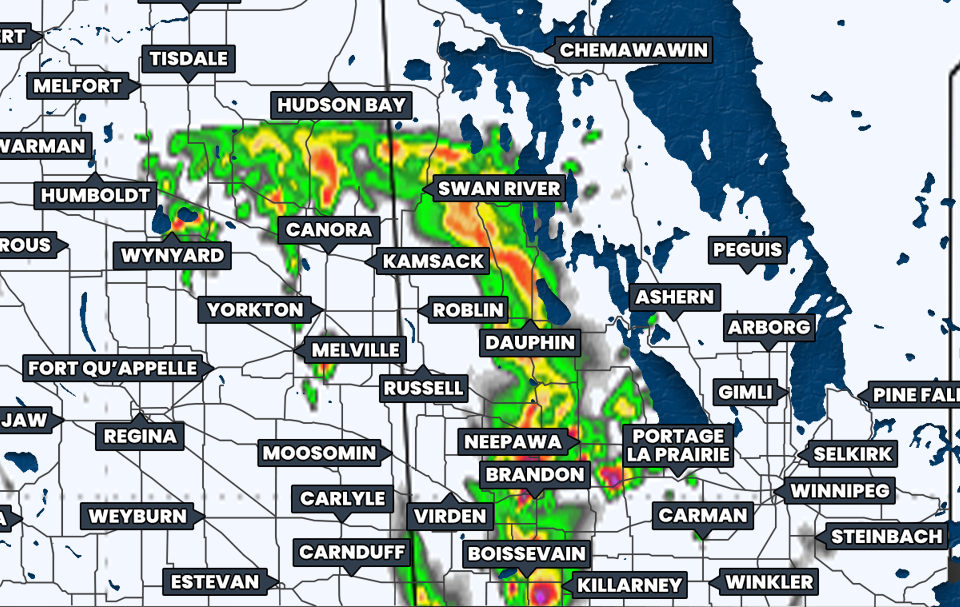
Simulated reflectivity at 3pm CST/4pm CDT, courtesy of weatherbell.

Severe thunderstorms could start to fire up in the early afternoon, particularly in Southwestern and West Central Saskatchewan. However, we will gradually see more organized development of stronger thunderstorms occur across Southern Saskatchewan and into Southwestern Manitoba as we get later in the afternoon, around 3-6pm, depending on the time zone.

Similar to what we saw on the weekend, the thunderstorms are expected to grow exponentially into large supercells which will track mostly northeastward through the evening and overnight.

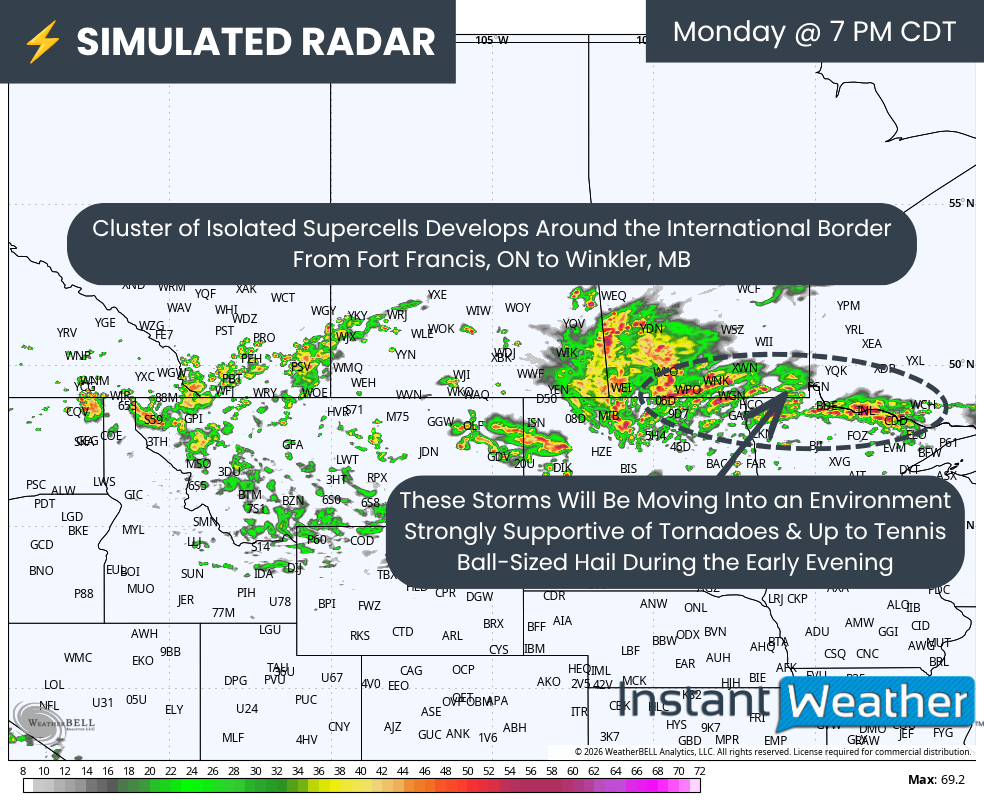
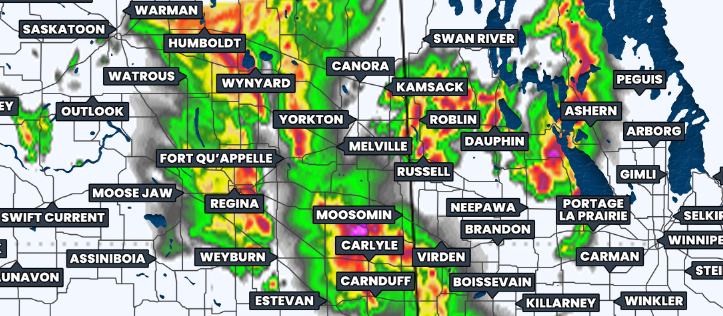
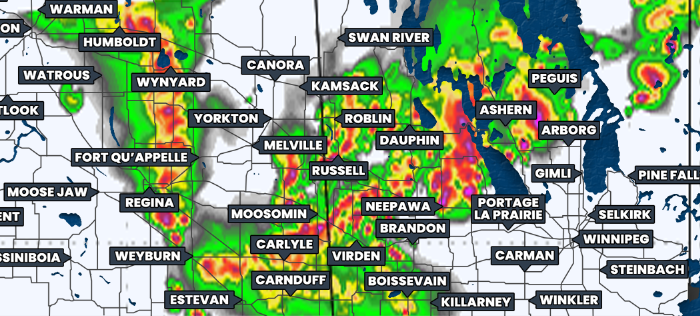
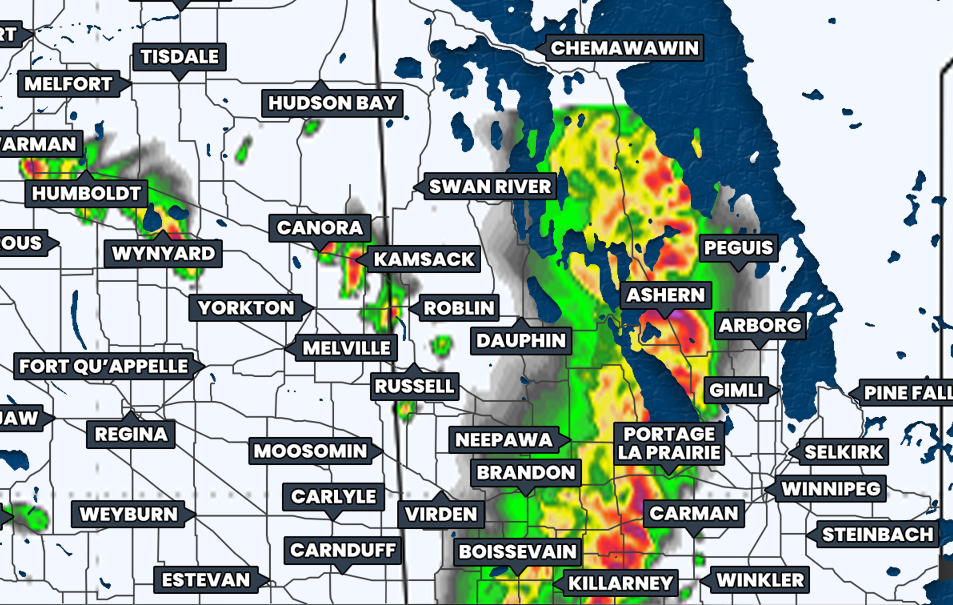
Simulated reflectivity at 7pm CST/8pm CDT, courtesy of weatherbell.

Even more thunderstorms are expected develop during the evening and storms will also move into the region from south of the border. As with the situation on both Saturday and Sunday, there is the likelihood that these additional storms will end up merging into a large line of thunderstorms. These thunderstorms will continue to be quite strong for a few hours after they transition into a linear storm mode.

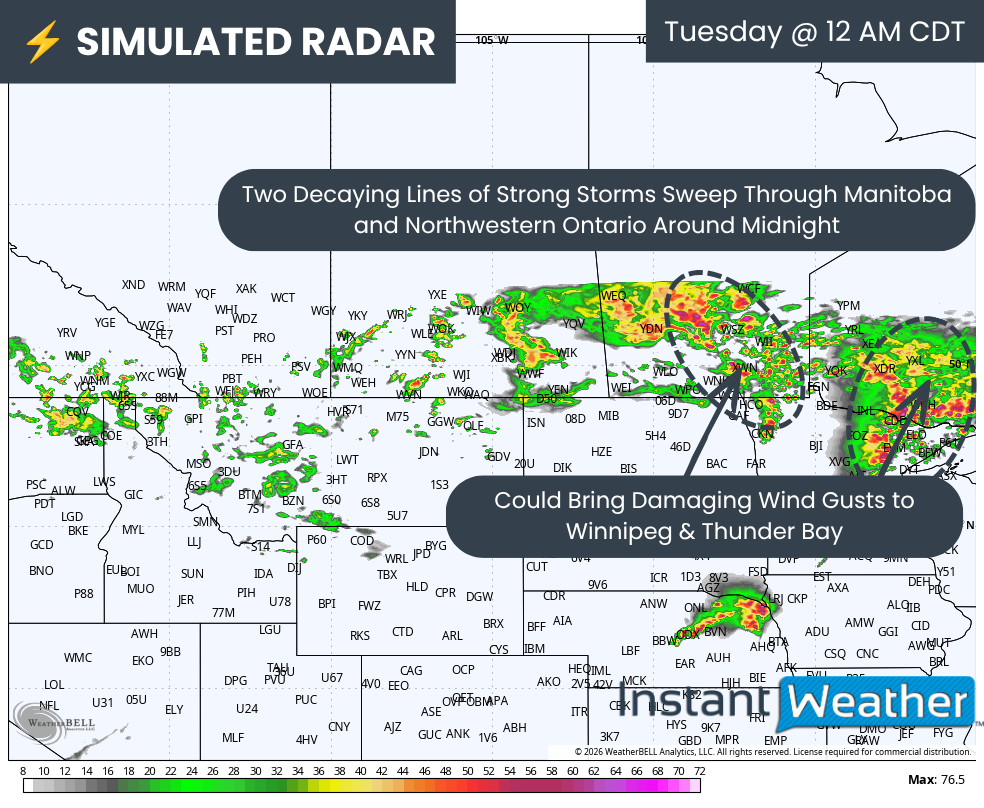
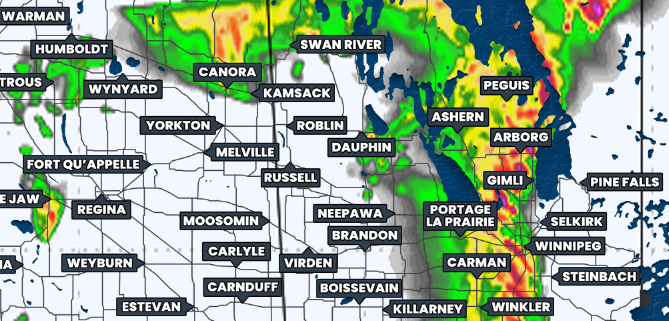
As the hours tick on and it gets closer to midnight, it’s likely that the storms will begin to gradually weaken. This is also around the time that the severe line will make its way into the Winnipeg area so it’s possible that the city could avoid the greatest severe hazards of the day.

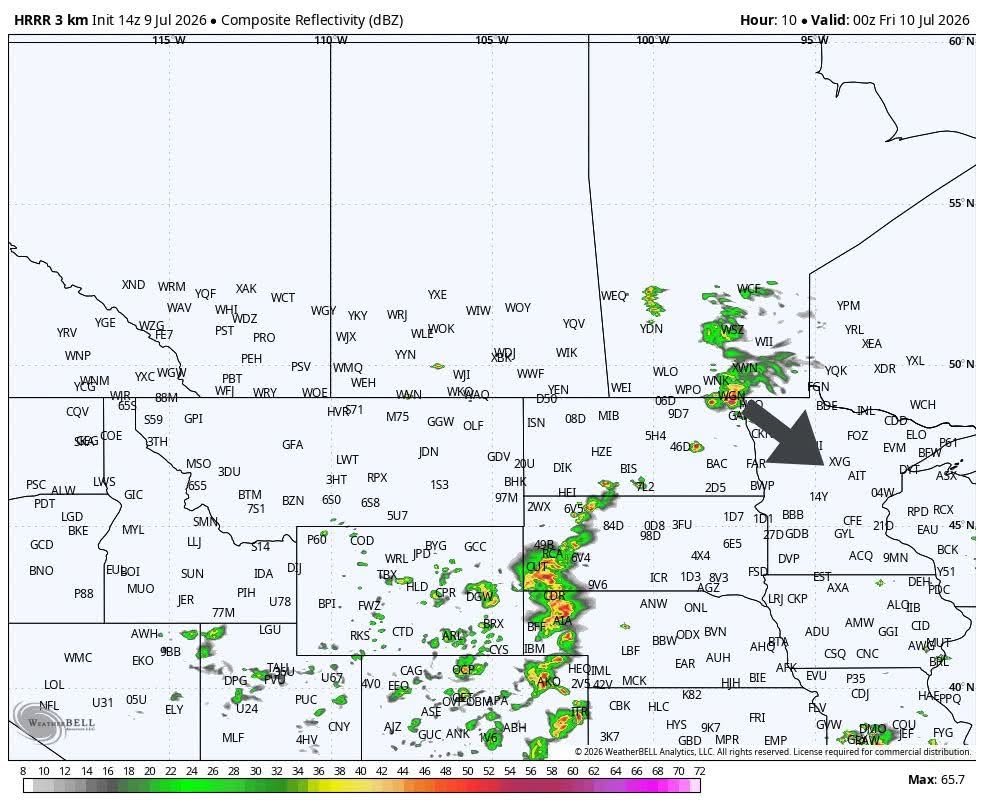
Simulated reflectivity at 11pm CST/12am CDT, courtesy of weatherbell.

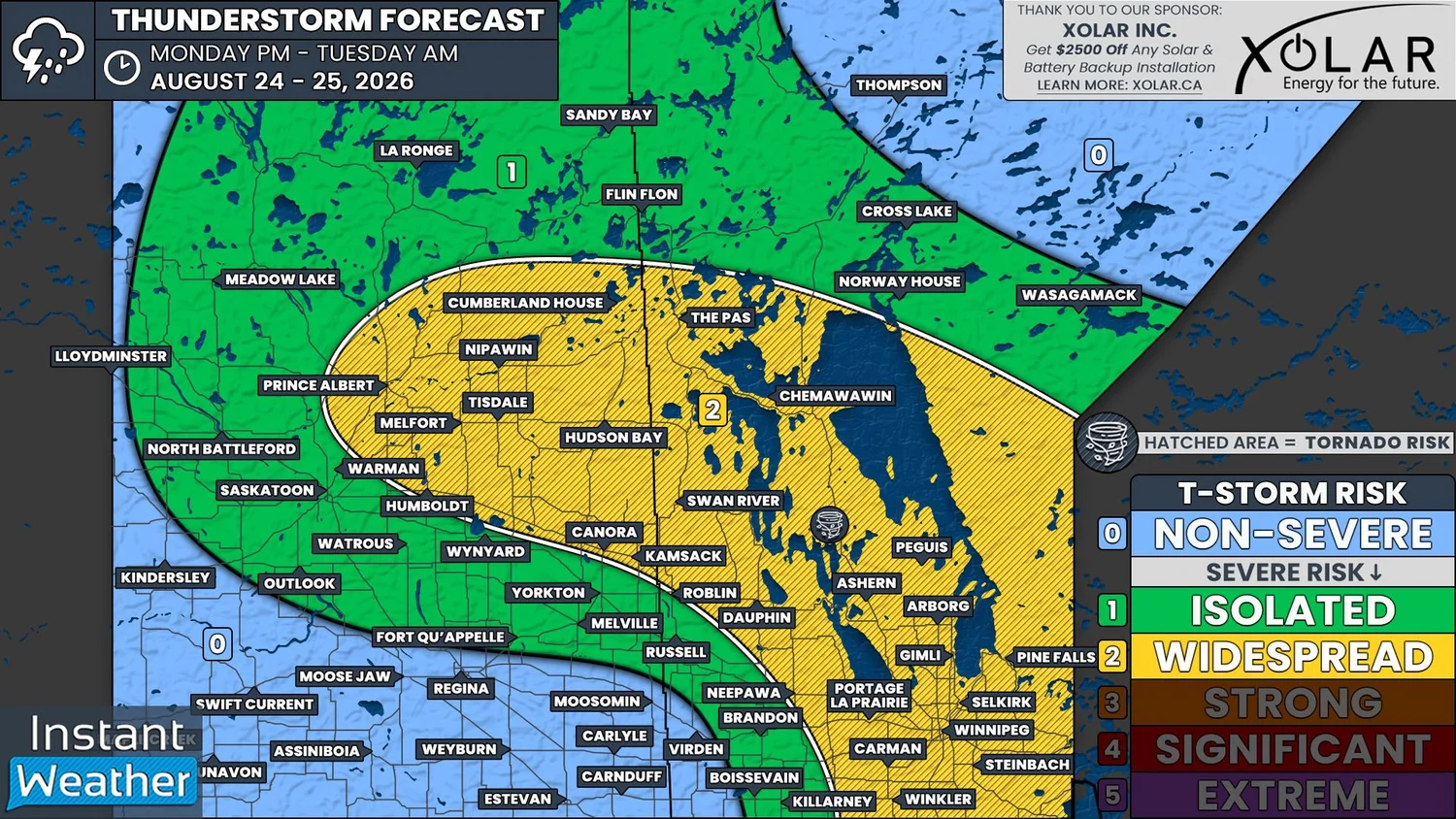
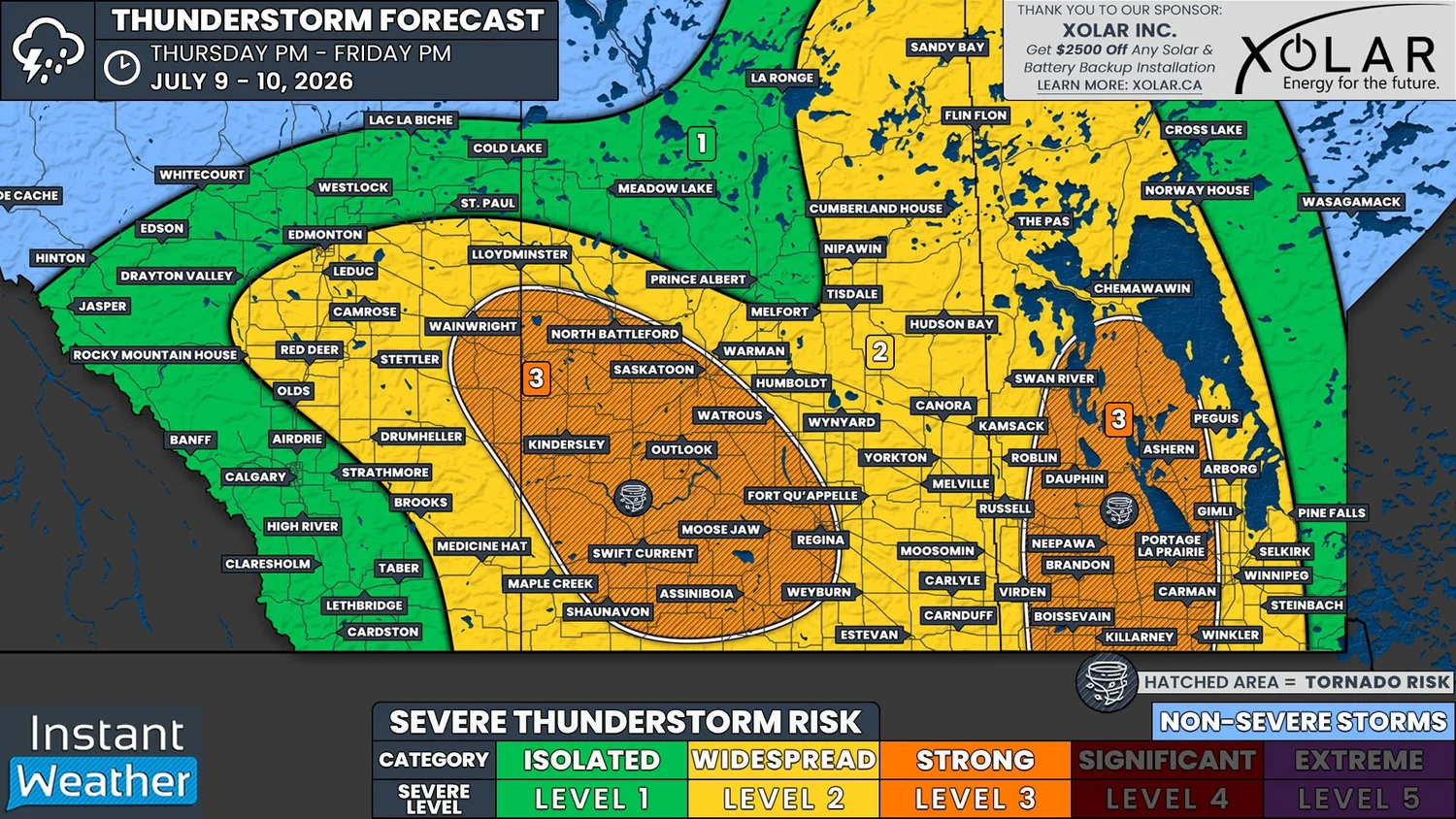
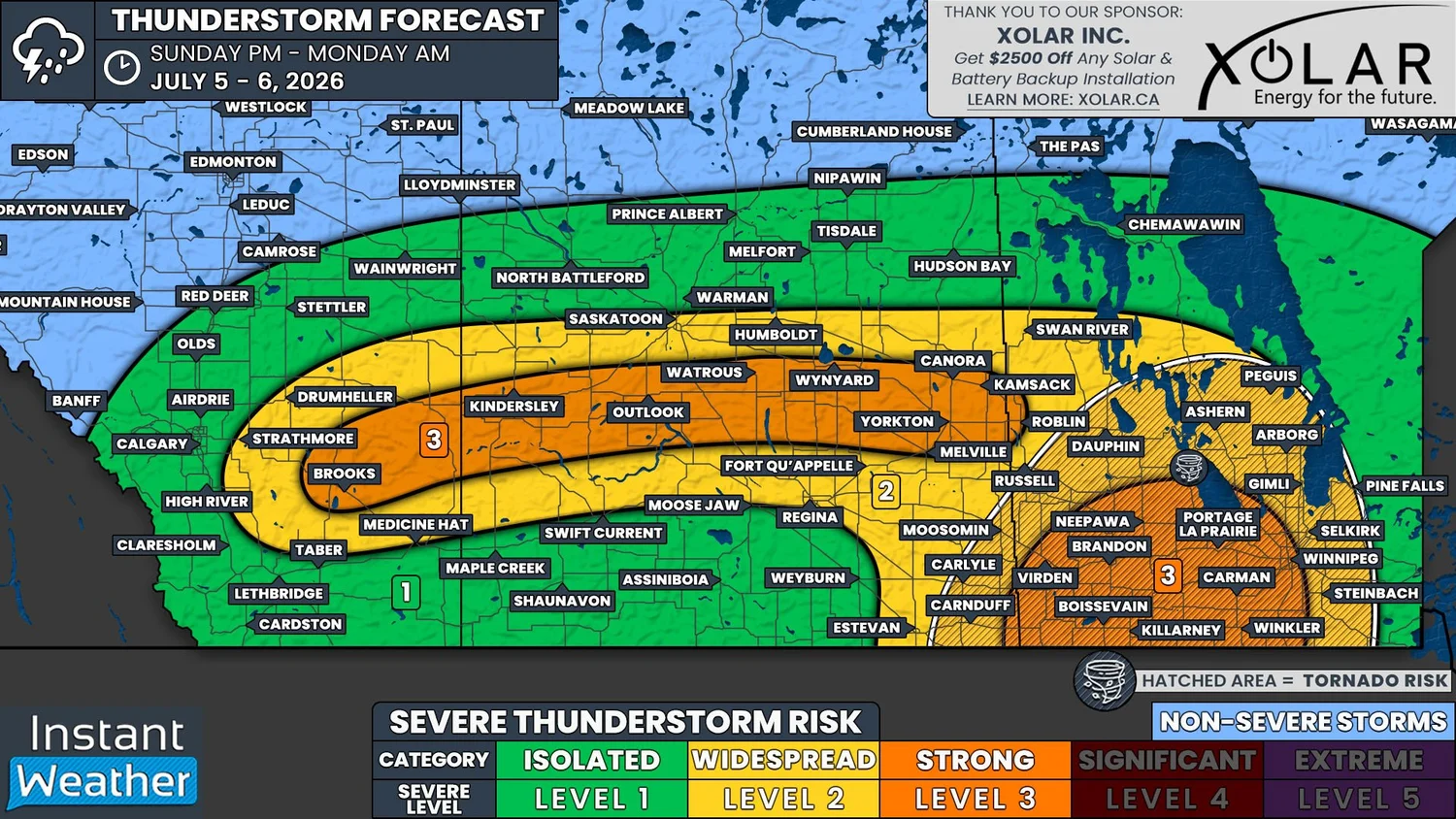
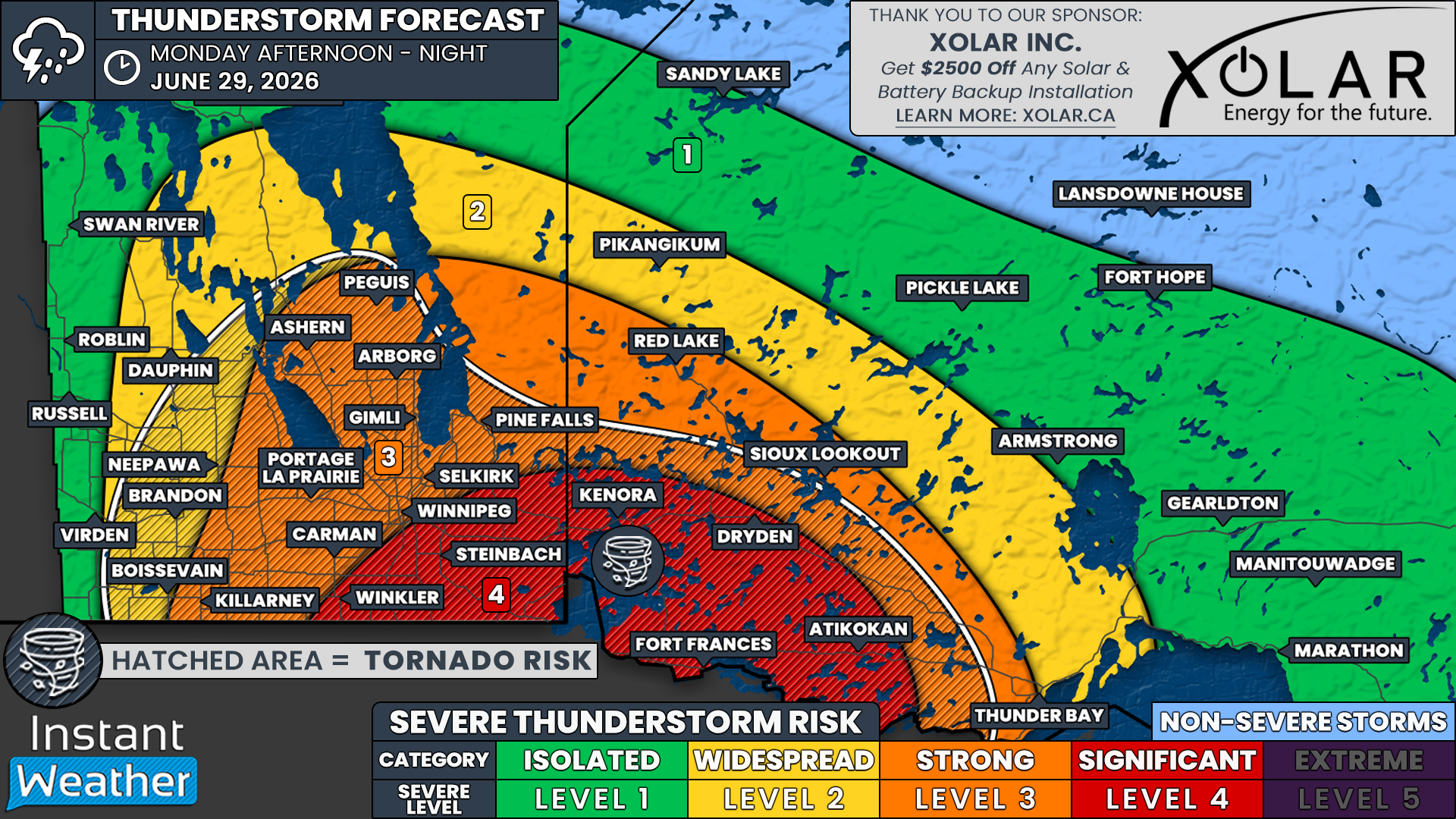
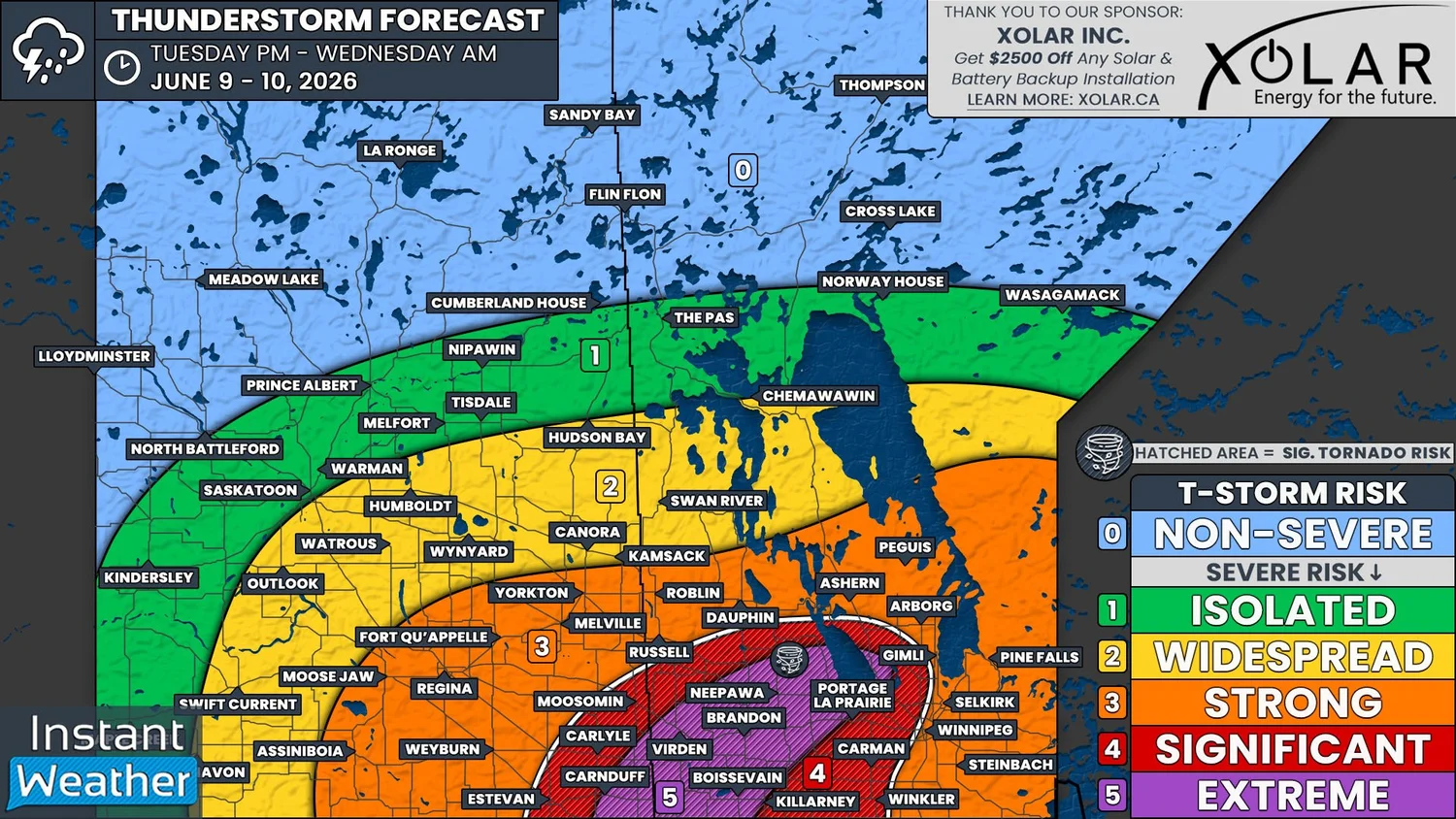
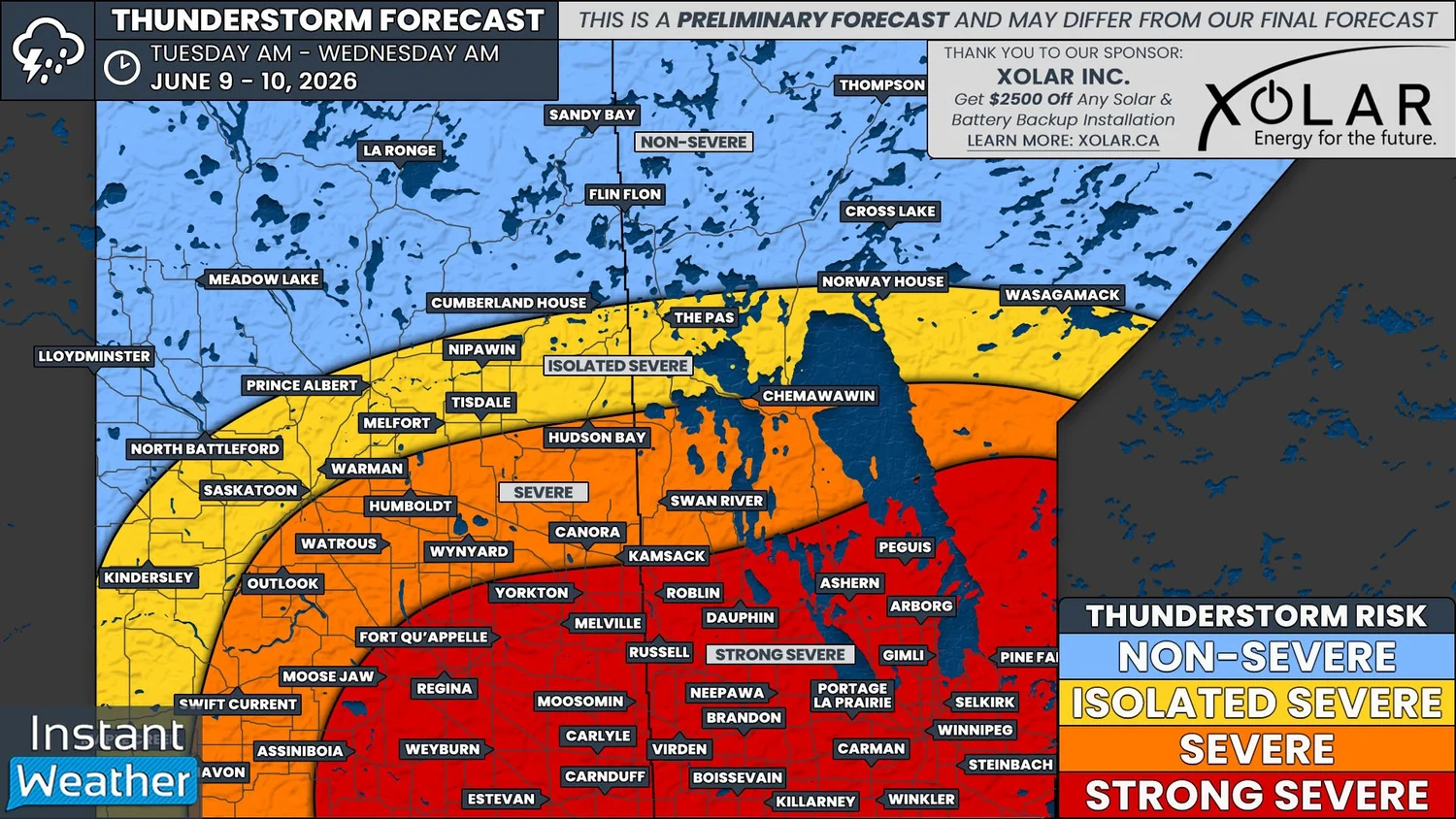
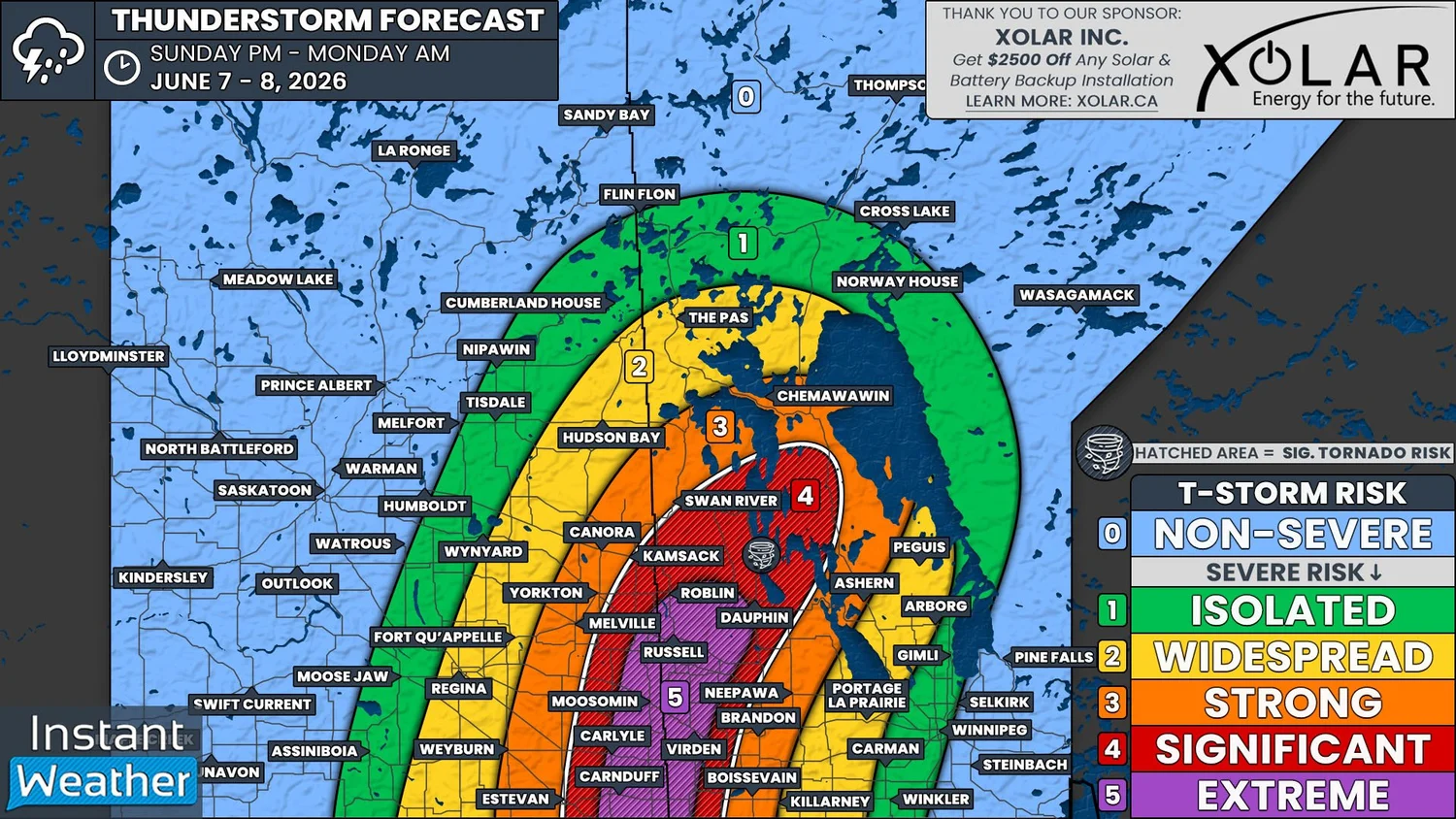
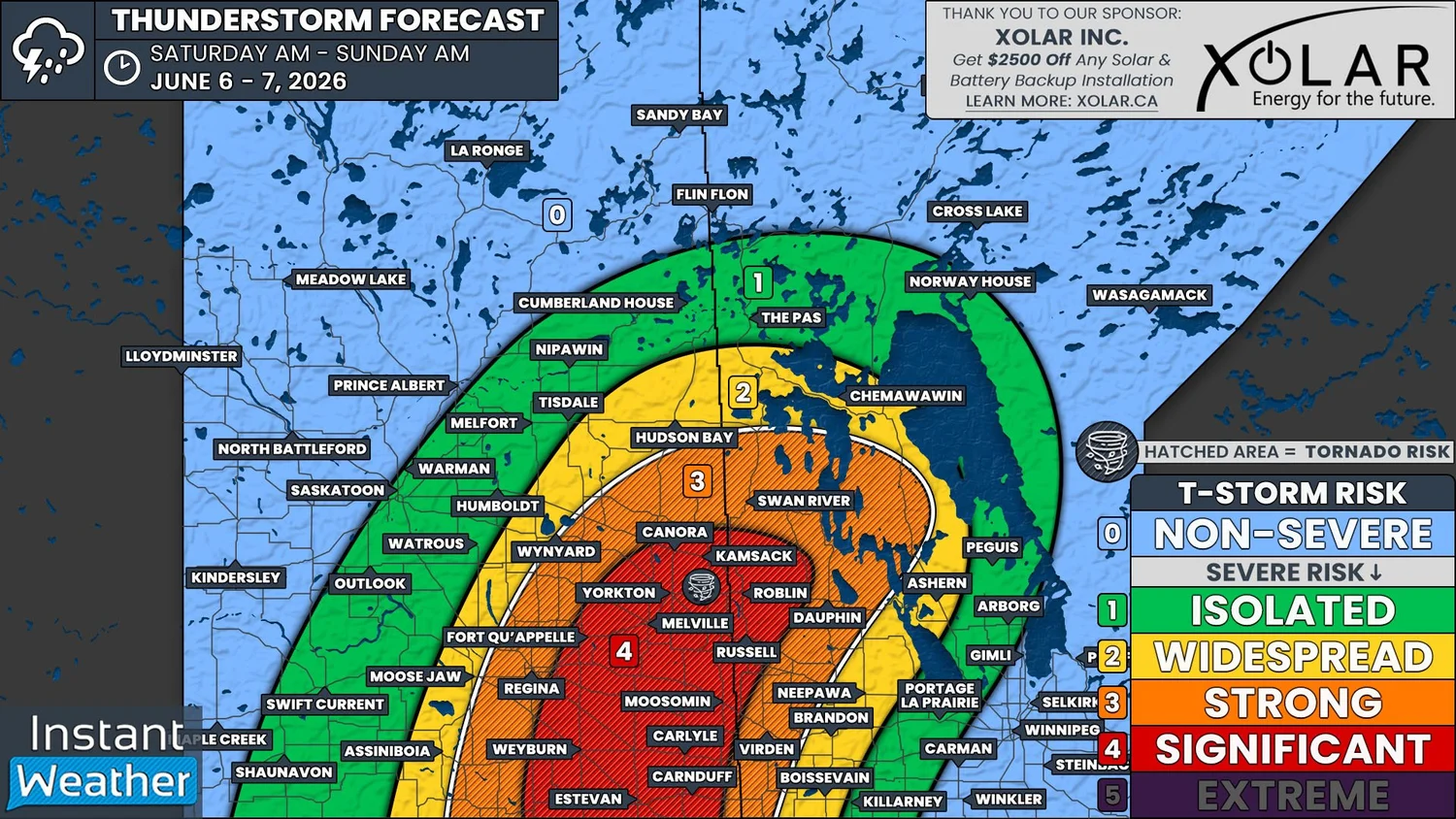
The risk of strong severe thunderstorms extends across much of Southern Saskatchewan and Manitoba today. Across much of the region, there will be the possibility for storms to produce ping pong ball hail, damaging wind gusts up to 100km/h, and heavy rains that will likely result in localized flooding.

However, the greatest threat of severe weather will once again be in Southeastern Saskatchewan, into Southwestern Manitoba and extending eastward into the Interlake Region and approaching the Red River Valley. This region, highlighted in red and purple on our forecast map, could see some exceptionally strong thunderstorms this evening that will originate from Montana.

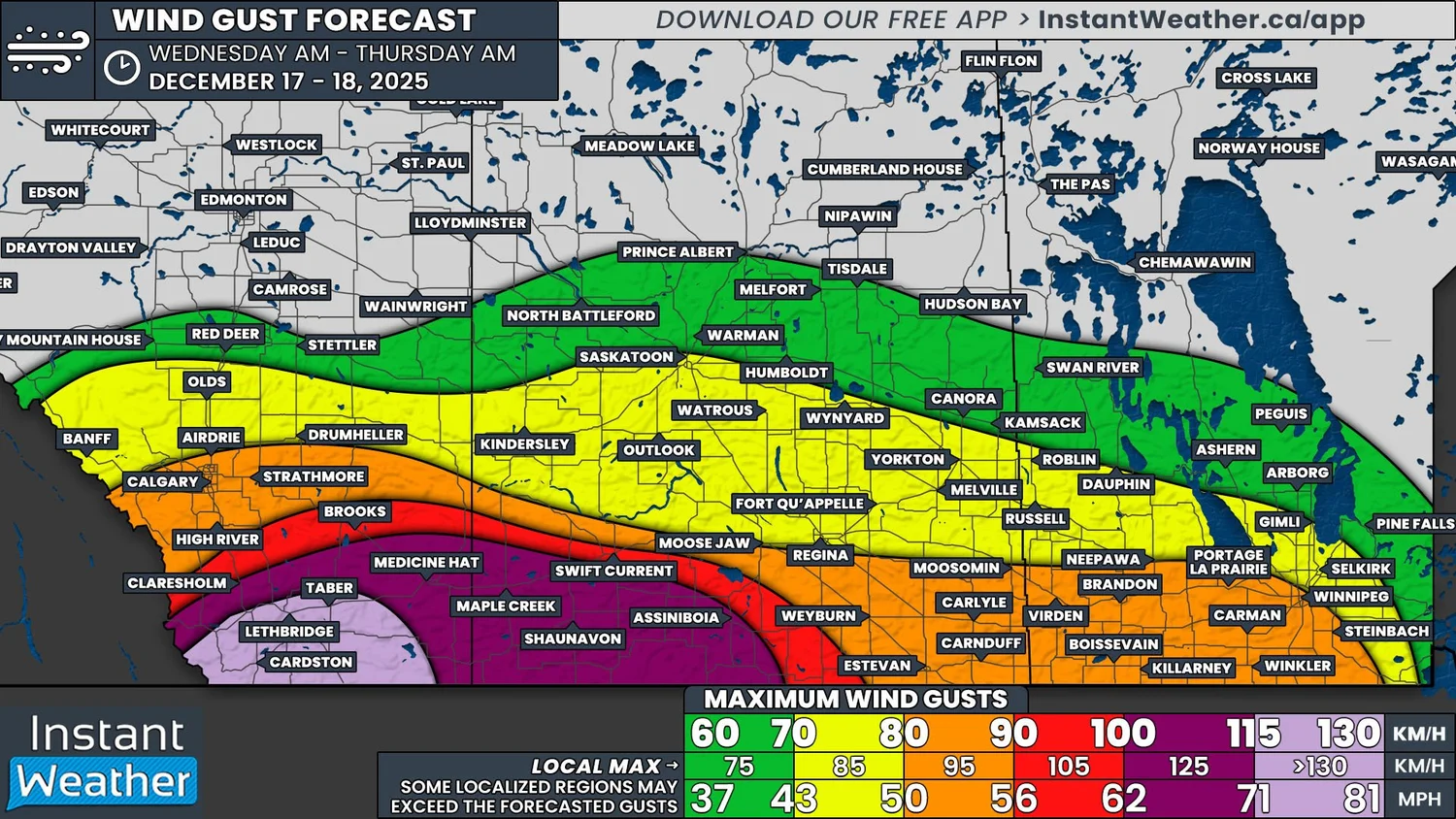
The main threat from the thunderstorms that move through this region is expected be widespread destructive wind gusts upwards of 130km/h and this could very likely end up being considered a derecho. On top of this, the storms will also have torrential downpours that could further exacerbate the flooding issues being faced by some communities and they may produce hail that could be as large as baseballs, which could be extremely dangerous if it’s being driven by winds up to 130km/h. As if this wasn’t enough, there is also a tornado risk across this region.

The major hindrance to tornado development over the weekend was that a lack of moisture ended up keeping the cloud bases high, until they were able to lower later in the evening on Sunday. This could end up being the case today, but this still has the potential to be a life-threatening situation.

Even without the tornado risk, today’s severe weather threat is very serious. If you live in the area that we’ve highlighted in either red or purple on our map, PLEASE be prepared for the likelihood that threatening weather could impact your area today. Make sure you have your phones charged and you have multiple ways to receive weather alerts. It’s also a good idea to have a plan in place in the event that you need to take shelter.


Threat of Large Hail, Damaging Winds and Tornadoes Returns to Saskatchewan and Manitoba on Tuesday

NOTE: YOU CAN CLICK ON THE MAP TO OPEN A ZOOMABLE IMAGE

It was a very busy weekend for severe weather in Southeastern Saskatchewan and Southwestern Manitoba. From the two day span, there have been countless reports of massive hail, wind damage, flooding from across the region, as well as a few tornado reports that are awaiting confirmation. Unfortunately, Monday’s calmer conditions won’t last because strong severe thunderstorms are once again expected to impact Southern Saskatchewan and Manitoba on Tuesday.

Early Tuesday, a low pressure system will move into Southeastern Montana and from there, it will strengthen as it tracks into Western North Dakota through the morning hours and into the afternoon. A warm front will extend eastward from the low pressure center, which will help draw lots of heat and moisture northward into Southern Saskatchewan and Manitoba.

Future Surface weather map with the positions of highs, lows, and fronts displayed for 12pm cst/1pm CDT on Tuesday, courtesy of the national weather service.

Temperatures are slated to climb into upper 20s and low 30s across the region in the afternoon and with dewpoints expected to be in the upper teens, there will be plenty of fuel for thunderstorm development. Some models are showing upwards of 4000J/kg of CAPE in some areas, which will support the development of supercell thunderstorms.

Veering winds will also create a significant amount of shear to maintain large supercell thunderstorms and support tornado potential. Overall, this is looking like a fairly similar environmental setup to Sunday.

During the late morning, there is a chance that some thunderstorms could develop in Southeastern Saskatchewan which would track northeastward into Southwestern Manitoba into the early afternoon hours. These storms will likely become severe and produce some small hail and strong winds, but they won’t be as strong as the storms expected later in the day. However, if these storms manage to persist across the Interlake Region, they could end up re-intensifying through the late afternoon and evening.

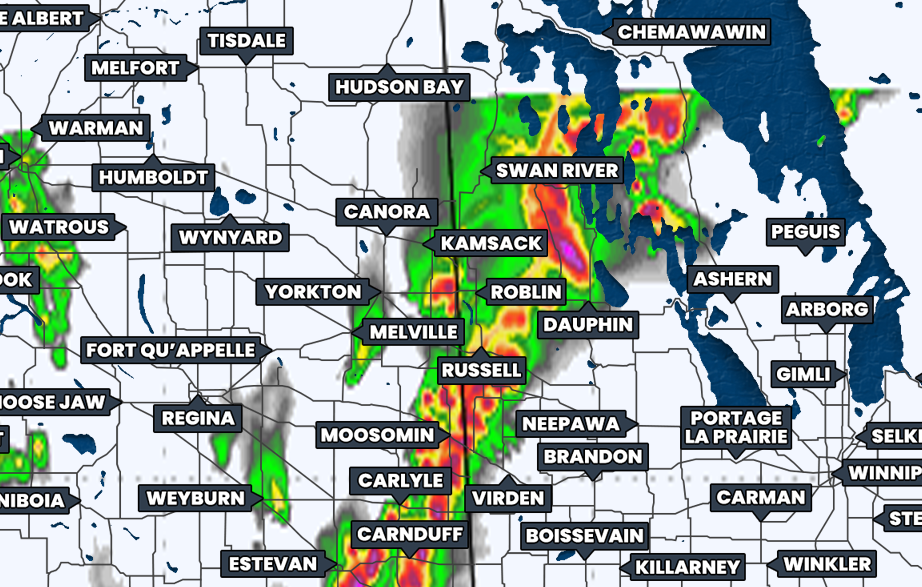
Simulated reflectivity at 4pm CST/5pm CDT, courtesy of weatherbell.

The strong severe thunderstorms could start to fire up in the early afternoon, particularly in Southwestern and West Central Saskatchewan. However, we will gradually see more organized development occur across Southern Saskatchewan and into Southwestern Manitoba as we get later in the afternoon, around 3-6pm, depending on the time zone.

Similar to what we saw on the weekend, the thunderstorms are expected to grow exponentially into large supercells which will track mostly northeastward through the evening and overnight.

Simulated reflectivity at 8pm CST/9pm CDT, courtesy of weatherbell.

More thunderstorms are expected develop during the evening and storms will also move into the region from south of the border. As with the situation on both Saturday and Sunday, there is the likelihood that these additional storms will end up merging into a large line of thunderstorms. These thunderstorms will continue to be quite strong for a few hours after they transition into a linear storm mode.

As the hours tick on and it gets closer to midnight, it’s likely that the storms will begin to gradually weaken. This is also around the time that the severe line will make its way into the Winnipeg area so it’s possible that the city could avoid the greatest severe hazards of the day.

Simulated reflectivity at 11pm CST/12am CDT, courtesy of weatherbell.

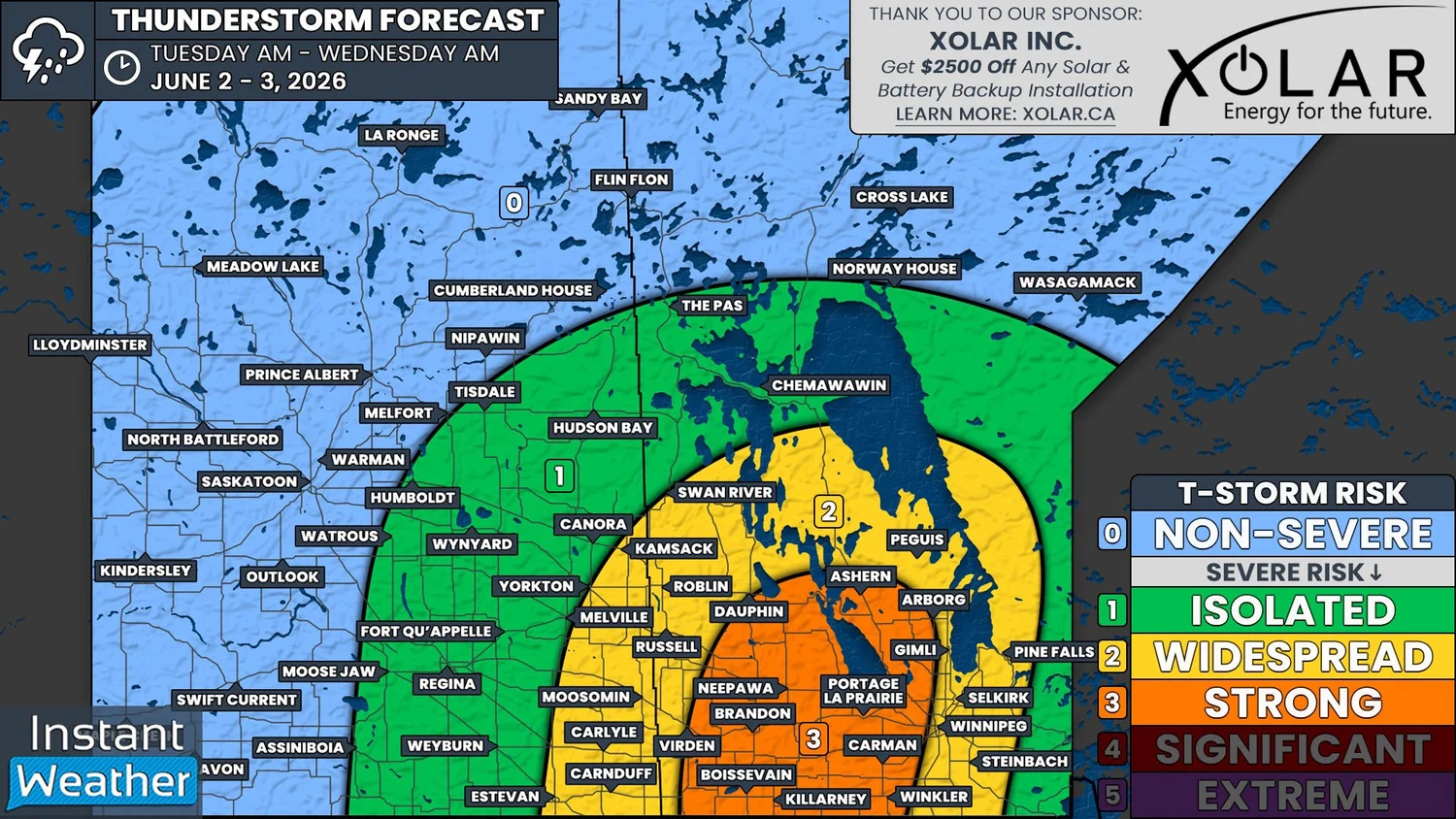
The risk of strong severe thunderstorms on Tuesday extends across much of Southern Saskatchewan and Manitoba. Throughout this region, the severe thunderstorms could end up producing hail that’s larger than golf balls, widespread damaging wind gusts up to 130km/h, and torrential downpours that could exacerbate the flooding issues some communities are already dealing with.

There is also the potential for tornadoes to form from these thunderstorms. The major hindrance to tornado development over the weekend was that a lack of moisture ended up keeping the cloud bases high until they were able to lower later in the evening on Sunday. This could end up being the case on Tuesday, given the similar environmental setup, but the risk is certainly still in place.

Please keep in mind that this is a preliminary forecast and could differ from our final forecast as more data comes in overnight and tomorrow morning.


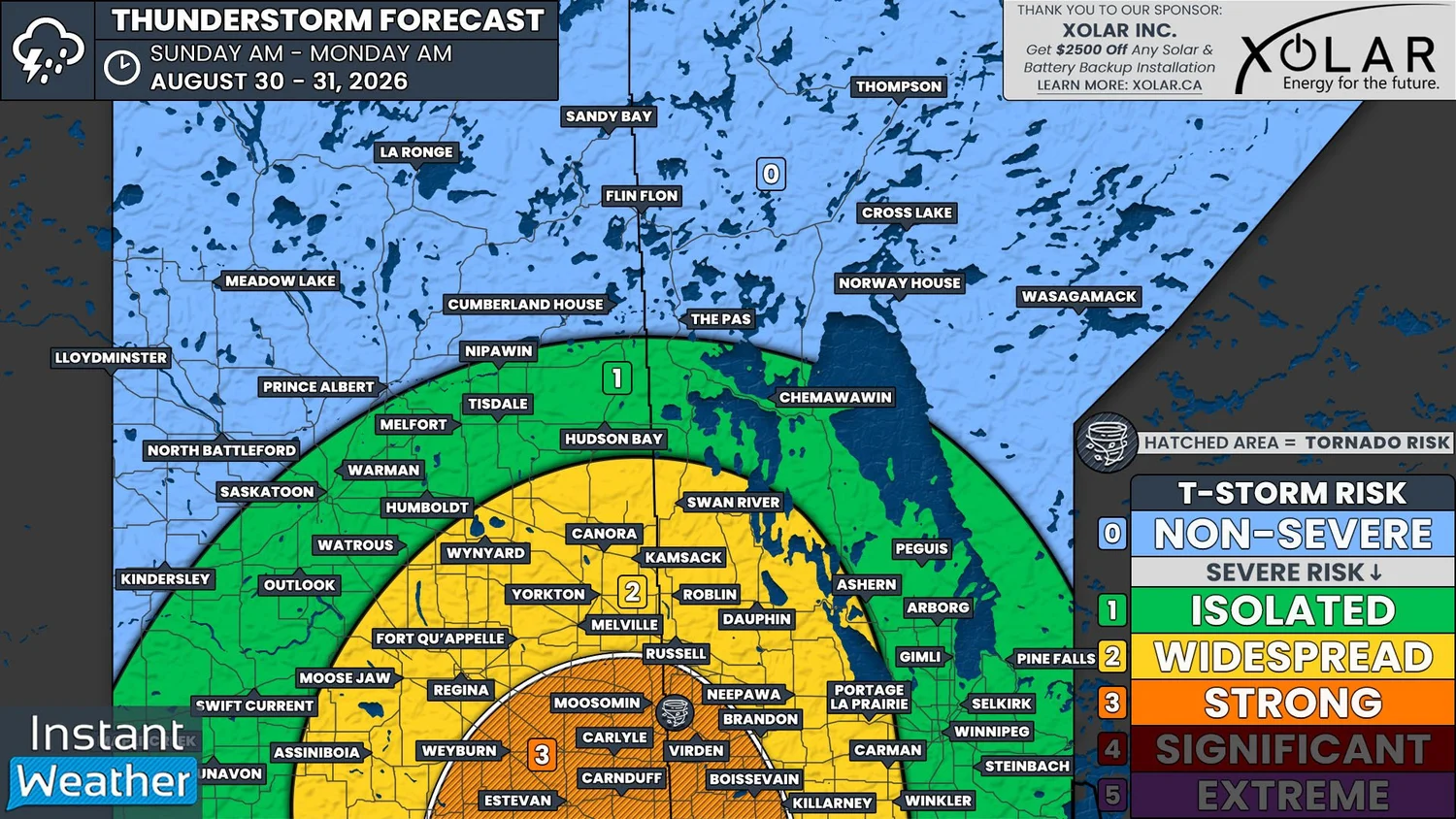
Widespread Tornado Threat and Softball-Sized Hail Possible with Extreme Thunderstorm Risk on Sunday as Severe Weather Outbreak Enters its Second Day

NOTE: YOU CAN CLICK ON THE MAP TO OPEN A ZOOMABLE IMAGE

After a busy day yesterday, that saw severe thunderstorms dropping massive baseball-sized hail over parts of Southeastern Saskatchewan and Southern Manitoba, we have the chance to do it all again today. It’s likely that today could be an even greater severe risk day than yesterday, with an extreme risk posed by the possibility of gigantic hail and multiple tornadoes. However, there has been a little bit of uncertainty surrounding how thunderstorms may end up developing this afternoon and evening.

Like yesterday, today’s severe thunderstorm threat will be triggered by a cold front that is currently oriented on a north-south axis and it located just west of the Saskatchewan/Manitoba border. This is a bit further west than originally anticipated when we issued our preliminary forecast on Friday, due in part to the front becoming stationary for a period of time yesterday. As a result, the severe risk today will cover more of Southeastern Saskatchewan and won’t extend as far east across Southern Manitoba.

To the east of the cold front, temperatures will once again climb into the low 30s this afternoon and it’s expected to be much more humid today, with dew points approaching the 20°C mark. The lack of moisture yesterday kept the cloud bases high, which greatly reduced the tornado risk, but it doesn’t look like that will be the case today.

The heat and humidity will lead to high levels of instability and upwards of 3000J/kg of CAPE to fuel thunderstorm development again today. Veering winds will also create a significant amount of shear to maintain large supercell thunderstorms.

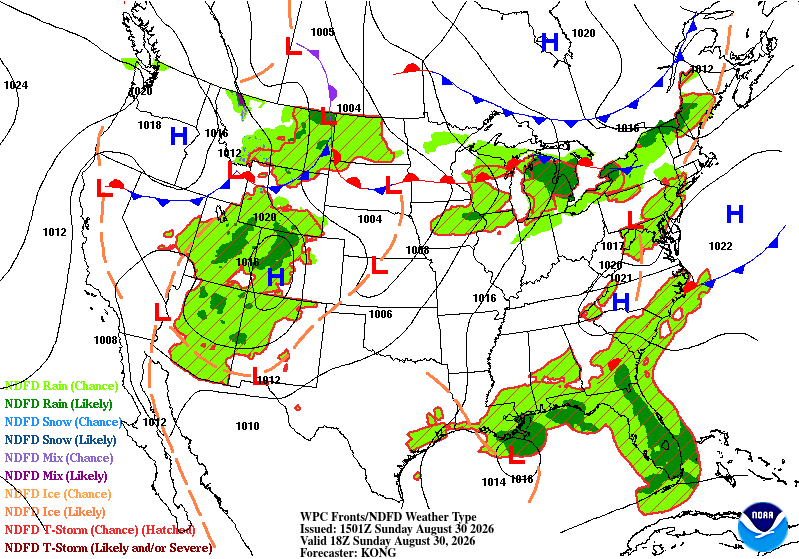
Surface weather map with the positions of highs, lows, and fronts displayed as of 6am cst this morning, courtesy of the national weather service.

As we’ve mentioned in this forecast already, and in our forecast from yesterday, there was uncertainty with today’s severe thunderstorm risk. There have been some mostly non-severe thunderstorms that have tracked through Southern Manitoba already this morning and it is possible these could hinder additional development later today.

The storms have weakened over the past couple of hours and the thought was that if they manage to clear early enough, that will allow for there to be ample surface heating needed for the additional explosive development later. However, if the storms stuck around into the afternoon, the severe thunderstorm risk would be greatly reduced. With the clearing of these morning storms already occurring, it seems likely the severe threat will not be diminished.

The significant severe thunderstorms could develop in the late afternoon and into the early evening, around 4-6pm in Southeastern Saskatchewan and extending northeastward into Southern and Central Manitoba. These storms could once again explode into massive and dangerous supercell thunderstorms that would track roughly northeastward through the evening.

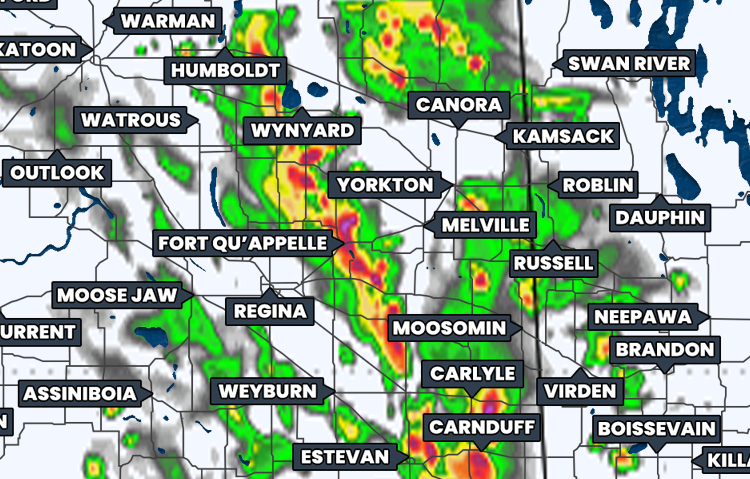
Simulated reflectivity at 4pm CST/5pm CDT, courtesy of weatherbell.

The area highlighted on our map in red, that covers a large portion of Southeastern Saskatchewan and Southwestern Manitoba, will be at a very high risk for dangerous severe thunderstorms. The area highlighted in purple, however, is where the strongest environment is expected to be and where there is an extreme risk for incredibly dangerous and life-threatening thunderstorms.

Throughout this region, the severe thunderstorms could end up producing absolutely massive, and maybe record-breaking, softball-sized hail, damaging wind gusts up to 120km/h, and very heavy rainfall that could lead to localized flooding. If we end up seeing the moisture that we were lacking yesterday, and the storm bases are lower, it is entirely possible that we could be looking at a tornado outbreak.

Simulated reflectivity at 8pm CST/9pm CDT, courtesy of weatherbell.

As we progress through the evening, more thunderstorms are expected develop and storms will also move into the region from south of the border. Once again, there is the likelihood that these additional storms will end up merging into a large line of storms which could impact a wide area into the overnight hours.

By the time we see a more linear storm mode, it’s likely that the storms will have weakened from their greatest strength, but they are still expected to be very strong and capable of producing very large hail, damaging wind gusts, and torrential rain.

The tornado threat should also decrease as we get later in the evening and into the overnight hours, but with how strong these thunderstorms could be today, there will still be a slight risk until the storms move into Northern Manitoba during the early morning.

Today’s severe weather threat is very serious. If you live in the area that we’ve highlighted in either red or purple on our map, PLEASE be prepared for the possibility of threatening weather to impact your area today. Make sure you have your phones charged and you have multiple ways to receive weather alerts. It’s also a good idea to have a plan in place in the event that you need to take shelter.

Once again, we will absolutely be live-streaming later so please join us while we monitor and track today’s severe weather. We hope everyone is able to stay safe today!


Tennis Ball-Sized Hail and Multiple Tornadoes Possible as Severe Thunderstorm Outbreak Targets Southeastern Saskatchewan on Saturday

NOTE: YOU CAN CLICK ON THE MAP TO OPEN A ZOOMABLE IMAGE

Over the last several days, we’ve been closely watching the possibility of an intense multi-day setup for this weekend that would impact Southeastern Saskatchewan today and shift into Southwestern Manitoba tomorrow. There has been a lot of chatter online about this severe weather risk and combined with several high-profile storm chasers in the area from the US, it’s easy to say that we’re not looking at your average thunderstorm activity.

Today’s severe thunderstorm threat will be courtesy of a warm and cold front that is poised over Southeastern Saskatchewan and Southwestern Manitoba. The warm sector between the two fronts will see temperatures climb into the upper 20s and low 30s this afternoon, with high humidity.

This will lead to high levels of instability and CAPE (Convective Available Potential Energy) for thunderstorm development. Add in veering winds, changing direction with height, which will create a great amount of shear, and you have the recipe for an outbreak of significantly strong severe thunderstorms.

Surface weather map with the positions of highs, lows, and fronts displayed as of 6am cst this morning, courtesy of the national weather service.

There have already been some scattered thunderstorms this morning which will continue through the afternoon across much of Southern Saskatchewan. These storms are expected to stay non-severe for the most part, but there is an isolated severe risk.

The thunderstorms that will be the focus for today aren’t expected to develop until this evening, starting around 5-6pm, to the east of Regina. Weather models are showing that these storms will likely quickly explode into large and dangerous supercell thunderstorms as they track roughly east-northeastward.

Simulated reflectivity at 6pm CST, courtesy of weatherbell.

The area highlighted on our map in red that covers a large portion of Southwestern Saskatchewan and into parts of the Parkland Region in Manitoba will be at the greatest risk for the strongest of these severe thunderstorms.

In this region, it’s likely that the storms could produce massive hail as large as tennis balls and possibly even larger, damaging wind gusts up to or exceeding 100km/h, and heavy downpours that could result in localized flooding. There is also a considerable threat that multiple tornadoes could touch down in this region; with the stretch from Weyburn to Yorkton appearing to be of particular concern.

As we progress through the evening, we will see additional thunderstorm development occur, which are expected to merge into a line of storms. This will bring a more widespread threat of the significant and strong storms across the rest of Southeastern Saskatchewan and into Manitoba.

Simulated reflectivity at 8pm CST, courtesy of weatherbell.

The severe weather threat will diminish gradually as the hours tick on in the evening and overnight. The tornado risk is also expected to decrease from its highest point by the mid-evening, but the storms could still be strong enough for the risk to remain through the evening. By midnight, there could still be a widespread risk of some severe storms, but this will quickly turn into a more isolated risk and scattered non-severe thunderstorms through the morning.

Looking ahead to tomorrow afternoon, we’re looking at another day of possibly strong severe thunderstorms, with the risk pushing further east across Southern Manitoba. What ends up happening tomorrow will really depend on how things unfold today. There’s the possibility that tomorrow could have even stronger storms than what is expected this afternoon, but this will be heavily contingent on how long any overnight storms manage to persist into tomorrow.

If the storms clear during the morning, that will allow for there to be ample surface heating for the development of another significant severe thunderstorm outbreak. However, if the storms continue into the afternoon, the severe thunderstorm risk will be greatly reduced.

We will have more details later today about how tomorrow could shape up. In the meantime, we will be watching today’s development very closely and we will be streaming later to track the severe thunderstorms live. Be sure to tune in!


June Starts With a Bang as Strong Severe Thunderstorms Threaten Southern Manitoba

NOTE: YOU CAN CLICK ON THE MAP TO OPEN A ZOOMABLE IMAGE

The summer-like heat that has taken hold of the southern half of Manitoba over the last few days is finally going to give way to more seasonal temperatures. A cold front will move through the province today, which will be responsible for the drop in temperatures, however, it will also be the trigger for severe thunderstorms across Southern and Central Manitoba.

Thunderstorms have already developed this morning in Western North Dakota and they have been tracking north-northeastward across Westman. So far, these storms have stayed non-severe, but there is an isolate severe risk associated with them as they will continue making their way into the Parkland Region through the remainder of the morning and into the early afternoon. There is a more widespread severe risk associated with the storms just on the other side of the Saskatchewan border.

While this first wave of storms aren’t too strong, the thunderstorms that will follow this afternoon, on the other hand, could be a different story.

Simulated reflectivity at 3pm CT, courtesy of weatherbell.

The second round of thunderstorms will arrive in the early afternoon in Westman, around 12-1pm, as a combination of discrete cells and small multicellular storms. However, they will gradually organize into an intense line of thunderstorms, that will stretch across Southwestern Manitoba and Western North Dakota by the mid-afternoon.

This line is expected to comprised of strong severe thunderstorms, which could possibly be rotating supercells, that will track northeastward across Southern and Central Manitoba.

The mid-afternoon and into the early evening, from about 3-6pm, will be the time frame when there is the greatest risk for severe weather hazards. Large hail, up to the size of ping pong balls or golf balls, is one of the major threats during this time, along with heavy downpours and damaging wind gusts in excess of 100km/h and possibly as high as 130km/h. There is also the threat of an isolated tornado forming from these supercell storms.

Simulated reflectivity at 7pm CT, courtesy of weatherbell.

By the time the storms reach the Winnipeg area, at around 7-8pm, it’s expected that they will weaken slightly as they shift away from being supercellular and into a more linear storm mode. There will still be a widespread severe risk, with intense winds being of particular concern. Heavy downpours and slightly smaller hail will remain a risk as the bowing line continues towards the Ontario border, however the tornado threat all but disappears.

As we get later in the evening and into the overnight hours, the storms will lose energy and the severe risk will become more isolated. Weak thunderstorms will persist through the early morning hours throughout Eastman and into the Red River Valley, but they will dissipate to light showers by sunrise.

This is the kind of setup that will have a lot of eyes on it. We will definitely be streaming later so make sure to join us for our live coverage of these storms.


Buckle Up: Parts of Saskatchewan & Manitoba About to Get Hammered By an Intense Spring Storm This Week

NOTE: YOU CAN CLICK ON THE MAP TO OPEN A ZOOMABLE IMAGE

We may be in the latter half of April, but winter is still hanging on across the Prairies. On Wednesday, a massive low pressure system will begin to develop which will bring chaos to Saskatchewan and Manitoba over the next few days.

Unfortunately, we’re looking at all precipitation types in both provinces, with some places possibly expecting full-on blizzard conditions, while others could see temperatures in the 20s and severe thunderstorms. This makes for a very complicated forecast, but we’ll do our best to break it down for you here.

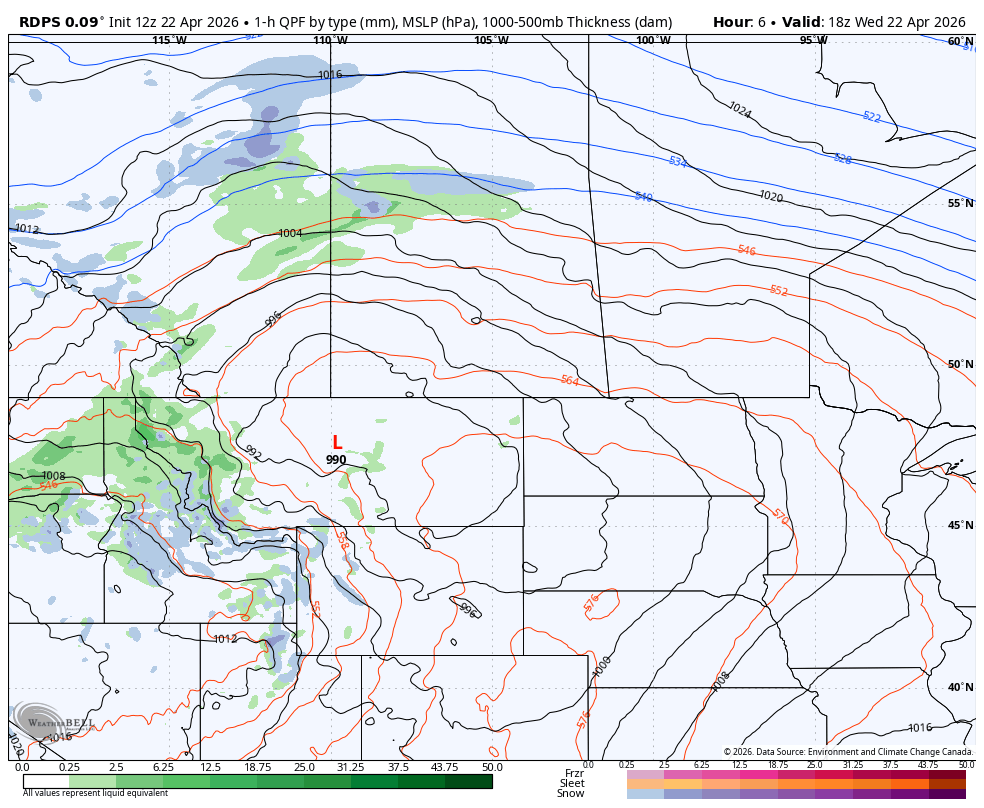
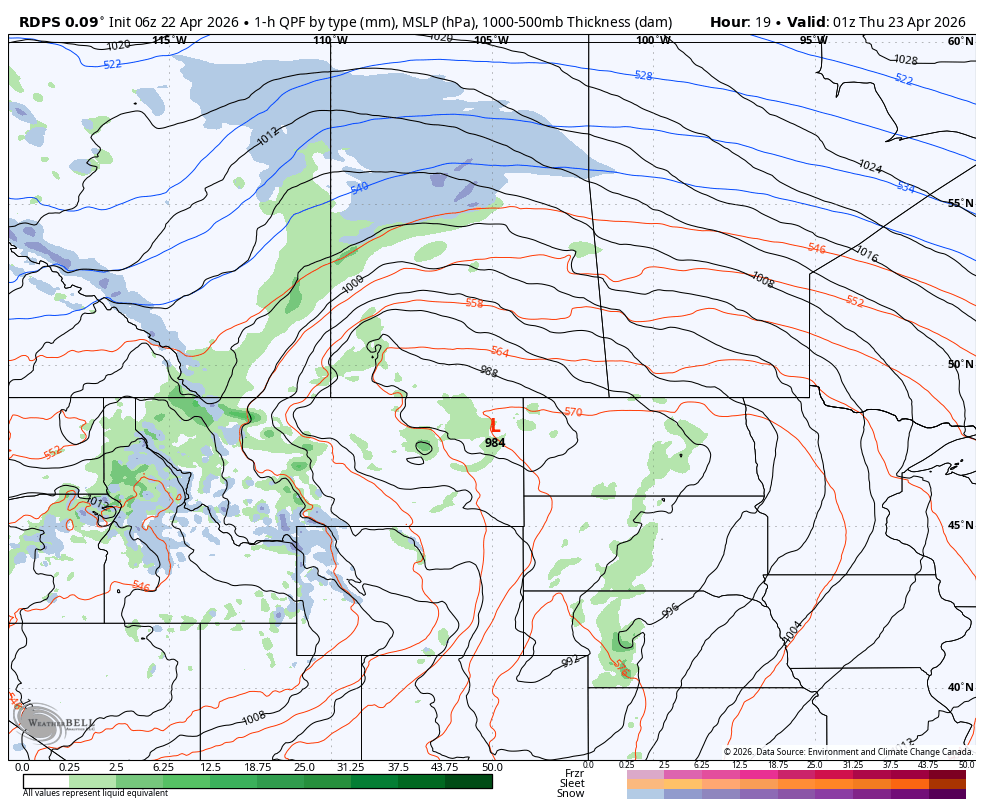
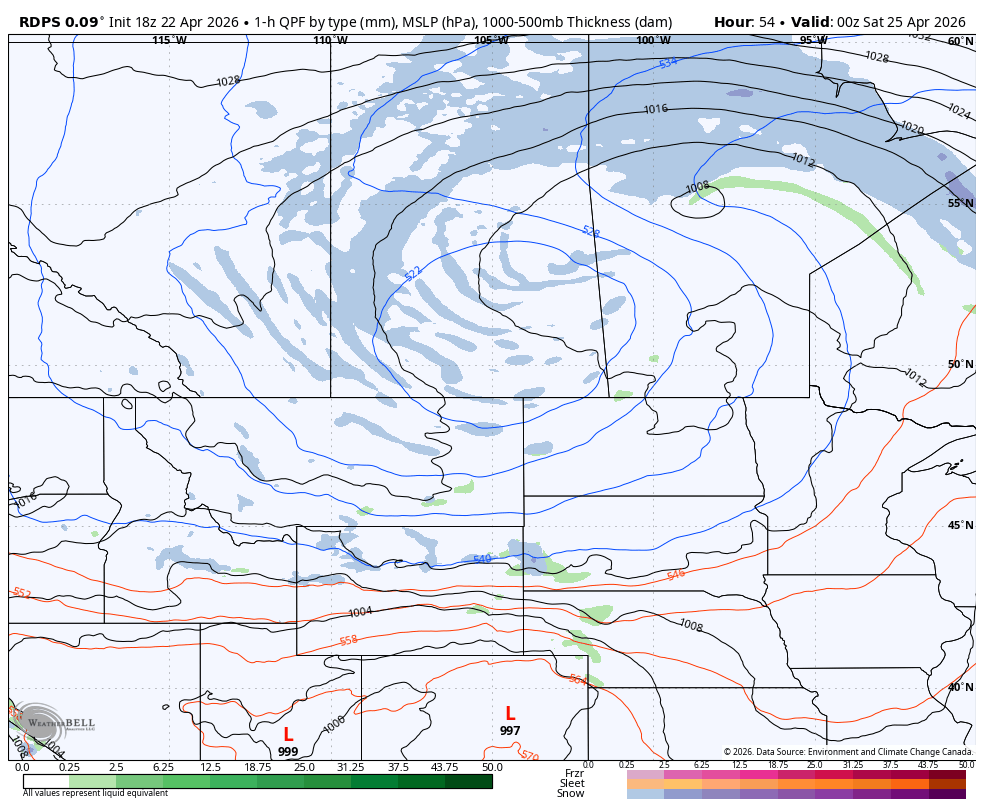
The rdps model showing precipitation type and intensity at 12pm cst/1pm CT on Wednesday, courtesy of WeatherBell.

The rdps model showing precipitation type and intensity at 7pm cst/8pm CT on Wednesday, courtesy of WeatherBell.

An area of light to moderate rainfall began to move into Northern Saskatchewan from Alberta on Wednesday morning, which then started to transition to snow before the lunch hour.

Through the afternoon and into the evening, the area of snowfall will expand and spread eastward as the low strengthens and becomes more organized. Meanwhile, the trailing rainfall will make its way into Central and Southern Saskatchewan.

The snowfall will be fairly light at first, but there is expected to be some pockets of more moderate snowfall during the evening. However, things will really start to ramp up as we get later in the evening and continuing into the overnight hours, just as the leading edge of the storm will start to cross into Northern Manitoba.

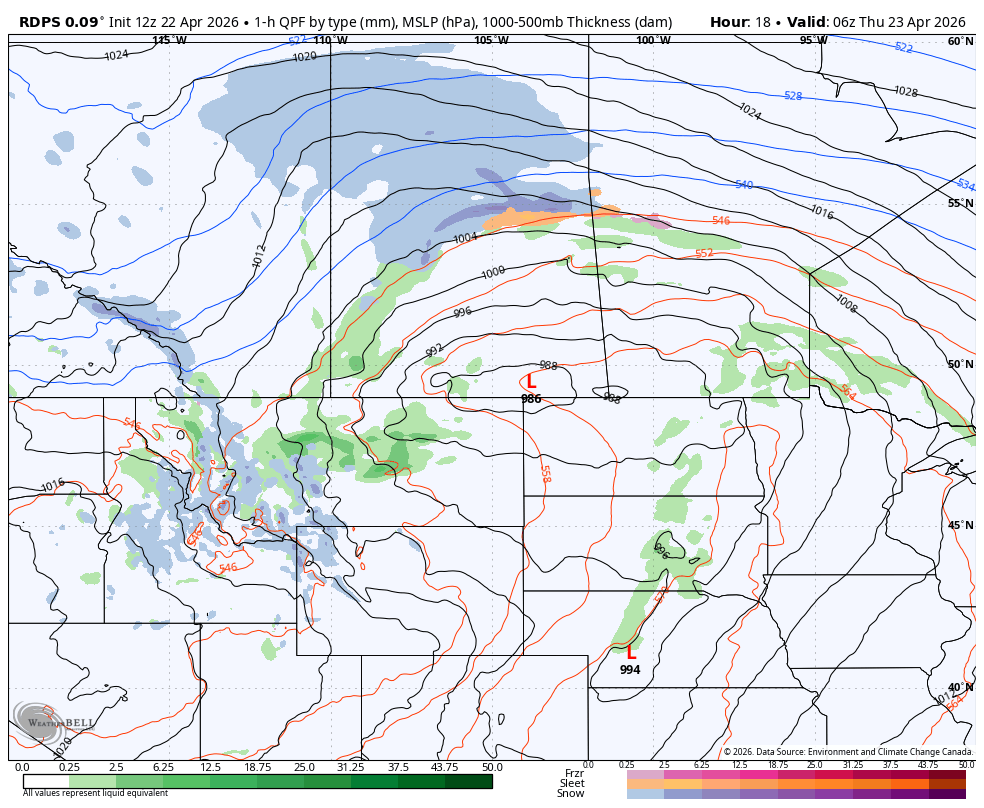
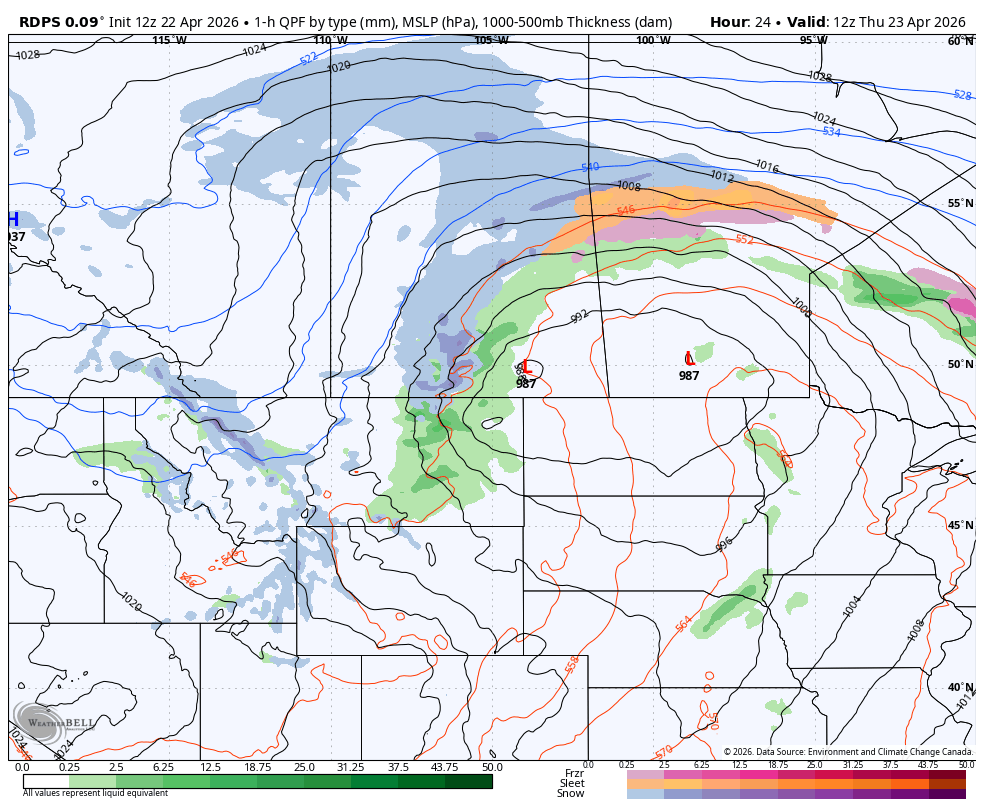
The rdps model showing precipitation type and intensity at 12am cst/1am CT on Thursday, courtesy of WeatherBell.

The rdps model showing precipitation type and intensity at 6am cst/7Am CT on Thursday, courtesy of WeatherBell.

This is when the heaviest snow will start to develop, falling at a rate of up to 3cm/hr, and it is expected to persist well into the afternoon across a significant swath of Northern Saskatchewan.

Meanwhile, the heavy rain that is expected to track through West Central and Southwest Saskatchewan overnight Wednesday will start to transition over to snow Thursday morning, as cold air from the Arctic is pulled in around the backside of the system. A quick 5-15cm of snow will be dumped over much of this region by the late afternoon/early evening, at which time this area of snowfall will begin to dissipate.

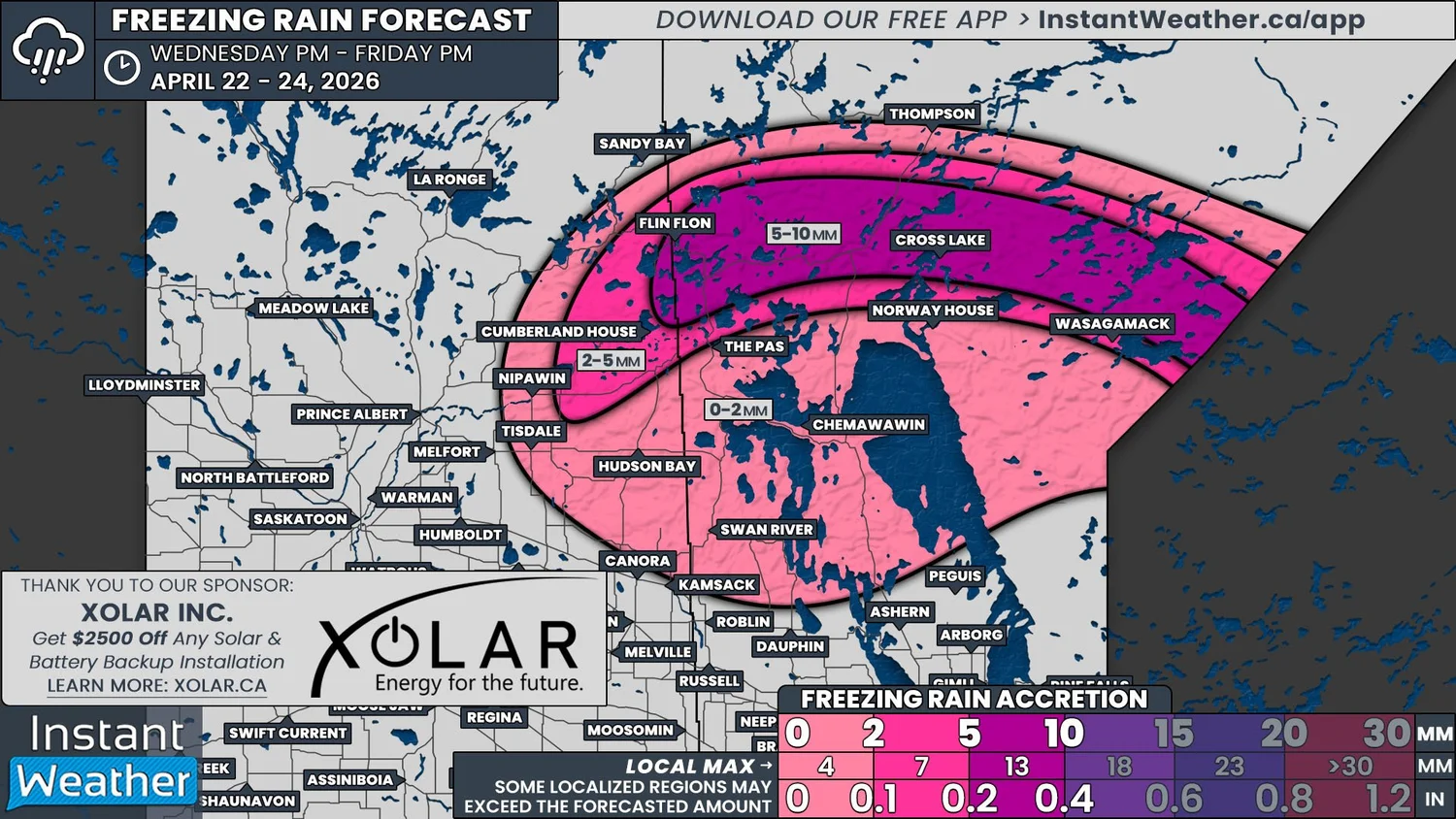
Also during the early morning hours, freezing rain and ice pellets will be added to the mixture of rain and snow in Northeastern Saskatchewan and into Northern Manitoba. The freezing rain could be quite heavy at times across a fairly narrow path that stretches from approximately Cumberland House and Flin Flon to the Ontario border.

Ice accretions above 5mm, and even as high as 10mm, are possible by the early afternoon Thursday, which has prompted Environment Canada to issue Winter Storm and Freezing Rain Warnings alongside the Snowfall Warnings. This is a significant amount of ice buildup that will likely damage both trees and powerlines and could lead to prolonged power outages for the area, so be prepared.

NOTE: YOU CAN CLICK ON THE MAP TO OPEN A ZOOMABLE IMAGE

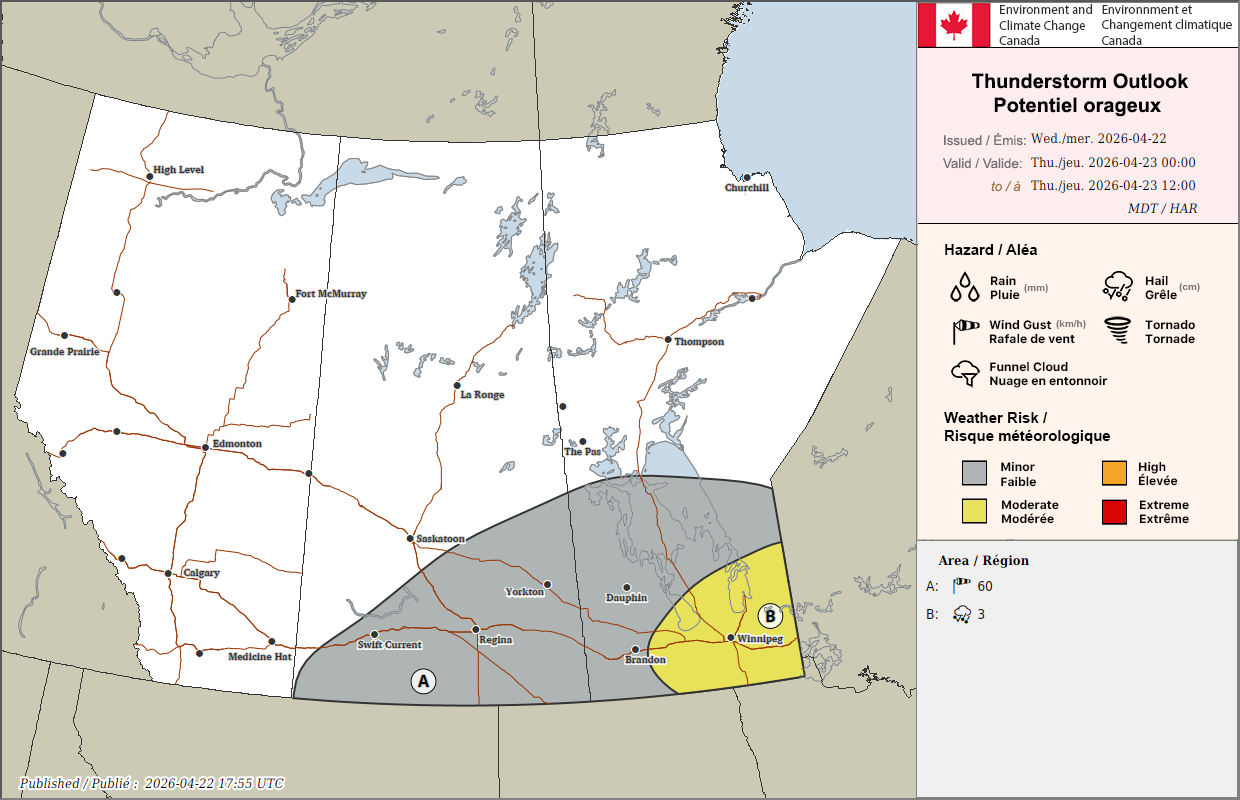
Environment Canada Thunderstorm Lookout Map for Thursday morning

The situation across Southern Manitoba and into the Southeast corner of Saskatchewan will be remarkably different. Late Wednesday evening and into the early morning hours of Thursday, there will be the risk of some elevated thunderstorms, particularly to the east of Brandon, that could have the potential to produce up to Toonie-sized hail.

Temperatures will then climb into the upper teens and low 20s in the afternoon in this region before the cold front slides through during the late afternoon and evening. This will trigger development of additional, marginally severe thunderstorms from Winnipeg eastward.

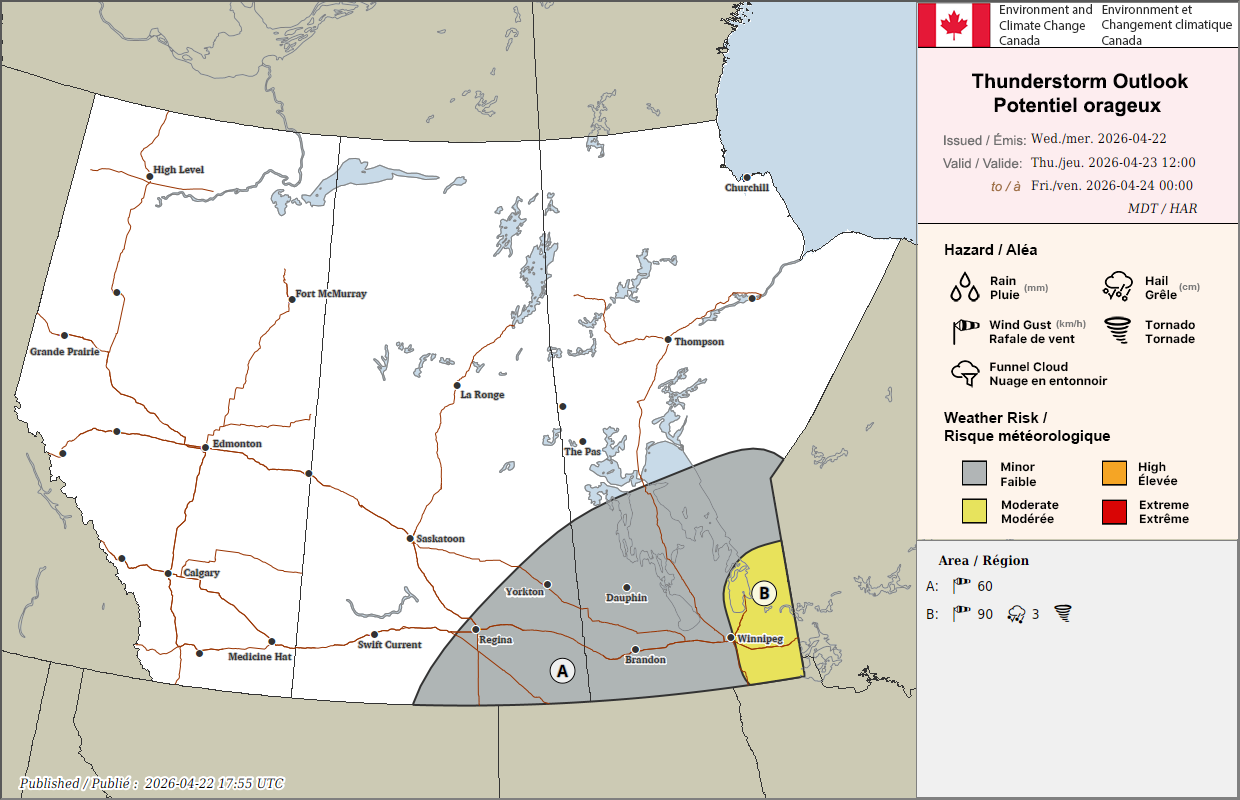
Environment Canada Thunderstorm Lookout Map for Thursday Afternoon and evening

The thunderstorms will likely form in lines, but an individual supercell or two could be possible. These storms may produce strong wind gusts up to 90km/h, Toonie-sized, and the possibility of a tornado can not be ruled out.

As of Wednesday afternoon, this thunderstorm development is conditional on a few factors so if, when, and where they might occur could change. We will definitely be watching the situation closely.

Outside of this area, to the north and west, there is a lesser risk from thunderstorms throughout the day, with strong wind gusts being the main concern. We will go into more detail about the wind later in the forecast.

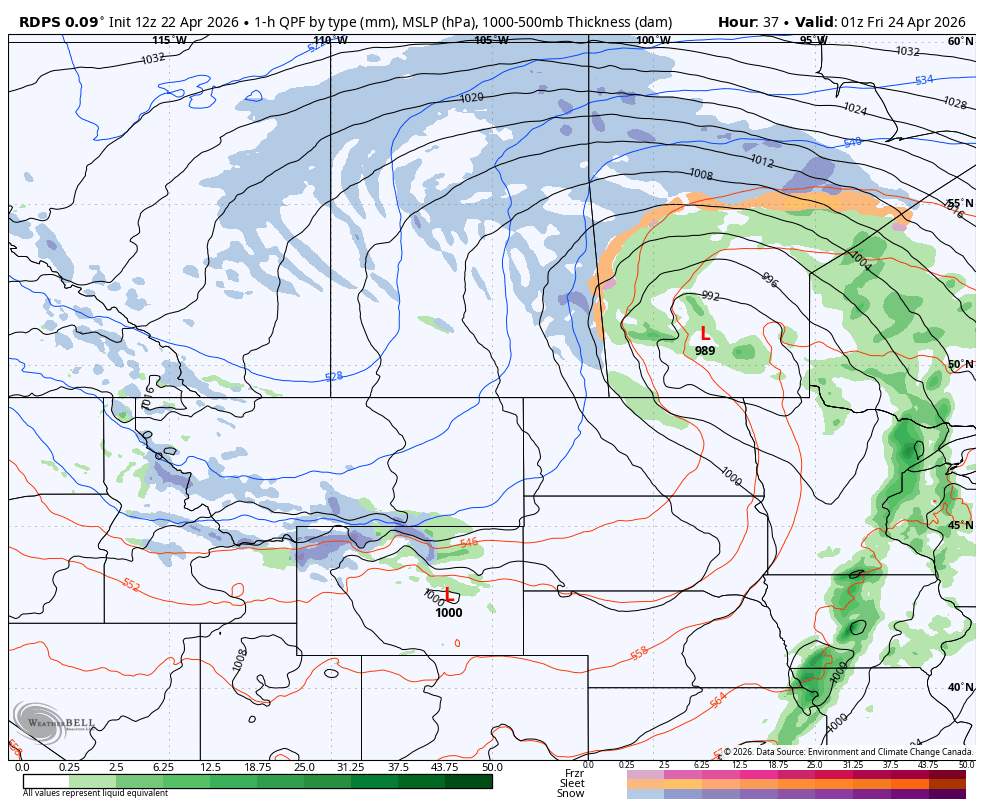
The rdps model showing precipitation type and intensity at 7pm cst/8pm CT on Thursday, courtesy of WeatherBell.

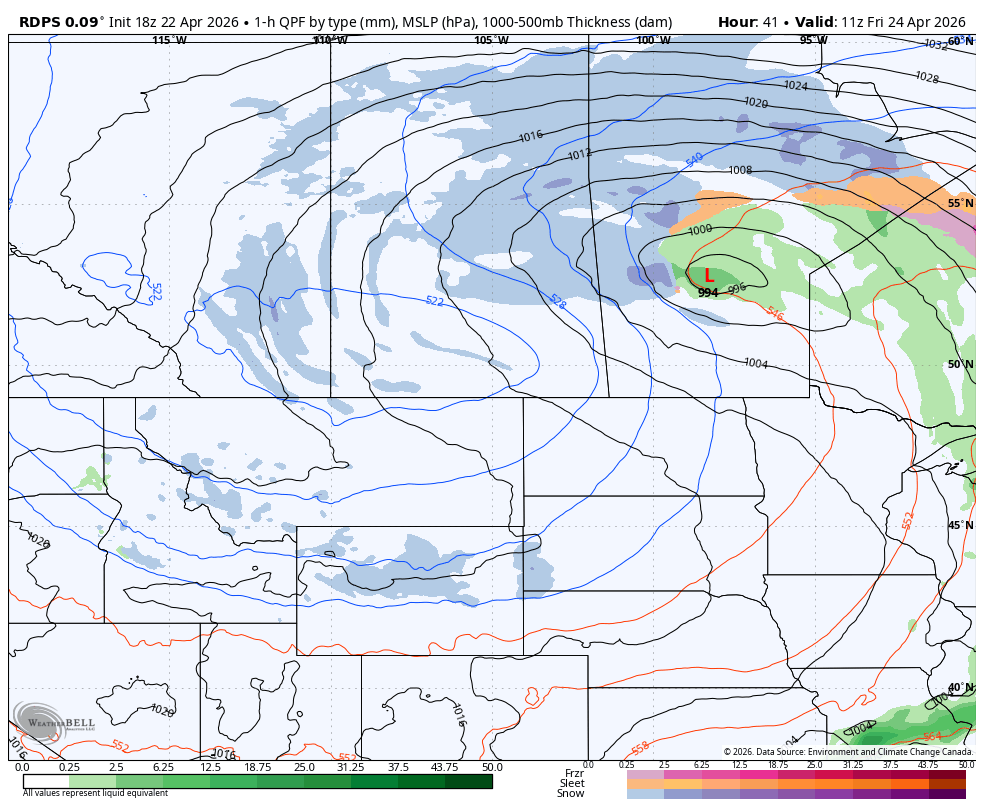
The rdps model showing precipitation type and intensity at 5Am cst/6Am CT on Friday, courtesy of WeatherBell.

As we get into Thursday evening, the system begins to lose some organization in Saskatchewan, while the heavier snow sets up in Northern Manitoba.

Overnight, the low will start to track northward and it will continue along with path through the day Friday. During this time, there is a possibility of brief freezing drizzle in Central Manitoba, but very little ice would build up.

The heavy snow will continue to fall in Northern Manitoba into the afternoon, while large areas of lighter snow will wrap around the low and settle over Saskatchewan for the majority of the day.

By Friday evening, the entire system will start to fall apart and the snow will taper off overnight. A few flurries will linger through Saturday morning, which may add a centimetre or two to the total accumulations across both Saskatchewan and Manitoba.

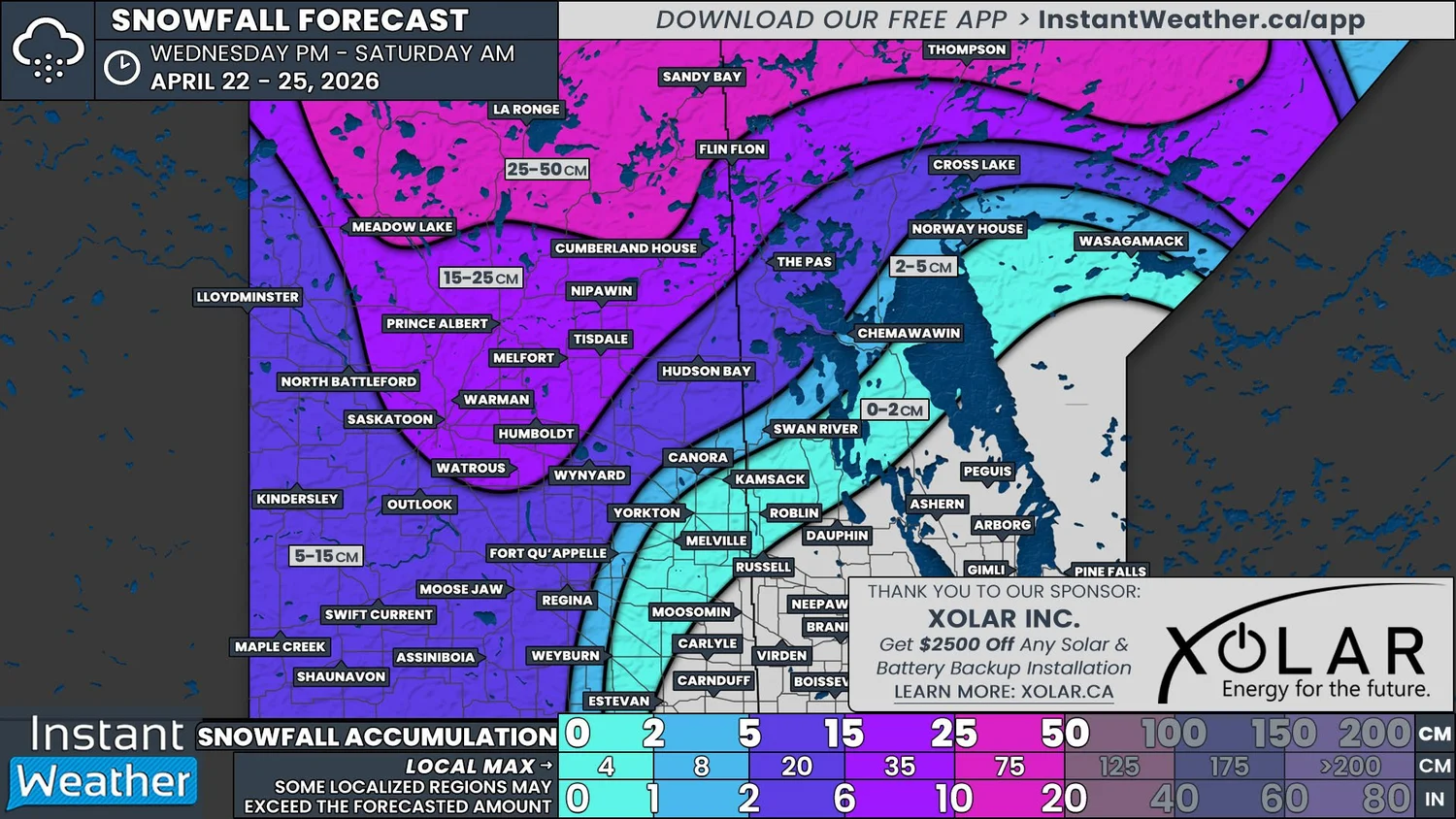
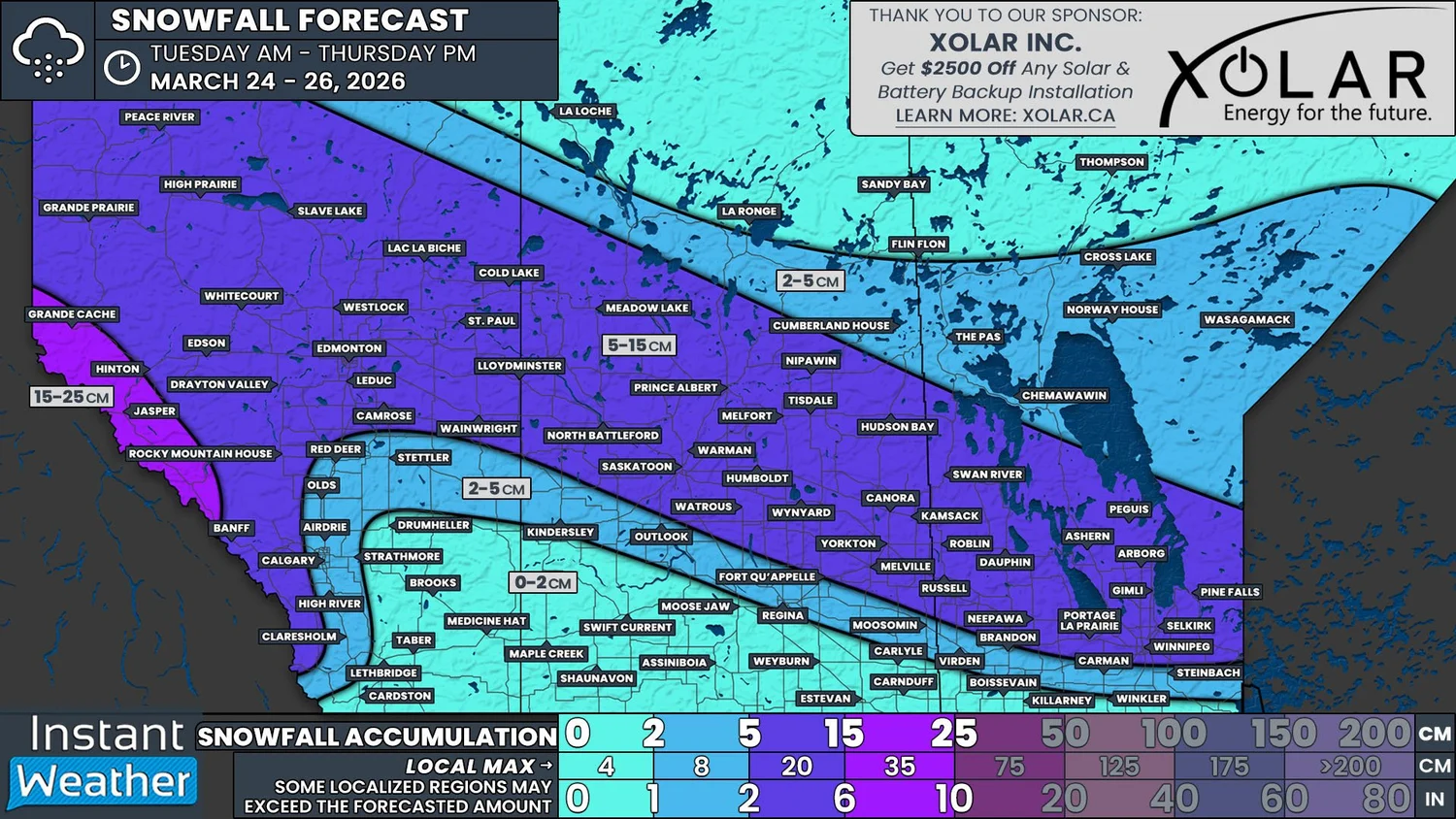
By the time the storm has finished, a total of 25-50cm of fresh snow is expected to fall across a large stretch of Northern Saskatchewan and Manitoba. An area of 15-25cm will extend southward into Central Saskatchewan while most of the rest of the province will be in the 5-15cm range.

Heavy rain is also a concern for areas to the south of the heaviest snowfall. Rainfall totals approaching 30mm could lead to some localized flooding, especially in areas where the ground is still partially frozen.

The rdps model showing precipitation type and intensity at 6pm cst/7pm CT on Friday, courtesy of WeatherBell.

Precipitation will not be the only hazard this storm brings; strong wind gusts will also be a concern.

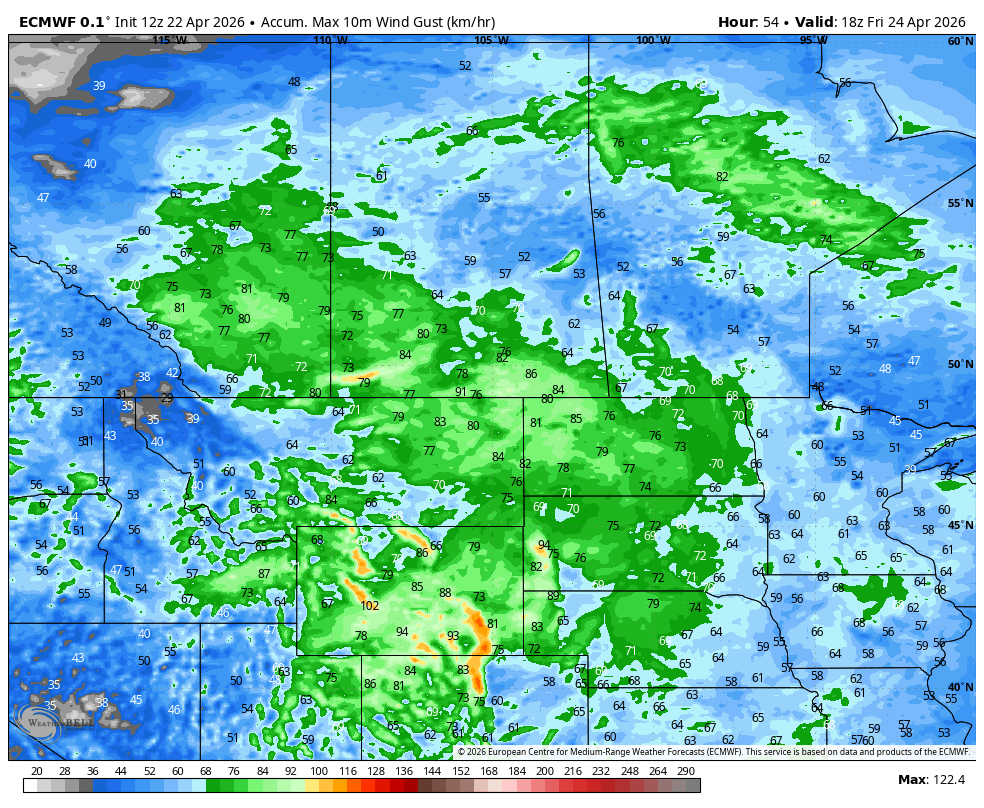
Strong wind gusts up to 90km/h, and possibly up to 100km/h in the Cypress Hills area, will develop this evening in Southeastern Alberta and Southwest Saskatchewan. These strong winds will continue in this region through to the morning before they start to travel eastward. They will cross Southern Saskatchewan through the day and into Southwest Manitoba by the evening, before they die down overnight.

Further north, where the heavy snow is slated to fall, the winds will not be quite as strong, topping out at around 70km/h. This still poses a major issue as it will likely lead to widespread whiteouts, and even crossing the threshold of being a blizzard, across Northern Saskatchewan and Manitoba. These will be treacherous conditions to attempt to travel in this region, so it will be best to postpone any unnecessary travel until the storm is over.

The ECMWF model showing Maximum Wind gust by 12pm CST/1PM CT Friday, courtesy of WeatherBell.


Winter's Last Hurrah? Prairies Brace for Up to 15cm of Snow as Atmospheric River Arrives Tuesday

NOTE: YOU CAN CLICK ON THE MAP TO OPEN A ZOOMABLE IMAGE

The calendar may say that it’s Spring, but it appears that Mother Nature may have missed the memo. An incoming system, courtesy of the atmospheric river funnelling moisture into British Columbia, will blast across the Prairies on Tuesday and Wednesday, dumping 5-15cm over a considerable swath of the region. It’s still too early to be certain, but this could very well be the last significant snowfall of the season for some parts of the Prairies.

The snow will begin to fall in the Rockies during the early morning hours of Tuesday. It will remain isolated to this area until the late morning/early afternoon, at which point the snow will start to spread deeper into Alberta.

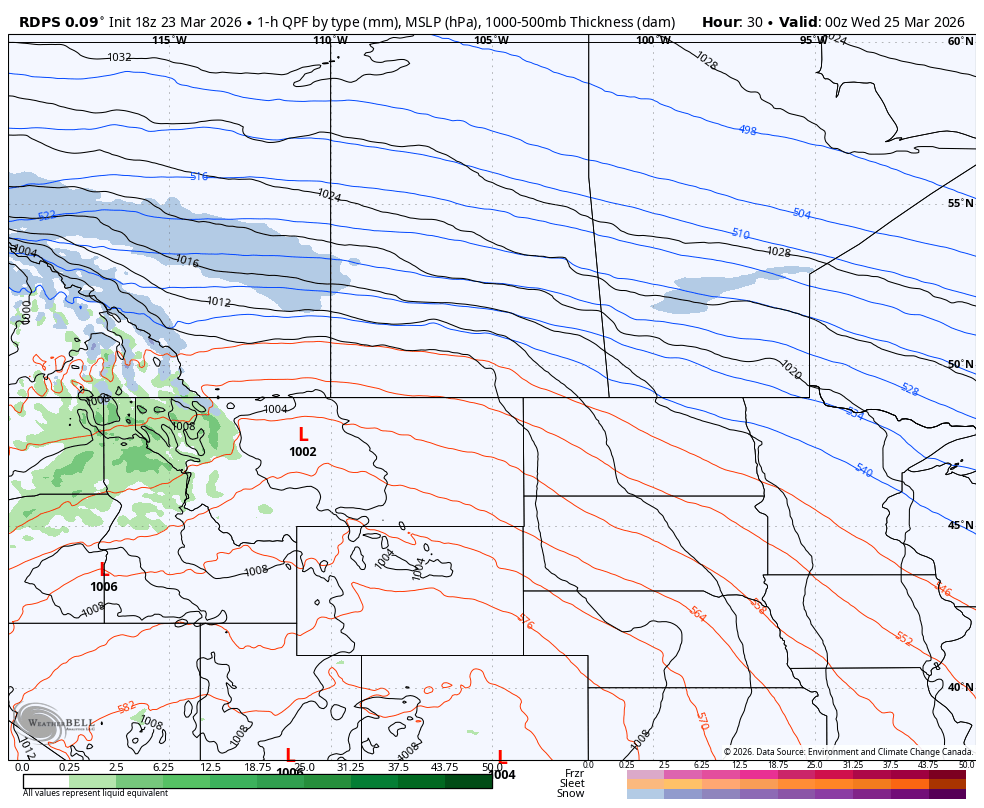
The rdps model showing precipitation type and intensity at 6Pm MT/7pm CT on Tuesday, courtesy of WeatherBell.

Through the afternoon and into the evening, the snowfall will orient along a rough northwest-southeast axis, stretching approximately from Grande Prairie to Lloydminster.

The leading edge of the snow will cross into Saskatchewan early Tuesday evening, spreading southeastward across the province throughout the rest of the evening and reaching the Manitoba border around midnight. It’s likely that there will be some light snow falling in parts of Southern Manitoba Tuesday evening, ahead of the main system, which could result in a few centimetres of accumulation before the majority of the accumulation arrives later.

There is the possibility of isolated pockets of freezing rain along the southern edge of the snow in Southern Saskatchewan and Manitoba throughout the day Wednesday, as the moisture interacts with areas with above freezing temperatures. The threat from the freezing rain is minimal overall, with only a millimetre or so expected, but it could be enough to make untreated surfaces a bit slippery.

The rdps model showing precipitation type and intensity at 2m MT/3pm CT on Wednesday, courtesy of WeatherBell.

The snow will begin to taper off in Alberta Wednesday morning, ending from west to east throughout the day. There could be some lingering light snow in Southern Manitoba overnight and into Thursday morning, but it is expected to end by the lunch hour.

This system will bring upwards of 15cm of snow across all three Prairie provinces, from Grande Prairie to Pine Falls. The snow isn’t expected to be too heavy, falling at rates up to 2cm/hr, but the possibility of some localized intensification may result in snowfall totals exceeding 15cm, especially in East Central Saskatchewan.

In the Rockies, the snow will fall continuously for the longest period of time, which will lead to accumulations of 15-25cm by Thursday afternoon. The greatest amount of snowfall occurring here poses a unique issue as it compounds the preexisting avalanche risk through the region and it also hinders the cleanup from avalanche control efforts that happened over the weekend.

Those who are south of the snow won’t be completely unaffected by the system as it moves through the region. On Wednesday, strong winds are expected to develop in Southeastern Alberta and Southwestern Saskatchewan. Wind gusts in the 60-80km/h range are likely for a few hours before they weaken later in the afternoon and into the evening.

The rdps model showing wind gusts at 11am MT/12pm CT on Wednesday, courtesy of WeatherBell.

We will be watching how this system develops through the day on Tuesday because a slight shift in the track could lead to significant changes to the forecast downstream, especially as it tracks into Manitoba. In the event that the path of the storm deviates from what is anticipated as of Monday evening, we’ll be sure to keep you updated.


Deep Freeze Continues Across the Prairies Thursday Night With Wind Chills Dropping Below -45°C

NOTE: if you click or tap on this image you can zoom in

Frigid Arctic air continues to blanket the Prairies, which has led to temperatures plummeting across the region. Dangerously low air temperatures and wind chill values will once again reach their lowest point of the day during the early to mid-morning on Friday, with many areas expecting to be colder than Thursday morning.

Air Temperature

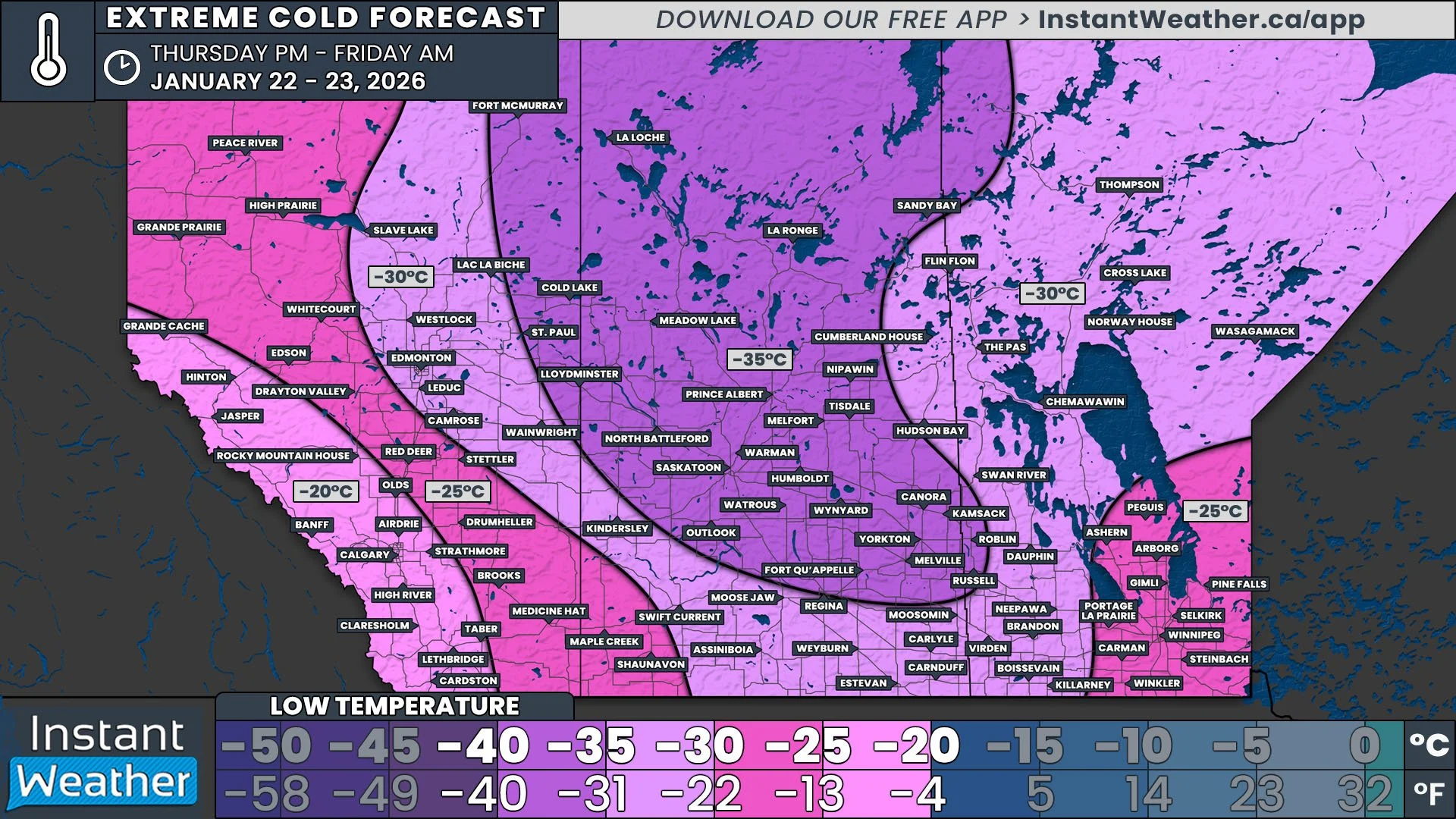
Alberta can once again expect to be the most mild of the three provinces tonight and tomorrow morning, relatively speaking. However, it will be several degrees colder tonight and tomorrow morning. A majority of the province will see low temperatures drop into the -20°C to -30°C range. East Central and Northeastern Alberta will be in the colder air, with Edmonton falling below -30°C while Lloydminster and Fort McMurray are expected to dip below -35°C.

In Saskatchewan, the “warmest” air will again be found in the Southwest, where the lows are expected to range from -25°C to -30°C. A large portion of the rest of Southern Saskatchewan will drop to into -30°C and -35°C range Thursday morning. Further north, including both Regina and Saskatoon, temperatures will fall below -35°C, though they should stay above -40°C.

Manitoba will experience more variation in low temperatures Thursday night and Friday morning than overnight Wednesday. Much of the province is expected to bottom out between -30°C and -35°C. Slightly warmer air over Southeastern Manitoba, including in Winnipeg, will keep temperatures above -30°C. At the same time, some slightly colder air will nudge into the Parkland Region, bringing temperatures in Roblin and Russel just below the -35°C mark.

NOTE: if you click or tap on this image you can zoom in

Wind Chill

Sustained wind levels will vary across the Prairies overnight Thursday and Friday morning. The winds will be fairly light across Alberta and Western Saskatchewan, ranging from calm to 15km/h, which will bring several degrees. The situation will be much more drastic in Eastern Saskatchewan and Manitoba. Here, sustained winds are expected to higher, at around 15-30km/h, and gusts up to 50km/h, which will drive wind chills much lower.

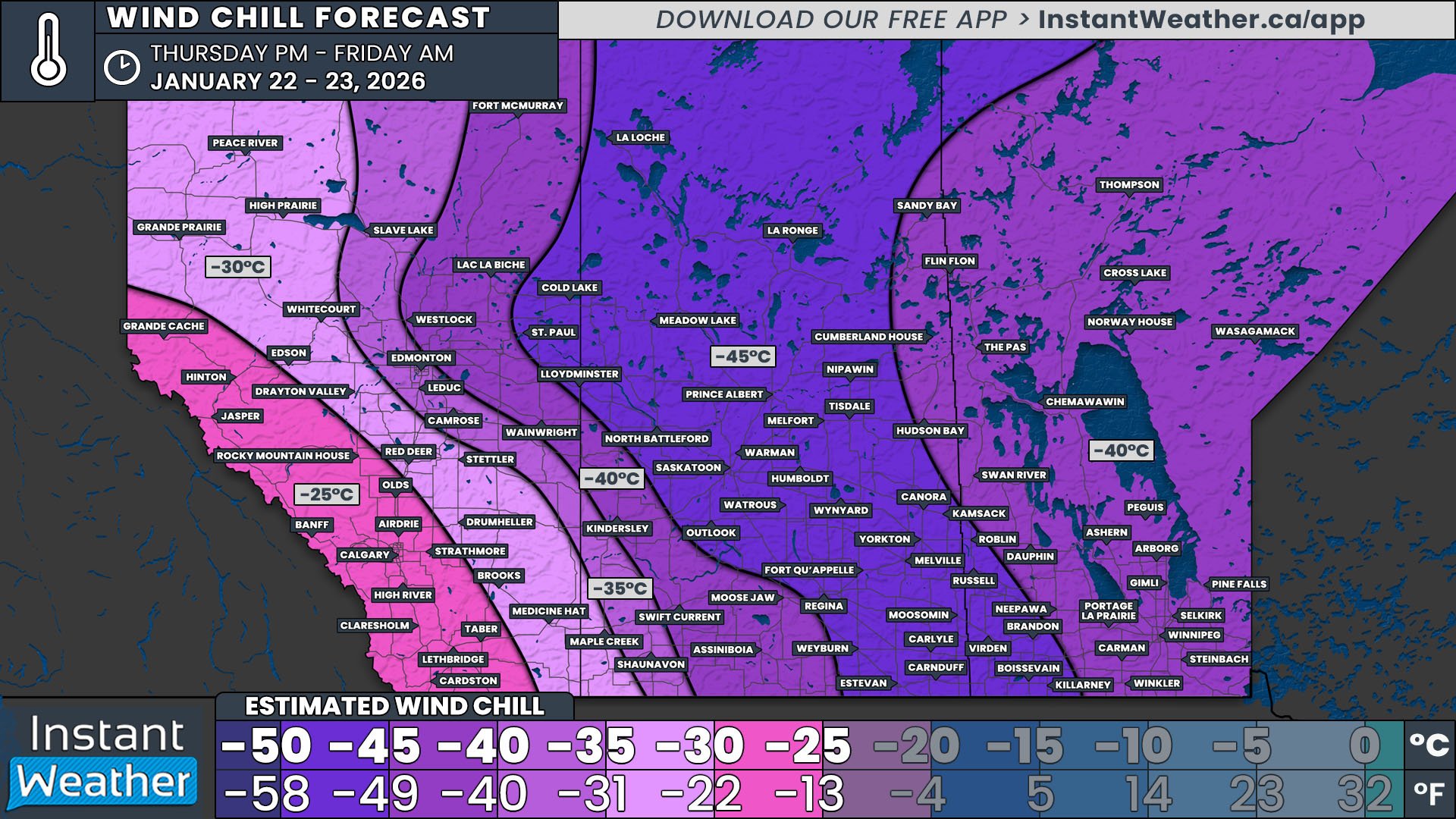
In Alberta, the comparatively milder temperatures will also translate to the least extreme wind chills, thanks to the light winds. Wind chill values will be approximately 5-10°C cooler than the air temperature, dropping steadily travelling northeast. It will feel colder than -25°C in Calgary and the Rockies, -30°C in Red Deer and Grande Prairie, -35°C in Edmonton, -40°C in Fort McMurray, and -45°C in Cold Lake and Lloydminster.

Most of Saskatchewan will be dealing with very harsh wind chill values Friday morning. Wind chills across much of the province, including Regina and Saskatoon, will make it feel colder than -45°C. Some weather models are even suggesting that the wind chill could possibly dip below -50° at times throughout Friday morning. There will be a slight reprieve in the Southwest, with Moose Jaw and Kindersley feeling like below -40°C and Maple Creek feeling like below -30°C.

Manitoba will see fairly uniform wind chill values, despite the increased variation in air temperatures. For most of the province, wind chills values will range between -40°C and -45°C. Wind chills will dip below -45°C in Southwestern Manitoba, where the winds will be the strongest.

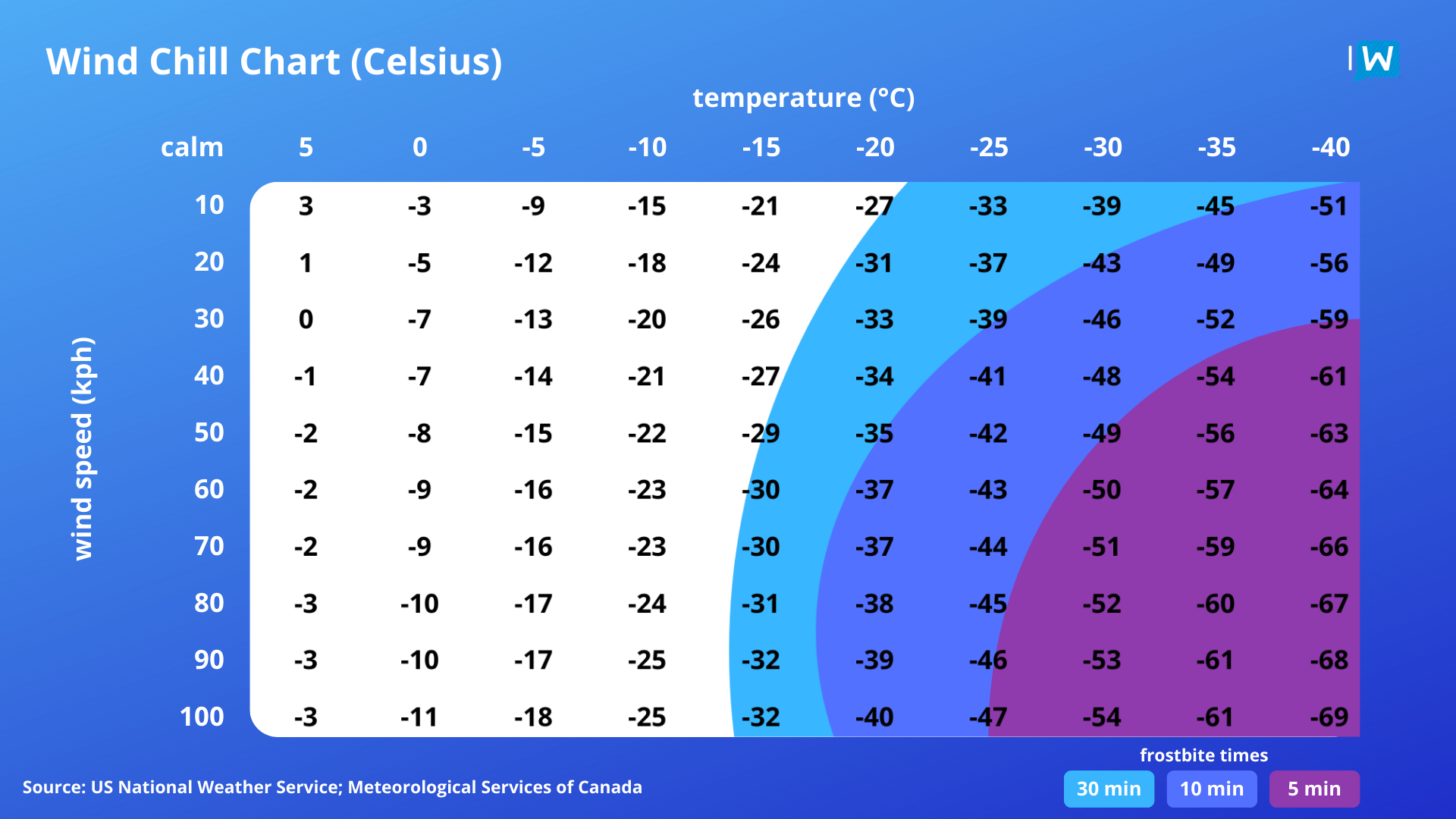
Wind chills values and frostbite times based on air temperatures and wind speeds.

With the wind chill values this low, it’s important to remember that frostbite can develop in as little as 10 minutes on exposed skin. Limiting time outdoors will be important, especially during the coldest part of Thursday morning. If you do need to be outside, dress in multiple warm layers and cover as much exposed skin as possible. Pets should be kept inside and it is also a good idea to keep an eye on any pipes that could be vulnerable to freezing during this prolonged cold.

This stretch of extreme cold is expected to continue for at least a few more days, with little relief during the day. It’s looking like we will be back into regular cold weather by Monday morning. In the meantime, we will continue share updates on just how cold it is expected to get.

Dangerous Multi-Day Arctic Cold Arrives Wednesday Night Across the Prairies With Wind Chills Dropping Below -40°C

NOTE: if you click or tap on this image you can zoom in

Bitterly cold Arctic air is flooding south into the Prairies, sending temperatures plunging across the region. The first taste of the bitter cold temperatures will be overnight Wednesday and into Thursday morning. The worst of the cold, both in terms of air temperatures and wind chill, is expected to from the mid to late morning on Thursday, with many areas dealing with dangerously low values.

Air Temperature

Alberta can expect to be the most mild of the three provinces tonight and tomorrow morning, but this is very relative given how cold it will still be in some parts of the province. A majority of Southern Alberta, the Rockies and the Foothills will see low temperatures drop into the -10°C to -20°C range. As you move northeast, the air becomes colder, with Edmonton falling below -20°C. Cold Lake is expected to dip below -25°C, while Fort McMurray will have temperatures falling below -30°C.

In Saskatchewan, the “warmest” air will found in the Southwest, where the lows are expected to range from -20°C to -25°C. A large portion of the rest of Southern Saskatchewan, including Regina, will drop to into -25°C and -30°C range Thursday morning. Further north, including Saskatoon and surrounding areas, temperatures will fall below -30°C, though they should stay above -35°C.

Manitoba will see some of the most consistently cold air across the Prairies.. Much of the province is expected to bottom out between -30°C and -35°C. The main exception to this will be the extreme southwestern corner of Manitoba, where temperatures are expected to stay slightly warmer, hovering just above the -30°C mark.

NOTE: if you click or tap on this image you can zoom in

Wind Chill

While many who live in the Prairies are used to cold temperatures in the winter, the wind will make the next few days feel even more harsh.

Brisk winds have been sustained at up to 30km/h across the Southern Prairies, but they will luckily ease throughout the remainder of the evening ahead of the coldest air. By the time the temperatures reach their lowest point Thursday morning, sustained winds should be lighter, at around 10-20km/h. Even so, with air this cold, it does not take much wind to bring wind chill values down significantly.

In Alberta, the comparatively milder temperatures will also translate to the least extreme wind chills. The winds will be very light through the Rockies and into the Foothills, limiting wind chill in those areas. Farther northeast, wind chills will drop steadily. It will feel colder than -20°C around Red Deer, -25°C in Edmonton, and -35°C in Cold Lake and Fort McMurray.

Most of Saskatchewan will be dealing with harsh wind chill values Thursday morning. Wind chills across much of the province will make it feel colder than -35°C. Regina and Saskatoon are both expected to see wind chills in the -40°C to -45°C range, while parts of Northern and Central Saskatchewan could see values approaching -50°C at times during the morning.

Manitoba will see fairly uniform wind chill values, much like the air temperatures.

There will be a bit of relief in the Northeast, where winds will be lighter, but for most of the province, wind chills values will range between -40°C and -45°C. Parts of Central Manitoba could see wind chills dip below -45°C, where winds are a bit stronger.

Wind chills values and frostbite times based on air temperatures and wind speeds.

With the wind chill values this low, it’s important to remember that frostbite can develop in as little as 10 minutes on exposed skin. Limiting time outdoors will be important, especially during the coldest part of Thursday morning. If you do need to be outside, dress in multiple warm layers and cover as much exposed skin as possible. Pets should be kept inside and it is also a good idea to keep an eye on any pipes that could be vulnerable to freezing during this prolonged cold.

This stretch of extreme cold is expected to continue into the weekend, with little relief during the day. We will continue to share updates on just how cold it is expected to get, along with when a slight warm up may arrive.

Blizzard Conditions Expected as High Impact Winter Storm Targets the Prairies Wednesday With Up to 30cm of Snow

NOTE: if you click or tap on this image you can zoom in

The next Clipper to cross the Prairies, the latest in the seemingly never-ending train of such systems, is setting up to be the most impactful of the season so far. This system will bring 15+cm of snow to all three provincial capitals, along with blizzard conditions to parts of Southern Saskatchewan and Manitoba Wednesday and into Thursday. There has been little change in the projected track of the Clipper since we shared our preliminary forecast Monday evening so many of the details remain the same and total snowfall accumulations have become clearer.

Alberta

Snow has fallen throughout the day Tuesday in the Rockies and this will continue into the evening and overnight. Late Tuesday evening, the snow will begin to expand southeastward from Northwestern Alberta as the low pressure center associated with the system starts to make its way into the province. The leading edge of the snow will cross Alberta through the early morning hours, reaching the Saskatchewan border shortly before sunrise.

The rdps model showing precipitation type and intensity at 5Am MT on Wednesday, courtesy of WeatherBell.

The snow will be fairly light to moderate for most of the impacted areas of Alberta. A majority of Southern Alberta can expect less than 5cm since the precipitation will start off as a mixture of rain and freezing rain, possibly for several hours, due to the temperatures hovering around the freezing mark. However, there will be a switch over to snow as the temperatures drop, leading to the freezing of wet surfaces and minimal snow accumulation.

To the north, the lack of warm air and more consistent snowfall will result in greater accumulations. A large swath of Central Alberta and into Northern Alberta can expect 5-15cm of fresh snow, falling at rates of 1-2cm/hr during the late morning and early afternoon. In the Edmonton area and southeastward through Wainwright to the Saskatchewan border, heavier snow is expected to fall, possibly exceeding 3cm/hr, leading to rapid accumulation above 15cm.

In the early afternoon, the snow will begin to taper off from northwest to southeast across Alberta and it will gradually exit the province during the evening.

NOTE: if you click or tap on this image you can zoom in

The rdps model showing precipitation type and intensity at 12Pm CST on Wednesday, courtesy of WeatherBell.

Saskatchewan

As the system makes its way through Saskatchewan, the situation becomes quite a bit messier. The leading edge of the precipitation will start to push through the province during the morning mostly as snow, but with rain, freezing rain, and ice pellets in the mix through the warmer air that will be present in Southern Saskatchewan. The freezing rain could last for several hours, resulting in a few millimetres of ice buildup on untreated surfaces. However, as the low tracks eastward during the afternoon, cold air will wrap around and result in a freezing of wet surfaces and a period of snow that follows.

Meanwhile, across Central Saskatchewan, as the snow moves through the province, it will intensify. Heavy snowfall rates up to 4cm/h during the afternoon and evening will result in the widespread quick accumulation of 15-30cm over an area that includes both Saskatoon and Regina.

The rdps model showing precipitation type and intensity at 7Pm CT on Wednesday, courtesy of WeatherBell.

Manitoba

The snow will finally start to cross into Manitoba in the late morning. There will be a much smaller pocket of warm air that will be isolated to the southwest corner of the province, so while there will be a chance for a brief period of freezing rain in Manitoba, the risk won’t be as prolonged or as widespread as in Saskatchewan.

The area of heavier snowfall will spread from Central Saskatchewan into Central Manitoba through the afternoon and evening, where it will also result in a widespread 15-30cm of fresh snow, including in Winnipeg.

During the evening, the system will begin to shift and start to track more southward as it also loses some intensity. This will bring the main band of snow into Southeastern Saskatchewan and Southern Manitoba overnight and through Thursday morning.

In Saskatchewan, the snow will taper off starting shortly after midnight and exit the province by around sunrise. The snow will continue for a few extra hours in Manitoba, starting to dissipate during the early morning hours and eventually finishing in the southeast corner of the province in the afternoon.

NOTE: if you click or tap on this image you can zoom in

This only covers the snowfall aspect of this storm, but there is one major factor left to consider: the wind. Strong winds are expected to develop Wednesday morning and continue through the afternoon and evening before dying down overnight across the Prairies. We’re looking at widespread wind gusts over 60km/h and likely exceeding 100km/h, particularly in Southern Alberta and Saskatchewan. There is even the possibility of damaging wind gusts that approach 130km/h in parts of Southern Alberta!

While the most intense gusts will not coincide with the area where the heaviest snow is expected to fall, gusts above 60km/h will be more than enough for blizzard conditions to develop across Central Saskatchewan and into Central Manitoba starting in the afternoon and lasting into the overnight hours. This will likely result in large stretches of multiple highways being closed due to very poor visibility along with rapid accumulation of snow on the road surfaces.

For the rest of the region, where the wind gusts could be stronger, even a little bit of snowfall could severely impact visibility throughout the day.

Travelling in these conditions can extremely dangerous so please plan ahead, try to limit any travel, and stay safe!
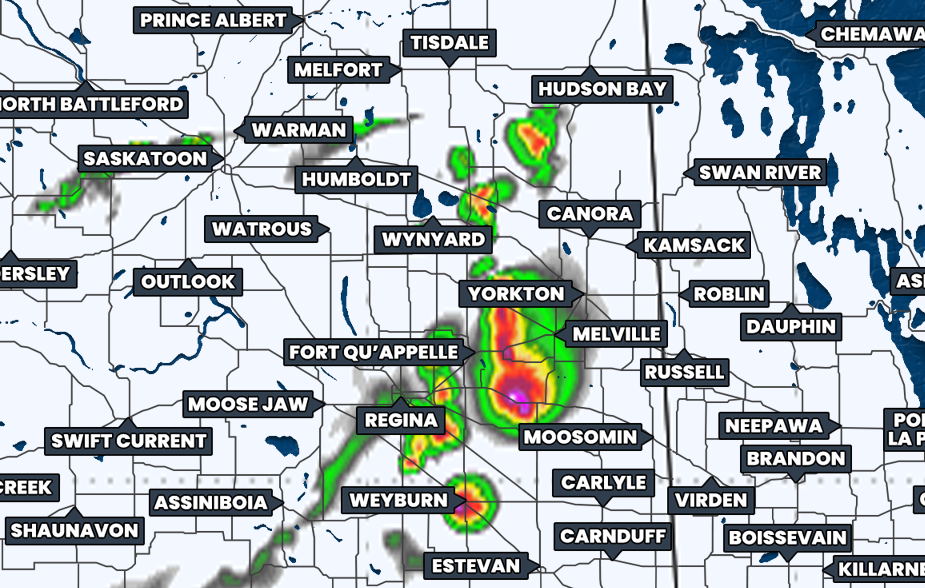
NOTE: if you click or tap on this image you can zoom in

First Look at the Major Snowstorm Set to Impact the Prairies This Week

NOTE: if you click or tap on this image you can zoom it

After a seemingly constant stretch of back-to-back clippers bringing brief blasts of snow, we’re finally looking at a proper snowstorm across the Prairies this week. While this will be another clipper, it will be much more impactful, bringing periods of heavy snow to Edmonton, Saskatoon, Regina, and Winnipeg. Here’s a preliminary look at roughly what can be expected, but keep in mind that exact timing and snowfall amounts will likely change between now and the start of the event.

The snow is set to begin late Tuesday or very early Wednesday morning in the Rockies and Northern Alberta before gradually spreading eastward with the trajectory of the associated low. The leading edge of the snow will cross into Saskatchewan before sunrise Wednesday and then into Manitoba by the late morning or early afternoon.

NOTE: if you click or tap on this image you can zoom it

The snowfall should be fairly moderate as it tracks across Alberta before it starts to taper off in the evening. To the east, on the other hand, the snow is expected to intensify Wednesday afternoon in Saskatchewan and in the evening in Manitoba, leading to a significant swath of up to 30cm of heavy snowfall by the noon hour on Thursday.

To complicate matters further, strong winds with gusts exceeding 100km/h are expected across the Southern Prairies beginning Wednesday afternoon and continuing overnight. This will very likely lead to white-out conditions, possibly even reaching the threshold to be considered a blizzard, in Southern Saskatchewan and Manitoba that will probably result in highway closures.

It’s also worth noting that in the warm sector, along the southern edge of the snow, there will be the possibility of a mixture of rain, freezing rain, and ice pellets which would be followed by snow as the temperatures fall. We will have more information on this risk, along with further details regarding the entire storm in our full forecast that will be posted Tuesday evening.

NOTE: if you click or tap on this image you can zoom it

Widespread 5–15cm of Fresh Snow to Blanket the Southern Prairies Early This Week

NOTE: if you click or tap on this image you can zoom it

As we get closer to the start of the storm expected to cross the Prairies and weather models have come closer in agreement, we now have more confidence to discuss the potential impacts over the next couple of days. This storm will travel eastward along the international border, which will limit most of the snowfall to southern portions of all three Prairie provinces.

Alberta

The snow will make its way into Southwestern Alberta after midnight, gradually spreading eastward across the province during the early and mid-morning hours. It’s during this time that there is also a risk of freezing rain for communities closer to the border, but it will quickly be replaced by snow. Meanwhile the scattered flurries remaining from Sunday through Calgary to Red Deer are also expected to organize and intensify, joining the snow further to the south.

The rdps model showing precipitation type and intensity at 7am MT on Monday, courtesy of WeatherBell.

As we get later in the morning, there will likely be some intensification and increased snowfall rates along the Highway 3 corridor and southward, which will result in greater overall accumulation. By lunchtime, the snow will begin to taper off to the north of Calgary and then from west to east starting in the early afternoon and exiting the province completely in the evening.

A widespread 5-15cm of snow is predicted by the end of Monday across Southern Alberta and areas that experience the heavier snowfall closer to the border could be on the higher end of that range. There could be pockets where accumulation totals could approach 20cm to the south of Highway 3, but this is much more likely to occur east of Highway 36.

The rdps model showing precipitation type and intensity at 7pm CT on Monday, courtesy of WeatherBell.

Saskatchewan

The leading edge of the snow will move into Southwest Saskatchewan in the mid-morning and it will spread eastward across the province through the day. There is also the slight risk for some freezing rain along the border to the south of Maple Creek and Shaunavon, but it should be over quickly.

The snowfall across Saskatchewan will be fairly short-lived and by the time the snow reaches the Manitoba border in the evening, it will actually start to taper off back along the Alberta border. Throughout the remainder of the evening, overnight and into Tuesday morning, the snow will gradually end from west to east.

Similarly to in Alberta, much of Southern Saskatchewan can expect at least 5cm of snow by midday Tuesday. There will also be heavier snowfall from Maple Creek to Estevan, mostly along Highway 13 and southward. This particular region will likely see snowfall totals around 20cm and Environment Canada may issue a snowfall warning to reflect this.

The rdps model showing precipitation type and intensity at 7am CT on Monday, courtesy of WeatherBell.

Manitoba

By the time the snow makes its way into Manitoba Monday evening, the entire system is expected to shift course and start moving more in a southeast direction as it interacts with another low pressure system from the States. As a result, the steady moderate snowfall will not extend as far east through the province. Regardless, the snow will still make its way across Southern Manitoba overnight and into Tuesday morning. It will slowly start to taper off from west to east around sunrise, gradually ending for border communities in the Eastman Region Tuesday evening.

The system will also start to weaken as it makes its way into Manitoba, so the heavier snowfall expected in both Alberta and Saskatchewan is looking like it won’t be as much of a concern. There will still be a swath of the region that can expect more than 5cm of snow by the end of Tuesday, but it is likely that this won’t exceed 10cm.

It is possible that this change in direction is more subtle than showing on weather models or doesn’t occur at all. We will watch as the system takes shape and makes its way through Alberta and Saskatchewan. If it appears that the track will change from what was initially expected, it’s likely that we will update our forecast for Manitoba.

As it stands, a decent amount of snow is expected to fall across the Southern Prairies. This snow will be heavy in some areas, which will likely make travel a headache, especially on some of the busier highways. Be sure to give yourself plenty of extra time if travelling during these periods of heavy snowfall and stay safe.

What's in a Name? Choosing the Right Tires to Drive you Through Canadian Winters

Tread patterns of summer, all season and winter tires. Image courtesy of discount tire.

Now that it’s the first week of November, many Canadians are starting to think about putting winter tires on their vehicles. There have been pockets of unseasonable warmth across the country in October and with it now being the start of November, the inevitable chill of winter is in the air, and many have already seen snow fall.

While winter tires are recommended throughout the country, they are mandatory in Quebec from December 1st to March 15th, and from October 1st to April 30th on certain British Columbia highways. Additionally, studded tires are allowed almost nationwide, with the exception of residents of Southern Ontario.

Insurance companies across the country offer discounts for installing winter tires as an incentive to encourage drivers to reduce the risk of accidents. So what makes winter tires that much better in the cold and snow than summer tires and where do all season and all weather tires fit into the mix?


With the right tools, it can be pretty easy to change your own tires!
Summer Tires

Summer tires are designed to handle both wet and dry road conditions with their wide tread and soft rubber. These tires also usually have deeper grooves that improve traction on wet roads and reduce hydroplaning, making them ideal for the wet spring and summer months.

Winter Tires

Like their name suggests, winter tires have been designed for winter roads. They are made with rubber that stays flexible at temperatures below 7°C (45°F), the magic number at which other tires become stiff and lose traction, greatly reducing their performance. Furthermore, winter tires have different tread patterns that are meant to divert water and slush to the sides, as well as little slits called sipes that increase the overall grip of the tires and helping them maintain contact with icy road surfaces. Over the past several years, tire manufacturers have started to include additional small particles, like crushed glass or walnut shells, that act as little studs on the surface of the tire for extra grip.


Performance of All Season Tires vs Winter Tires with decreasing temperatures. Image courtesy of Discount Tire.

All Season & All Weather Tires

Some people argue that winter tires aren’t necessary if they have all season tires on their vehicle. Unfortunately, this is a slight misnomer because while these tires can handle a bit of cold and snow, they fail to handle heavier snowfalls that are common in Canadian winters. All season tires, unfortunately, sacrifice traction in wet conditions that would be found in summer tires and some of the flexibility and grip seen with winter tires in order for the tread to last longer. Realistically, these should be called 3 season tires as opposed to all season. So while they’re not the best option for winter driving in Canada, all season tires are definitely a better choice than regular summer tires.

All weather tires, not to be confused with all season tires, are a true year-round tire designed to handle Canadian winters. Unlike all season tires, these tires remain soft and flexible well below 7°C. The tread pattern on all weather tires is a combination of all season and winter tires, making them better suited for driving through heavier snow than all season tires. While they still don’t match the performance of a true winter tire, all weather tires are the best option for those who don’t want the hassle of swapping out their tires twice per year or simply do not have the space to store an extra set. Their versatility truly makes all weather tires a middle of the road tire (pun intended) for Canadian drivers.


The three-peak mountain snowflake symbol found on winter and all weather tires. Image courtesy of Canadian tire.

When looking for tires to get you through the winter, it is recommended to chose either a proper winter tire or an all weather tire, so long as it has the three-peak mountain and snowflake symbol on the sidewall. This is an industry standard symbol which indicates that the tire meets strict regulations for winter performance; becoming mandatory on all winter tires beginning in 2018, transitioning away from just using the M+S (Mud and Snow) designation.

Note: The author formerly received payments from “Big Tire” however, this article was not funded.


Further Reading

https://www.canadiantire.ca/en/how-to/automotive/how-to-choose-winter-tires.html

https://www.continental-tires.com/ca/en/tire-knowledge/winter-tire-laws-in-canada/

https://www.continental-tires.com/ca/en/tire-knowledge/winter-tire-markings/

https://www.discounttire.com/learn/tires-below-45

https://www.discounttire.com/learn/winter-summer-allseason

Severe Thunderstorms Possible for Manitoba Thursday, But Risk Remains Questionable

NOTE: YOU CAN CLICK ON THE MAP TO OPEN A ZOOMABLE IMAGE

The southern half of Manitoba, particularly in the southeast, could see some severe thunderstorms today when a cold front tracks through the region. However, in typical Manitoba fashion, whether storms end up even developing today is very questionable.

The cold front will begin to move through Southern Manitoba early this afternoon and it should reach the Winnipeg area around the late afternoon or early evening hours. Normally, a cold front is more than enough to trigger severe thunderstorms, but the issue is that there is expected to be a significant amount of capping in the atmosphere today, which would greatly inhibit thunderstorm development.

Due to this capping, there is considerable disagreement between weather models regarding when and where thunderstorms could end up forming today. There are those that show storms initiating in Southern Manitoba beginning in the late afternoon, while other models have storm development beginning much later, once the cold front has crossed into Northern Ontario. To cover this range in possibilities, our forecast has a Slight risk from the Red River Valley to the Ontario border.

The hrdps model showing thunderstorms to the south and east of lake Winnipeg at 6pm CT, courtesy of WeatherBell.

If storms end up developing in Manitoba later today, they will likely start off as isolated supercell thunderstorms along the front that should then quickly merge into a line of storms that continues tracking eastward. These could end up being quite strong storms, especially since the same cold front triggered strong severe thunderstorms in Central Saskatchewan yesterday which produced some very damaging winds, large hail, and even a few tornado warnings.

The risks in Manitoba today are much the same if the storms end up developing here: very strong wind gusts that could be well in excess of 100km/h, hail up to the size of tennis balls, and torrential downpours that could lead to localized flooding. There is also the possibility of an isolated tornado, especially closer to the Ontario border.

We will be keeping an eye on how the situation unfolds today and if storms end up forming within the province later today, we will provide updates and probably livestream.

Widespread Severe Thunderstorm Threat Across the Prairies Friday into Saturday, Tornado Risk in All Three Provinces

NOTE: YOU CAN CLICK ON THE MAP TO OPEN A ZOOMABLE IMAGE

The same system that brought some severe thunderstorms to Central and Northern Alberta yesterday, albeit much weaker than originally anticipated, could once again trigger severe thunderstorms today. This time, however, we’re looking at two distinct areas across the Prairies where severe thunderstorms could impact.

The first area of concern is across the southern half of Manitoba and in Eastern Saskatchewan, along the provincial border.

Isolated thunderstorms could start to develop along Saskatchewan-Manitoba border, especially in the area from Hudson Bay to Cumberland House, around the lunch hour. These storms should then track eastward into Manitoba fairly quickly and they could become severe while still in Saskatchewan. If the storms remain sub-severe as the enter Manitoba, it’s very likely that they will still strengthen to become severe as they continue eastward throughout the afternoon and evening.

Additional thunderstorm development could continue southwestward, back into Southeast Saskatchewan, throughout the afternoon. These storms are also expected to track eastward across Manitoba through the evening and overnight, leading to the widespread severe risk.

It’s worth noting that thunderstorm development throughout this entire area is slightly questionable. The environment will be primed with heat, moisture and instability, but there’s the possibility that capping in the atmosphere will prevent them from even forming in the first place. If this cap breaks, however, we could be looking at some explosive thunderstorm development.

Any storms that do develop will likely have the potential to produce golf ball-sized hail or larger, damaging wind wind gusts in excess of 100km/h, and heavy downpours that could lead to some localized flooding. There is also the risk of a tornado forming from storms that could move through Southwestern Manitoba and into the Interlake and Red River Valley in the evening. It’s possible that the tornado risk could extend into Winnipeg, but there is some uncertainty with how far east it goes.

Simulated radar from the HRRR model shows the possible location of storms at 5pm CT, courtesy of Weather Bell.

Meanwhile, there will also be the risk for severe thunderstorms to form in Southern Alberta, along the cold front that continues to push southward through the province.

Scattered thunderstorms could start to develop as early as the mid afternoon throughout the Foothills, mostly to the south of Red Deer. While some of the storms that could develop may become severe, those that develop from Airdrie to Claresholm will be the ones worth watching today.

It’s not until a bit later in the afternoon and into the evening that this area could see the development of thunderstorms. These particular storms will likely strengthen quickly into strong, long-track supercell thunderstorms that will travel eastward across Southern Alberta through the evening. It’s entirely possible that these supercell thunderstorms could maintain their strength through the evening and overnight as they push deep into Saskatchewan, possibly reaching as far east as Moose Jaw, and maybe even into Regina, in the early morning hours.

The threat from the severe storms in Alberta and into Saskatchewan today is very similar to yesterday, with the potential for golf ball-sized hail, damaging wind gusts in excess of 100km/h, heavy downpours that could lead to localized flooding, and even the possibility of a tornado. However, considering that yesterday’s High Risk from Environment Canada and expectations from weather models didn’t quite materialize, we’ve opted to go with a Slight Risk for Southern Alberta and Saskatchewan today. However, the possibility is still there for strong storms to develop so be mindful of any Watches or Warnings that may be issued.

Strong Severe Storms Possible in Central Alberta & Saskatchewan, Uncertainty Further East and into Manitoba

NOTE: YOU CAN CLICK ON THE MAP TO OPEN A ZOOMABLE IMAGE

There are two areas across the Prairies where there is the risk of severe thunderstorms today. The difference between these two areas, however, is the likelihood of storm development, with storms in Central Alberta and Saskatchewan looking much more likely to occur than those in Eastern Saskatchewan and into Manitoba.

A cold front that will track through Alberta and Saskatchewan today is expected to begin triggering thunderstorm development early this afternoon in West Central Alberta. These storms should intensify into a line of strong severe thunderstorms as they approach the QE2 corridor, particularly around Red Deer.

This line of storms should maintain its strength for several hours, travelling eastward across Alberta through the afternoon. The storms will then cross into Saskatchewan by the late afternoon/early evening and continue their eastward trajectory, gradually weakening later into the evening and overnight.

Borderline destructive wind gusts of up to 120km/h are possible from Red Deer eastward towards Saskatoon as the line of severe thunderstorms move through the region. Furthermore, hail as large as golf balls and localized flooding are concerns, along with the possibility of one or two embedded tornadoes.

Additional scattered thunderstorms could pop up behind the main line in both Alberta and Saskatchewan throughout the day and continuing overnight, but these storms are expected to be weaker. For those attending the Stampede today, there is the chance for an isolated storm, but the greatest risk for severe weather will remain to the north.

Meanwhile, there is also the risk of severe thunderstorms in Eastern Saskatchewan, along the Manitoba border, and eastward into Manitoba as the cold front makes its way into this area. In particular, parts of Southern Manitoba could be the main target of these storms.

Modelled CAPE (Convective available potential energy) as of 5PM CT highlighting southwestern Manitoba as the area with the most energy

All the ingredients for severe thunderstorms are expected to be in place today in this area, with heat and energy funnelling northward throughout the day ahead of the arrival of the front. Despite this, a strong cap will also be in place, so whether or not storms actually form remains questionable. Short-term weather models are not even showing any thunderstorms developing in this area, further cementing the uncertainty here.

IF thunderstorms end up breaking through the cap, it’s not expected to occur until the evening, but the storms could become quite strong. Large hail will be the main concern with these potential storms, with golf ball-sized or larger appearing possible. Strong wind gusts and torrential rainfall, possibly leading to localized flooding, could also be associated with storms that develop. This situation will certainly bear monitoring throughout the day.

It’s also worth noting that temperatures across the Prairies, with the exception of most of Southern Manitoba, can expect to see more comfortable temperatures tomorrow following the passage of the cold front today.

Questionable Daytime Storms Followed By More Organized Nocturnal Threat in Saskatchewan & Manitoba Thursday

NOTE: YOU CAN CLICK ON THE MAP TO OPEN A ZOOMABLE IMAGE

The cold front which triggered severe weather across Alberta and into Western Saskatchewan yesterday will continue its track eastward today, bringing the risk of severe weather into Eastern Saskatchewan and Manitoba. Similar to yesterday, storm development is questionable throughout the afternoon and evening, with any storms that do develop likely to become severe. There is, however, a much stronger nocturnal risk in place for some areas.

The possibility of isolated thunderstorm development will begin in the mid-afternoon and continue through the evening, starting in Saskatchewan and extending eastward into Manitoba with the gradual movement of the cold front. Weather models disagree with where and when these storms might occur and there is a distinct lack of organization with the storms that do show on the models.

If thunderstorms end up developing during this time, the environment will lead them to likely become severe. These storms could end up being capable of producing hail as large as ping pong balls and strong wind gusts up to 100km/h. There is a small chance that one or two of these storms could produce a tornado, with the risk of this increasing for more southern storms.

The greatest severe thunderstorm threat arrives after midnight, as a large cluster of storms will likely move into Southeastern Saskatchewan and Southwestern Manitoba from south of the border. These storms are expected to be stronger than the ones that could develop during the day and they will track across Southern Manitoba through the early morning hours and eventually exiting into Ontario.

The nocturnal thunderstorms that move through this region may produce up to golf ball-sized hail and damaging wind gusts in excess of 100km/h. There will be a broad region of rain surrounding these thunderstorms and this could lead to some localized flooding as the storms track eastward.

Modelled temperature anomaly for Thurday shows Temperatures 5-10+°C above seasonal across most of Saskatchewan and Manitoba, courtesy of weatherbell.

We have also found ourselves in a bit of a heat wave across most of Saskatchewan and Manitoba for the next couple of days. Temperatures are expected to climb into the low and mid 30s across parts of the region today and tomorrow, which is 5-10°C above the seasonal average for this time of year. With the humidity, it could feel closer to 40°C in some areas.

While more comfortable temperatures move into Saskatchewan on Friday and then Manitoba on Saturday, and this not being nearly as hot as it can get in the summer months, it’s important to be mindful of dealing with the bit of heat while it’s here.

If you spend a great deal of time outdoors, it is crucial to stay hydrated by sipping on water throughout the day and aiming to drink at least one cup of water every 15 minutes, continuing to do so even after you’ve gone inside. We know that there is often nothing better than a cold beer on a hot day, but remember that alcohol is actually dehydrating so make sure to drink plenty of water as well if you indulge in your adult beverage of choice.

Your body loses electrolytes from sweating, so sports drinks that are high in electrolytes can help replenish what has been lost. Salty snacks are also helpful when it comes to regaining lost electrolytes.

Other tips for staying cool include wearing lightweight, light-coloured clothing and limiting direct sun exposure, if possible. Many municipalities offer public spaces with air conditioning where residents can go to cool off, especially those without central air in their homes/apartments.

This is surely not the last we’ll see of these temperatures this summer so keep these tips in mind and have a plan in place if you must spend long periods of time outdoors in the heat.

More Severe Thunderstorms Likely Across Central & Southern Manitoba Saturday

NOTE: YOU CAN CLICK ON THE MAP TO OPEN A ZOOMABLE IMAGE

After some severe thunderstorms and tornado warnings yesterday, we’re looking a similar setup as yesterday. A trough will continue moving through the province and it is expected to trigger more severe thunderstorms today.

Severe thunderstorms have already begun to move through the Interlake Region this morning, which are expected to continue to strengthen as they travel eastward. The greatest severe thunderstorm threat, however, looks to start in the early to mid afternoon and continue into tonight.

The afternoon storms could develop across a large swath of Central and Southern Manitoba. However, there has been disagreement between weather models regarding where exactly these storms could occur and how strong they might become.

Some models are showing that storms could begin developing in the early afternoon through the Parkland Region and southward, into parts of Westman and to the west of the Red River Valley. The timing of the storm initiation in the south is also a bit uncertain, with models suggesting it could occur sometime between 1pm and 5pm. There is also the likelihood of additional storms crossing into the Parkland area from Saskatchewan in the early evening.

Simulated Radar from the NAM model showing the possible line of thunderstorms moving through the Red River Valley at 5PM CT, Courtesy of Weatherbell.

The storms that manage to form are expected to rapidly gain strength as they chart a course eastward across the province. They are likely to become supercells and could end up merging into a large line of severe thunderstorms through the afternoon.

These intense thunderstorms will have the potential to produce golf ball or larger hail, damaging wind gusts in excess of 100km/h, and possibly a tornado. The risk of a tornado is less than yesterday, but the possibility can not be completely ruled out. These are expected to be moisture-laden and slow-moving thunderstorms, so localized flooding is definitely a concern as well.

Thunderstorm activity will gradually dissipate through the late evening hours as they approach and cross into Ontario. The severe thunderstorm threat is expected to conclude across Manitoba by midnight.

Severe Weather Threat Extends Across the Prairies Friday with Strong Risk and Tornadoes Possible in Parts of Saskatchewan & Manitoba

NOTE: YOU CAN CLICK ON THE MAP TO OPEN A ZOOMABLE IMAGE

It’s shaping up to be an active day across the Prairies today, with severe thunderstorms possible across all three provinces. In fact, today brings the strongest severe weather risk we’ve seen all week.

Most of the thunderstorms expected across the region will likely remain marginally severe, stretching from the Foothills in Alberta to the Manitoba-Ontario border. However, the bullseye for the most intense storms is over Southeastern Saskatchewan and Southwestern Manitoba.

Thunderstorms are expected to kick off in parts of the Southern Foothills early this afternoon. These storms will track east-northeastward, and additional development is likely through the mid-afternoon along a broad arc stretching eastward across Central Saskatchewan and into Central Manitoba later in the evening.

These widespread storms should persist into the night across the Prairies, especially the further east you go. Some of these storms could become severe and produce nickel-sized hail, along with strong wind gusts. There is also a risk of localized flooding due to heavy rain from slow-moving or training thunderstorms.

In Alberta, conditions could be favourable for funnel clouds to form. While most of these remain harmless, there is a low chance that one or two could touch down briefly as a weak landspout tornado.

Simulated Radar from the HRRR model showing the arc of thunderstorms at 6pm MT/CST & 7PM CT, Courtesy of Weatherbell.

The greatest threat for severe weather today, however, will be to the south of the main batch of storms in Sakatchewan and Manitoba. The model image above shows these additional storms having already developed in the evening. Thunderstorm development in this more volatile area is expected to begin slightly earlier, around 3-5pm. Storms in this region will track eastward, while the southern edge of the cluster in Saskatchewan will likely expand south-southwestward toward the US border.

This area is forecast to encounter a highly supportive environment for severe storms in Southeastern Saskatchewan, with the possibility of storms to rapidly develop into supercell thunderstorms. Some isolated supercells could also initiate within this environment, along the Saskatchewan-Manitoba and into Southwestern Manitoba.

The highest risk area stretches from Carlyle, SK eastward through Brandon, MB, and north from the US border to the Foxwarren radar site. Storms moving through this area could become quite strong, with the potential to produce golf ball or larger hail, damaging wind gusts in excess of 100km/h, and possibly one or two tornadoes. Intense rainfall is also likely, making localized flooding a concern in this region as well.

Simulated Radar from the HRRR model showing thunderstorms in North Dakota, as well as in Saskatchewan & Manitoba at 9pm CST & 10PM CT, Courtesy of Weatherbell.

There are a couple of factors that might limit storm strength in this region. Lingering morning rain and cloud cover could reduce daytime heating, which would decrease the available energy for storm development. Additionally, an area of low-pressure that will track through North Dakota today may pull some of that energy south of the border, weakening the storms on the Canadian side.

Regardless of how strong the storms become, they are expected to track eastward throughout the evening and into the overnight hours. By the time they reach the Red River Valley after midnight, the storms should be quite weak and likely dissipate entirely not too long after.

Severe Thunderstorms Possible in Parts of Manitoba Tuesday with Risk of Large Hail & Strong Winds

NOTE: YOU CAN CLICK ON THE MAP TO OPEN A ZOOMABLE IMAGE

Scattered severe thunderstorms are possible across parts of Southern and Central Manitoba today as a low pressure system moves through the region. Daytime heating will build the energy for these storms and for them to likely become severe beginning later in the afternoon and into the evening.

Thunderstorm activity is expected to start in the late afternoon, around 3-5pm, particularly in the North Eastman region, but also in Eastman. The storms will likely become severe and will persist for a few hours in the region as they travel eastward into Ontario.

Simulated Radar from the HRRR model showing 7pm CT and storms missing Winnipeg, Courtesy of Weatherbell.

There is some disagreement between short-term weather models, but it is possible that severe thunderstorms could also develop stretching southwestward into the Red River Valley at roughly the same time. On the other hand, this development could end up beginning slightly later, around 6pm. In the second scenario, it’s possible that storms could form closer to the US border, resulting in Winnipeg getting missed by the severe weather.

The main risks from today’s severe thunderstorms are hail that could be as large as ping pong balls and strong wind gusts up to 90km/h. The chance of a tornado forming from these storms is low.