Tornado Risk for Regina Area as Significant Severe Storm Risk Target Saskatchewan & Manitoba Saturday

NOTE: YOU CAN CLICK ON THE MAP TO OPEN A ZOOMABLE IMAGE

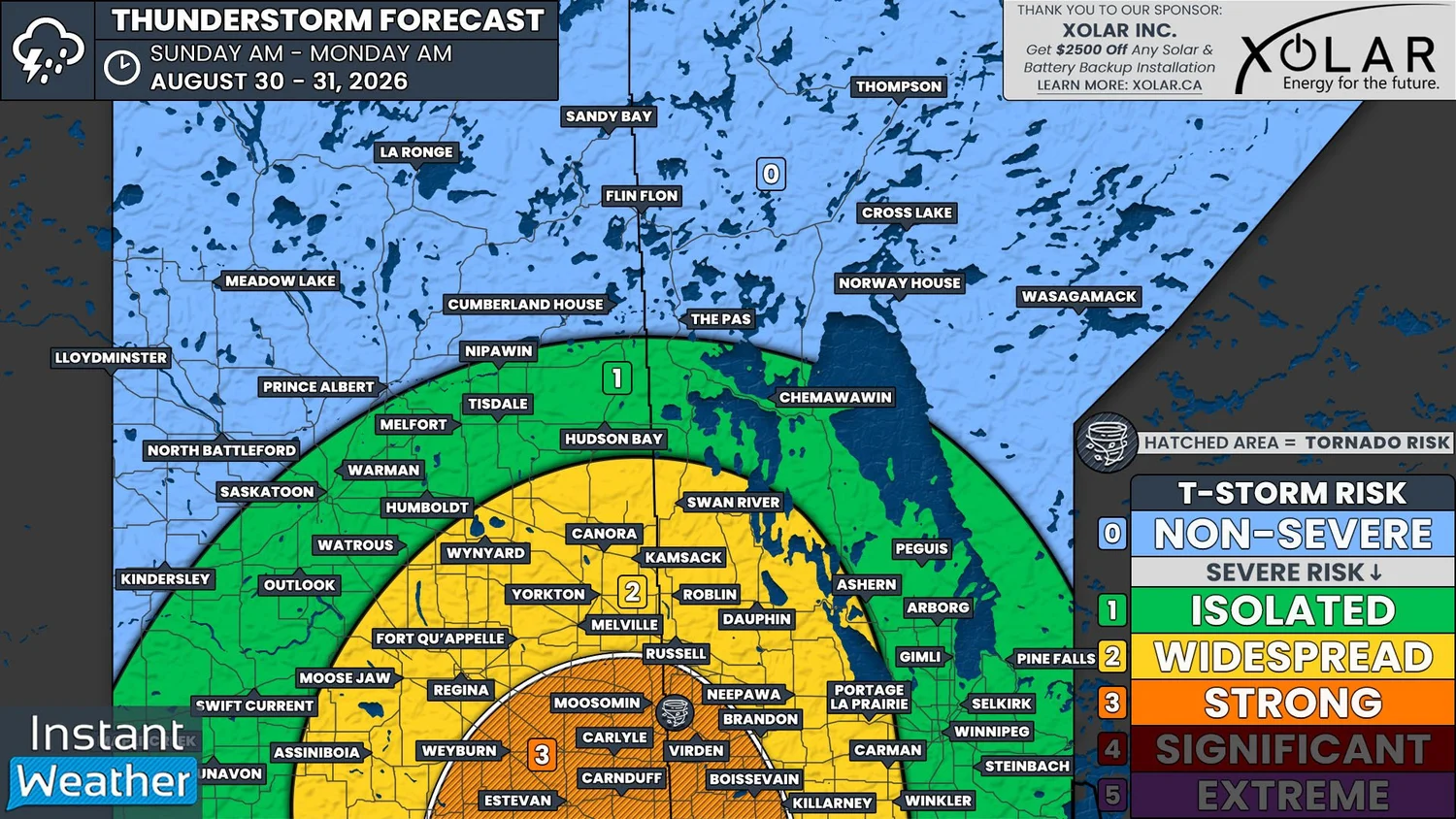
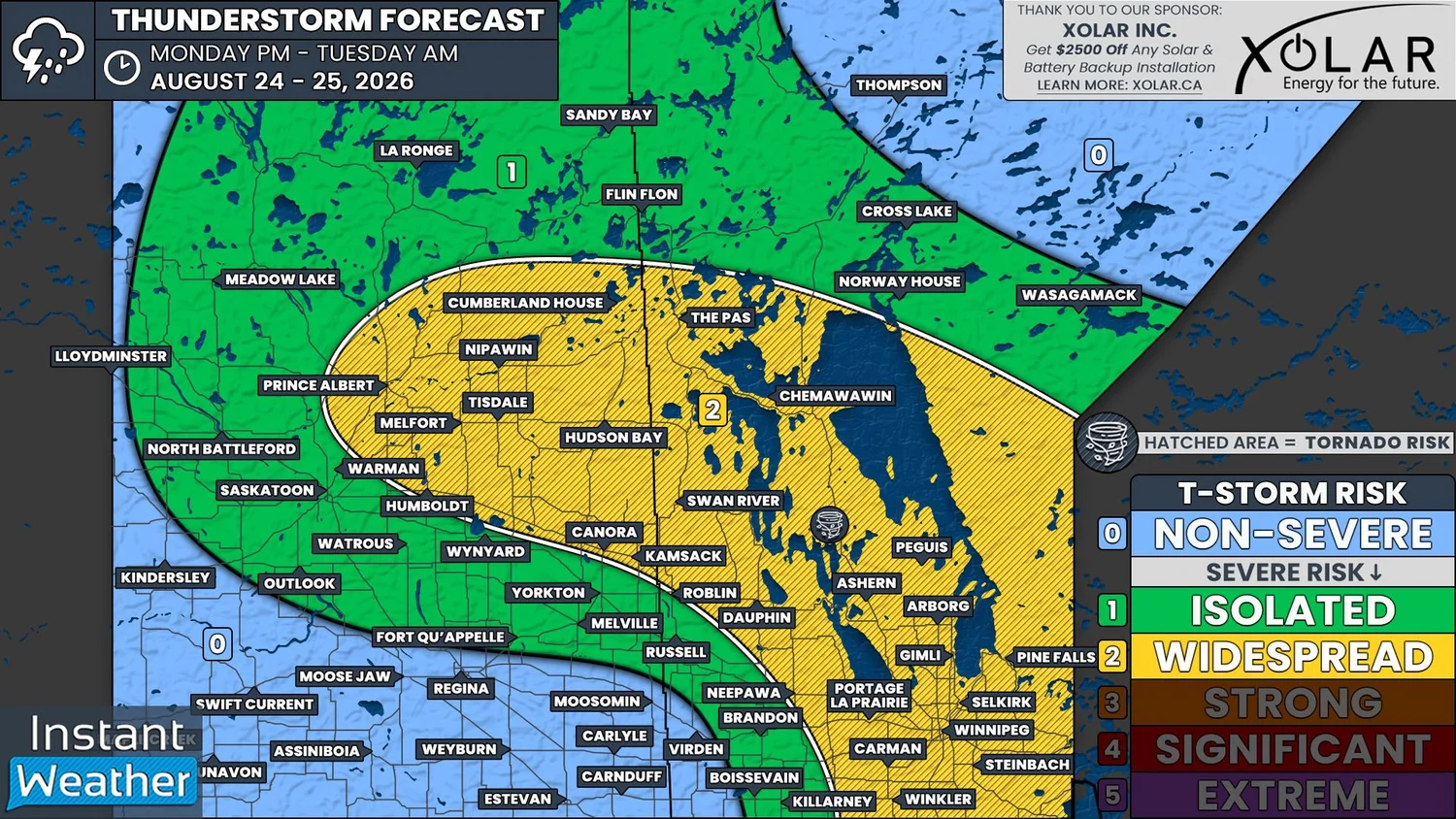
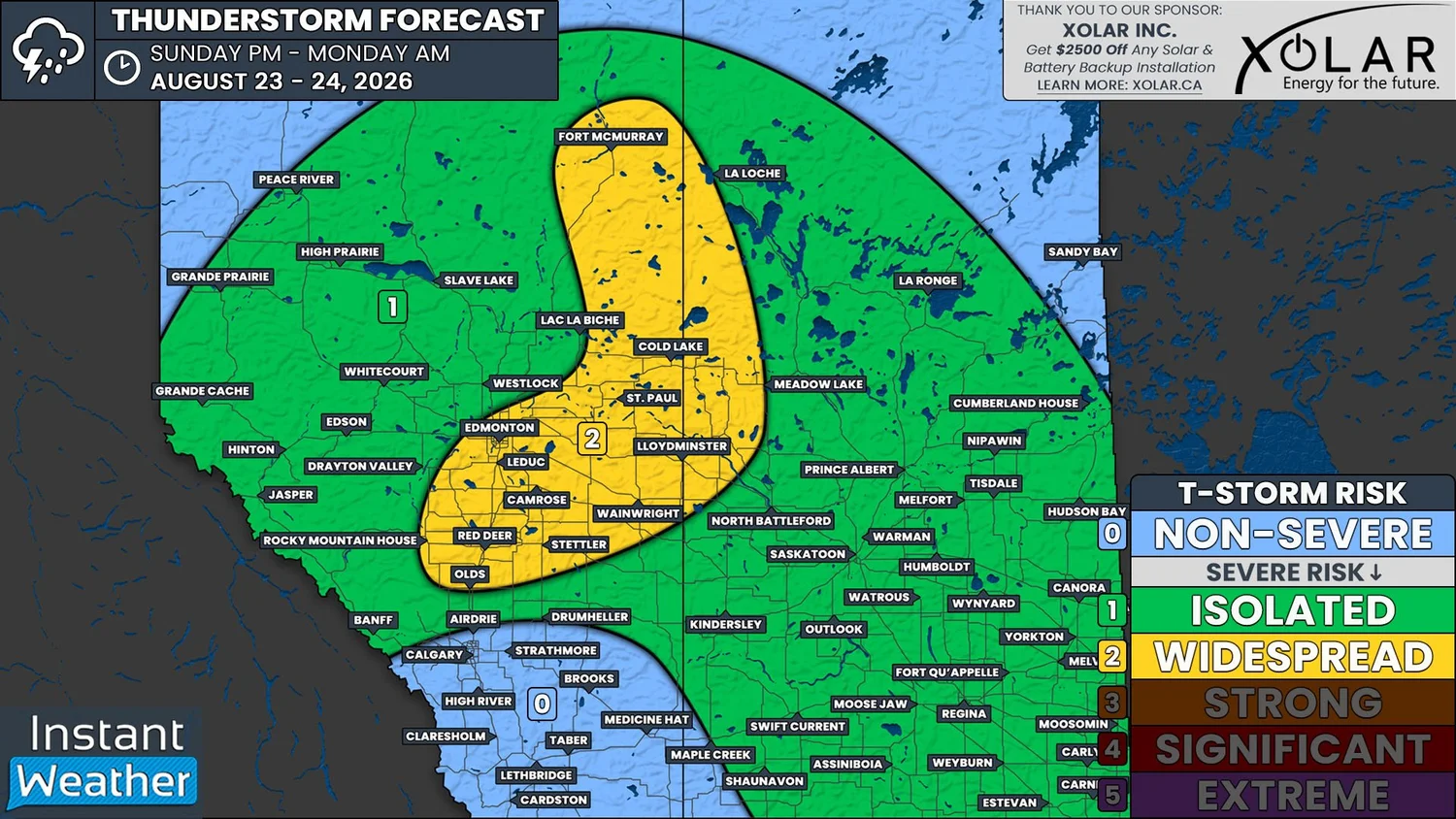
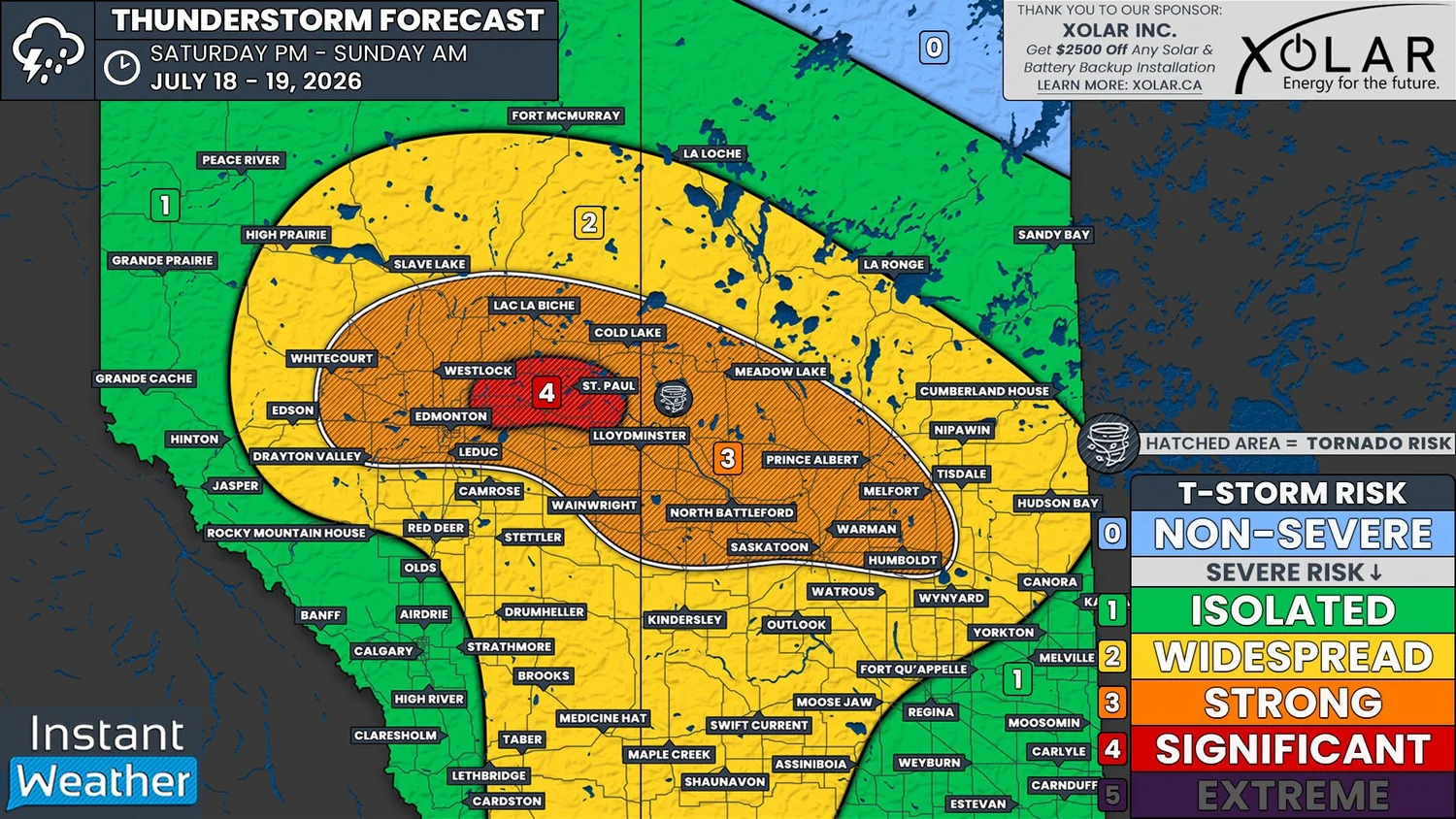
After a brief reprieve from active weather across Saskatchewan and Western Manitoba, the threat of severe thunderstorms returns on Saturday. This round of storms could bring a potentially significant severe weather risk to portions of Southeastern Saskatchewan, especially around Weyburn and Estevan.
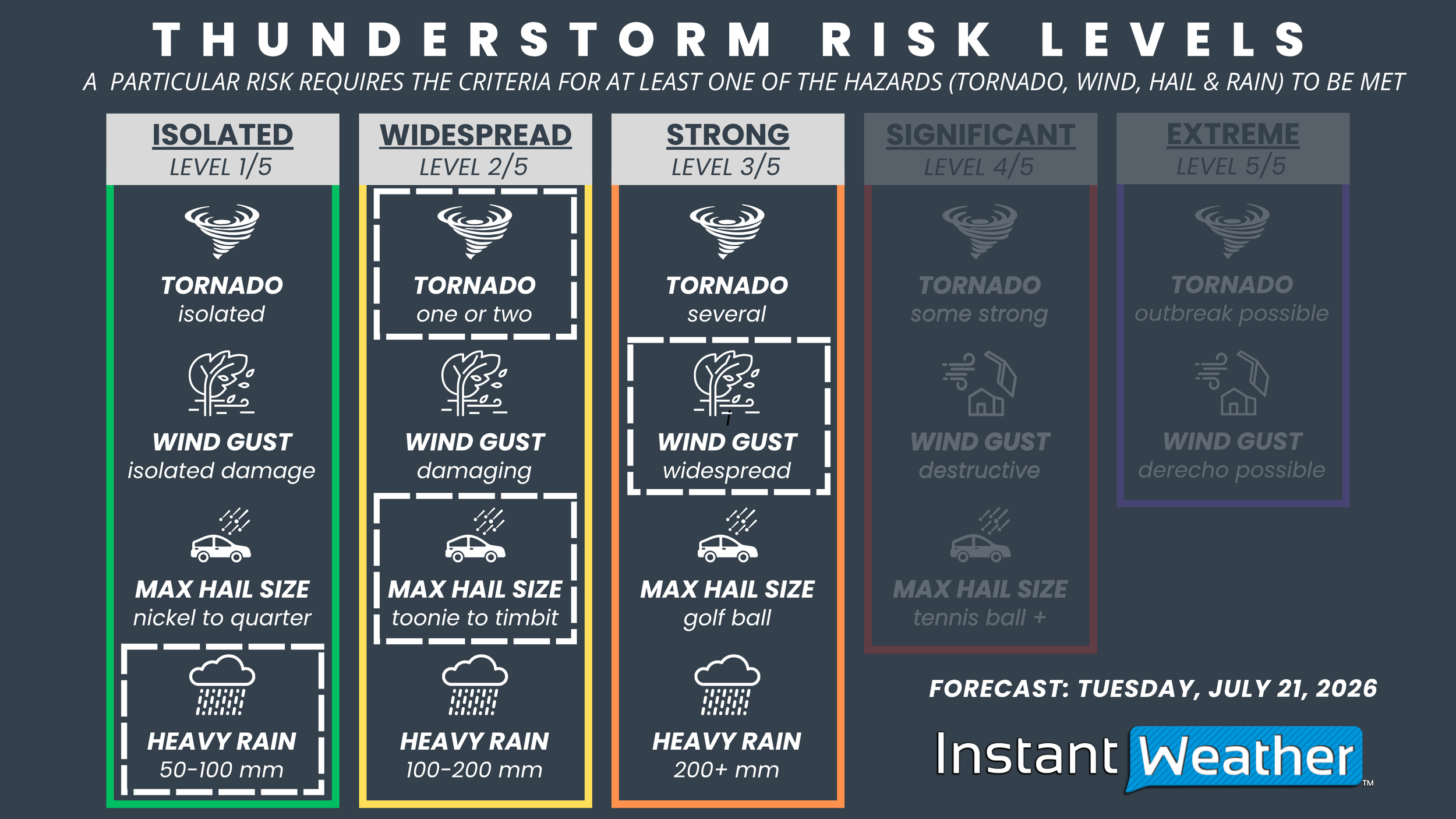
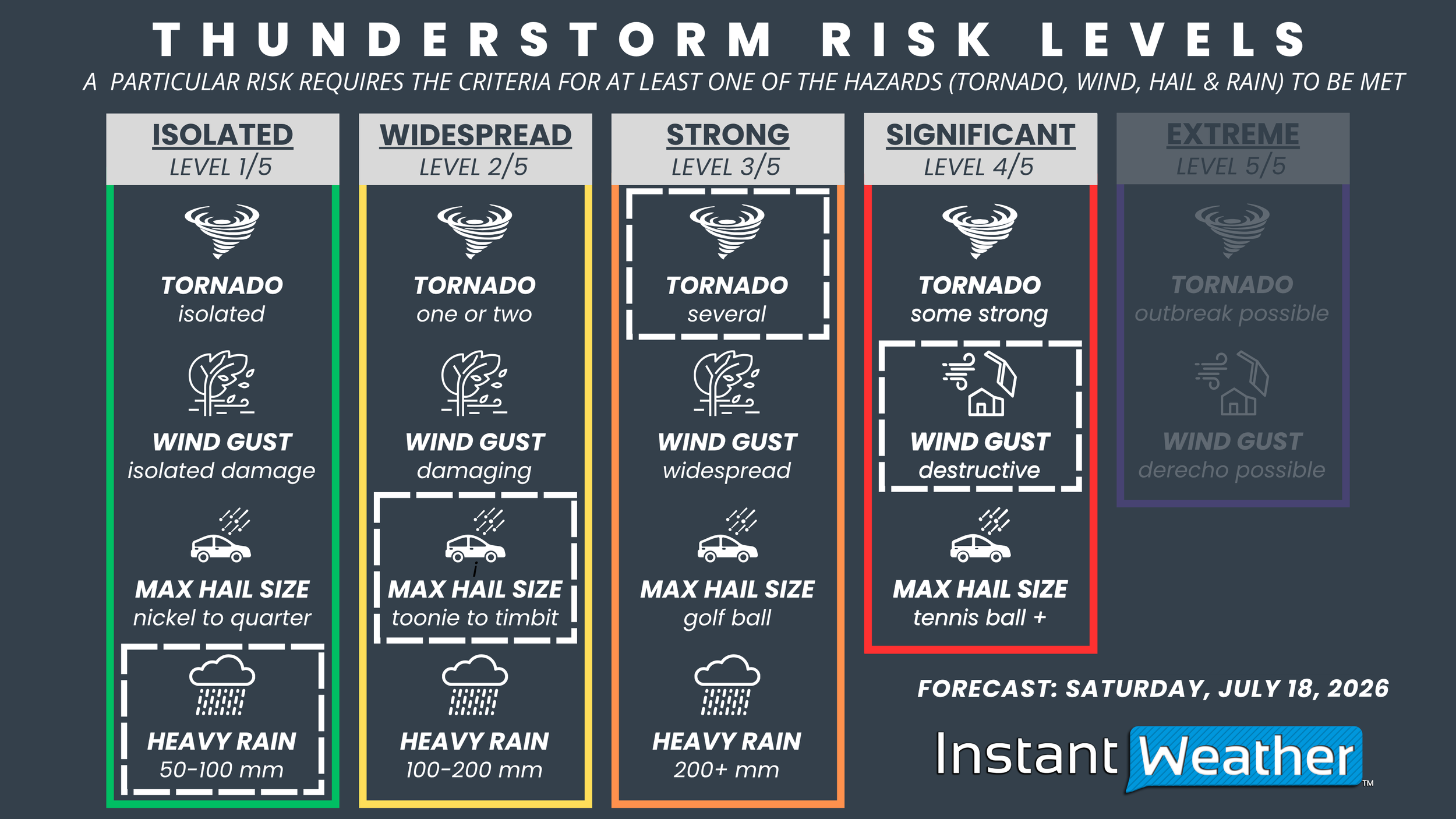
Isolated thunderstorms are expected to develop near the International Border around the dinner hour. Any storms that form could quickly become supercells capable of producing all severe weather hazards, including tornadoes, golf ball-sized hail and destructive wind gusts up to 120 km/h.

There is also a strong severe weather risk extending northward toward Assiniboia, Moose Jaw and Regina. An isolated tornado cannot be ruled out in these areas as well, although confidence in storm development is lower compared to locations closer to the border.

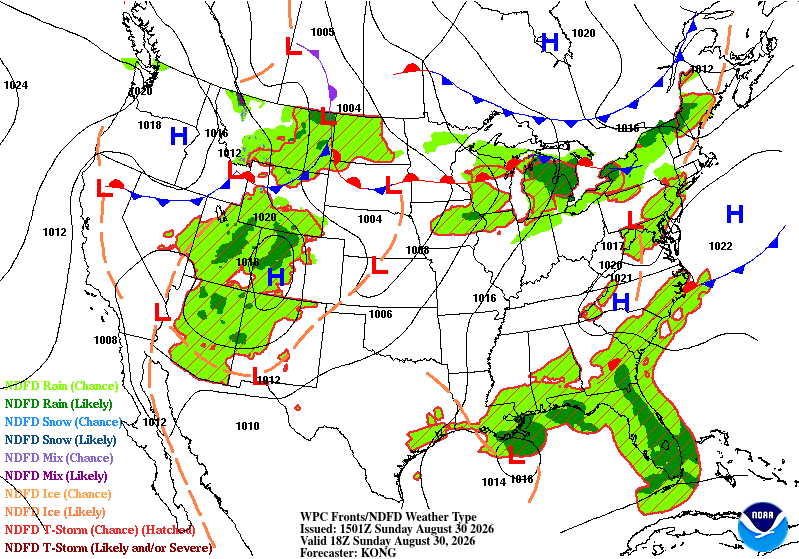
Further south, additional thunderstorms are expected to develop across Montana and North Dakota. As the evening progresses, these storms are forecast to merge into a large complex that will race northeast toward Saskatchewan and Southwestern Manitoba.

The earlier isolated supercells over Southeastern Saskatchewan are expected to be absorbed into this larger storm complex as it crosses the border. As this happens, the primary threat will shift from large hail and tornadoes to widespread damaging wind gusts as the storms organize into a fast-moving line during the mid and late evening hours.

This line is expected to sweep northeast from Regina toward the Manitoba border. There is still some uncertainty regarding how well it will maintain its strength after sunset, as the loss of daytime heating will reduce available instability. However, we expect at least an isolated to widespread severe weather risk to continue past midnight as the storms approach the Yorkton and Brandon corridor.

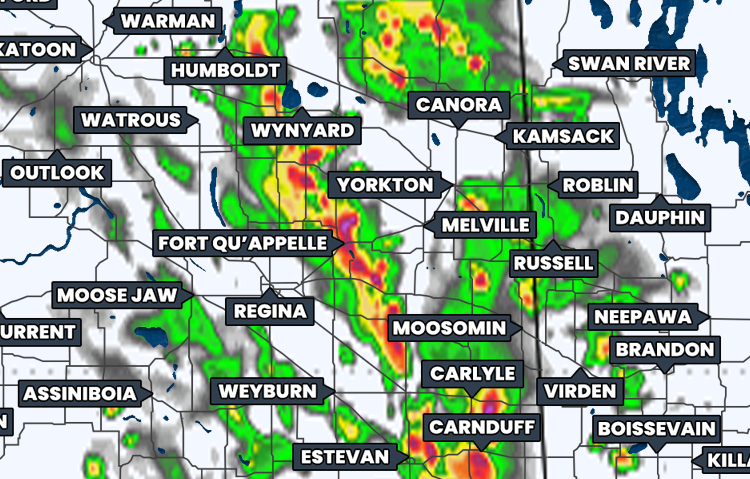
SIMULATED RADAR - MAP FROM WEATHERBELL

Based on the latest data, isolated thunderstorms are most likely to develop between 5 and 7 PM CST near the International Border. These storms could impact the Weyburn and Estevan areas as they rapidly intensify into supercells capable of producing large hail, damaging wind gusts and tornadoes.

The environment will be particularly favourable for tornadic development during the first few hours of these storms' lifespan. The greatest tornado risk appears to be closest to the border, although this threat could extend northwest toward Moose Jaw and Regina if storms are able to develop there during the late afternoon and early evening.

SIMULATED RADAR - MAP FROM WEATHERBELL

As the mature line of storms over Montana and North Dakota advances into Saskatchewan, the earlier isolated storms are expected to merge into the line, forming a bowing segment stretching from Regina to the Manitoba border.

Although the tornado threat will decrease once the storms become linear, a brief QLCS spin-up tornado cannot be ruled out, particularly near any bookend vortices that develop within the line. The primary hazard, however, will become widespread damaging wind gusts, with localized gusts over 100 km/h possible. The hail threat will also diminish by this stage, although quarter to toonie-sized hail may still accompany the strongest storms.

The line will continue sweeping across Southeastern Saskatchewan and into Southwestern Manitoba during the overnight hours. While isolated damaging wind gusts will remain possible within the strongest portions of the line, there is still uncertainty regarding how well the storms will maintain their intensity after midnight.


Southern Ontario Faces Severe Storm and Tornado Risk Thursday Ahead of Possible Canada Day Heatwave

THIS FORECAST IS SPONSORED BY:

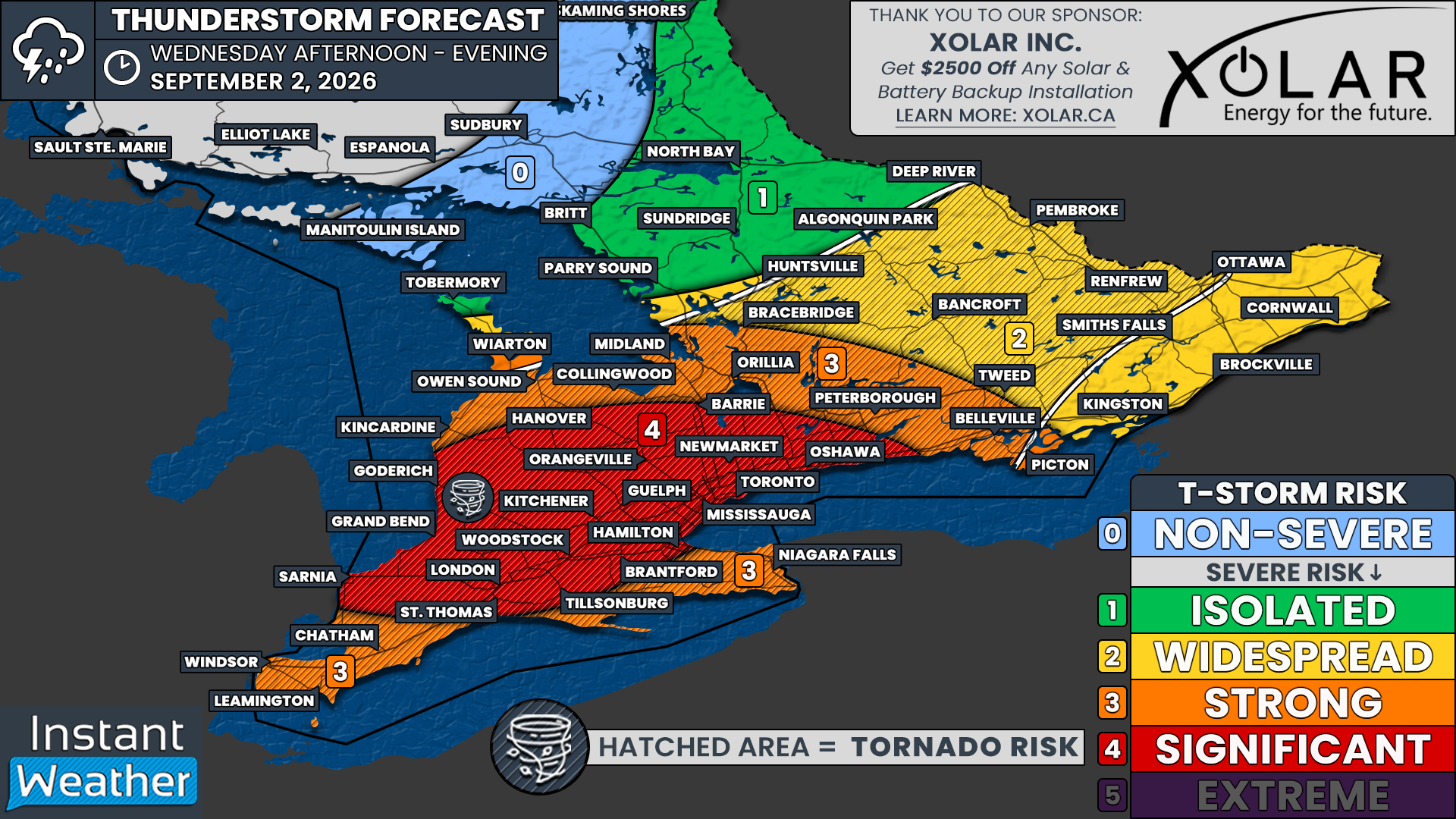
NOTE: YOU CAN CLICK ON THE MAP TO OPEN A ZOOMABLE IMAGE

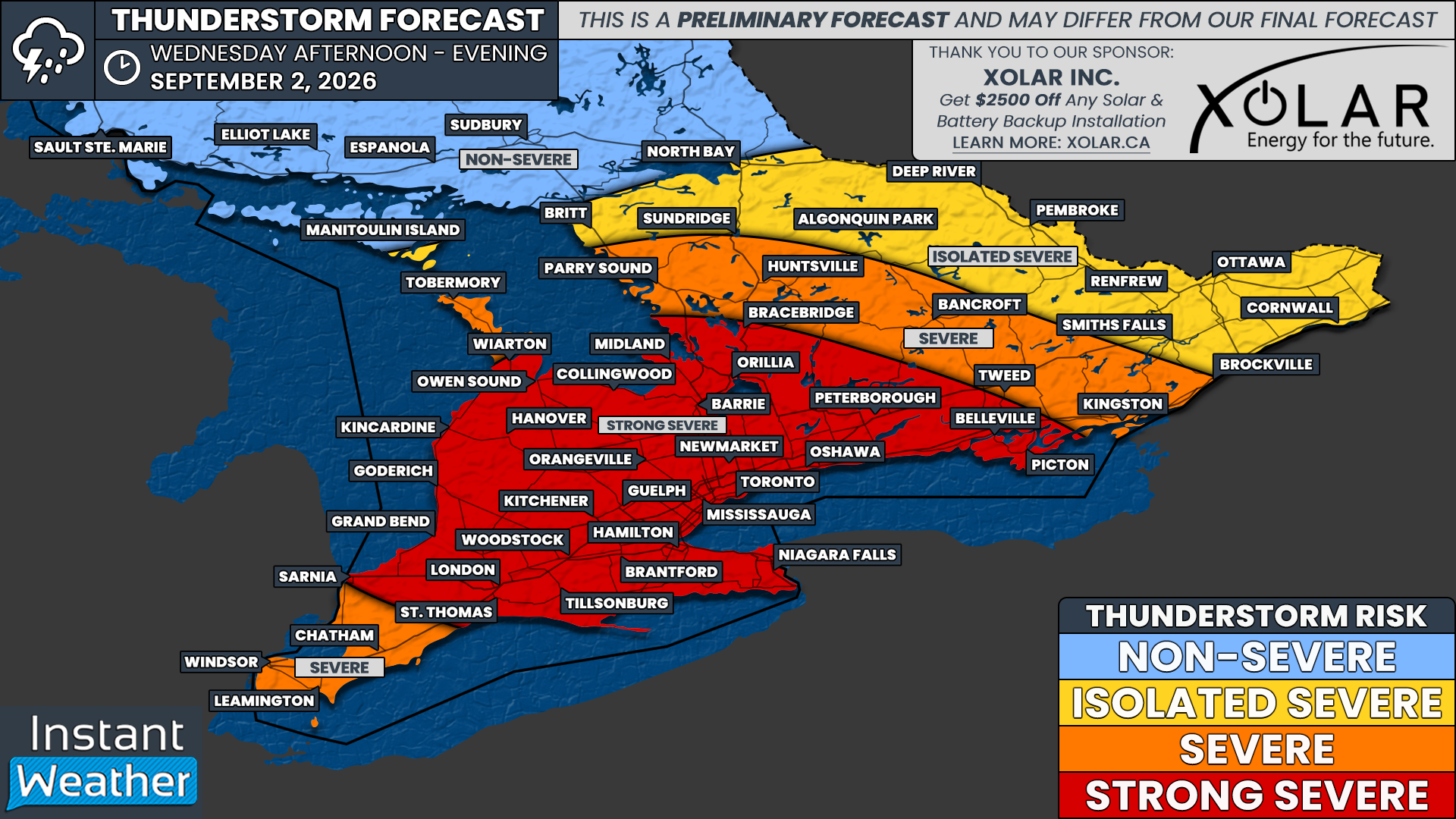
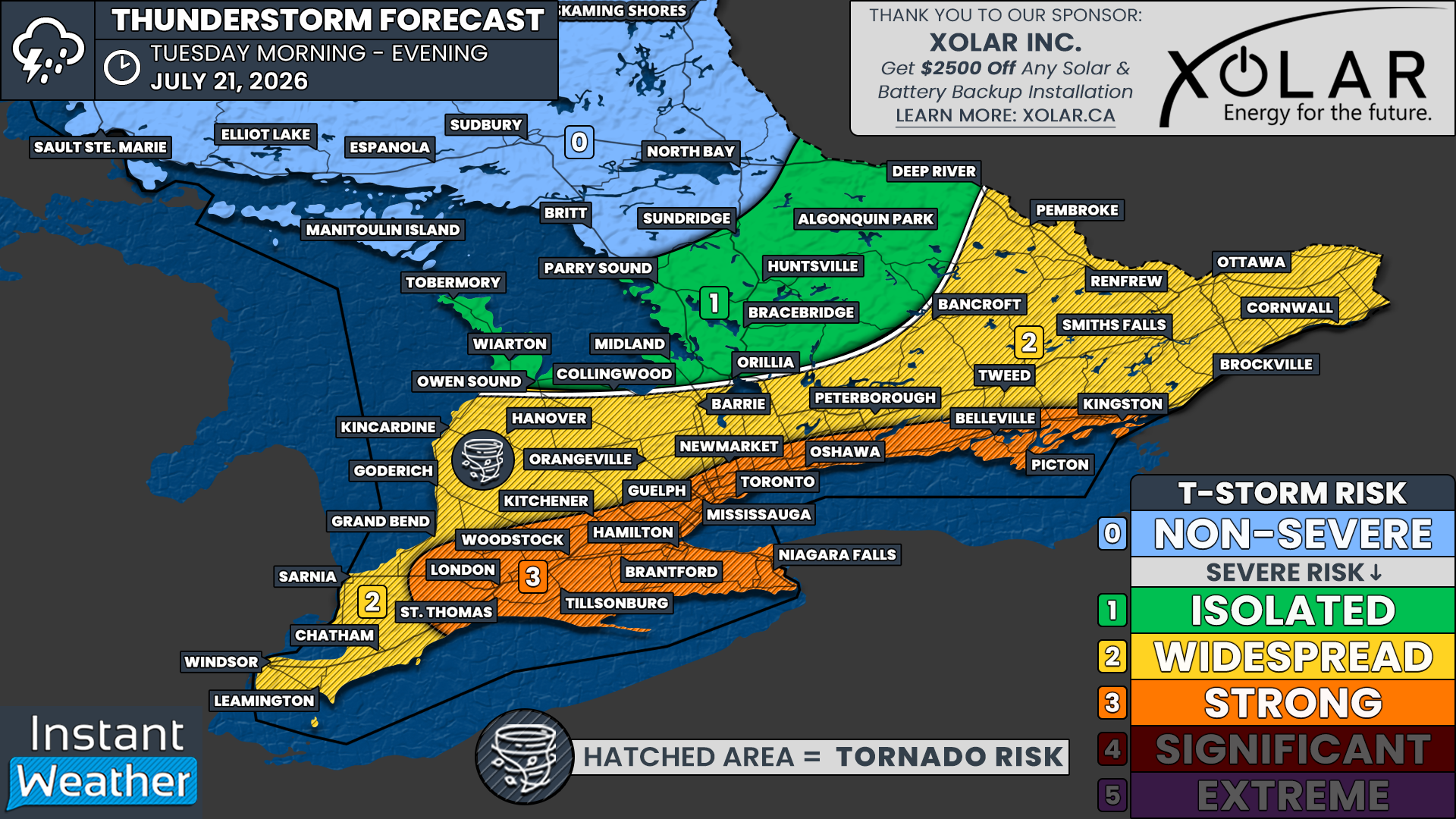
While the latter half of June has been relatively quiet across Southern Ontario when it comes to severe weather, thanks to cooler temperatures dominating the region, that pattern is about to change in a big way. As we head into the final days of June, much warmer and increasingly humid air will begin pushing into the province, bringing with it a rapidly increasing risk for thunderstorms.

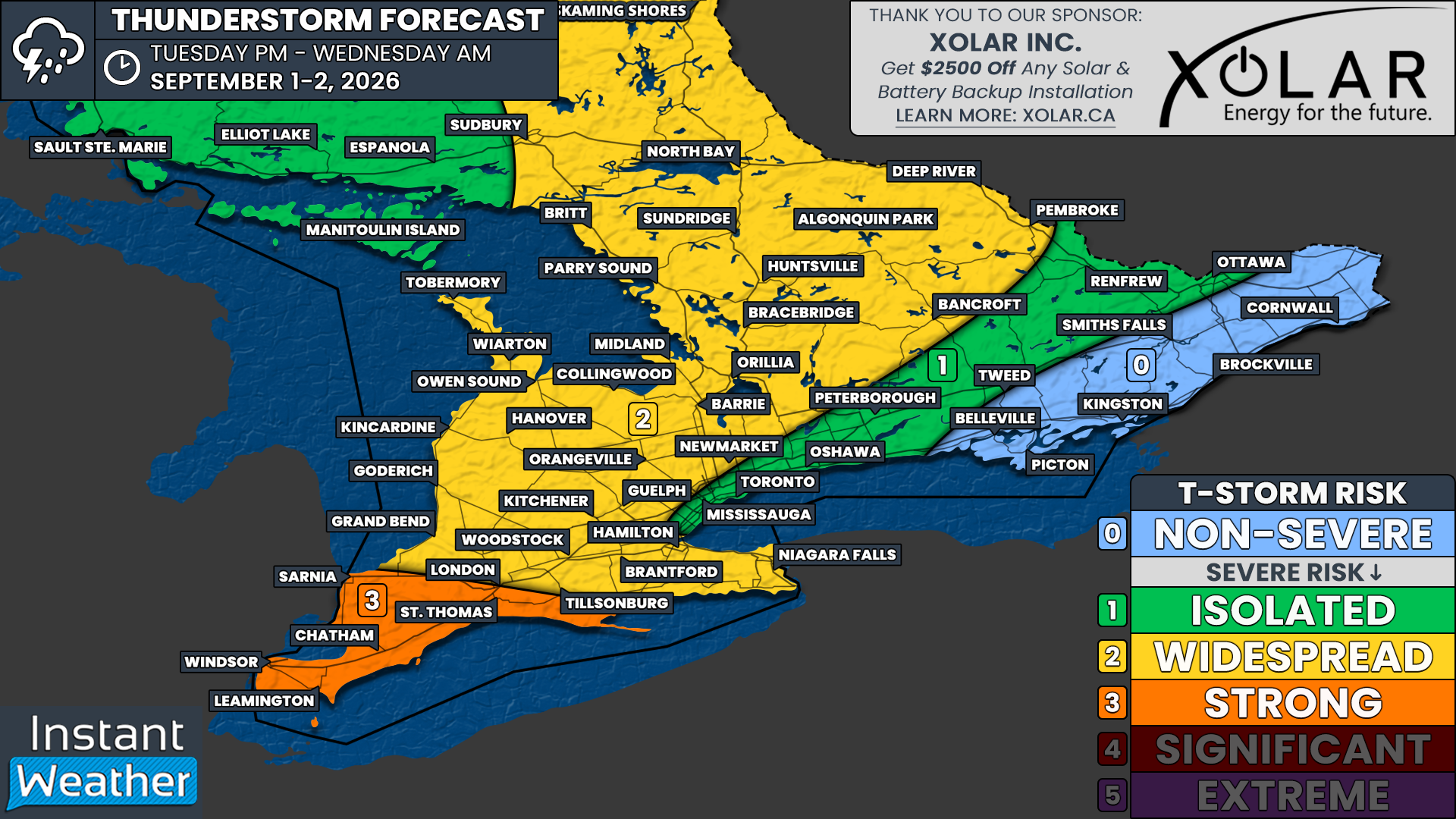
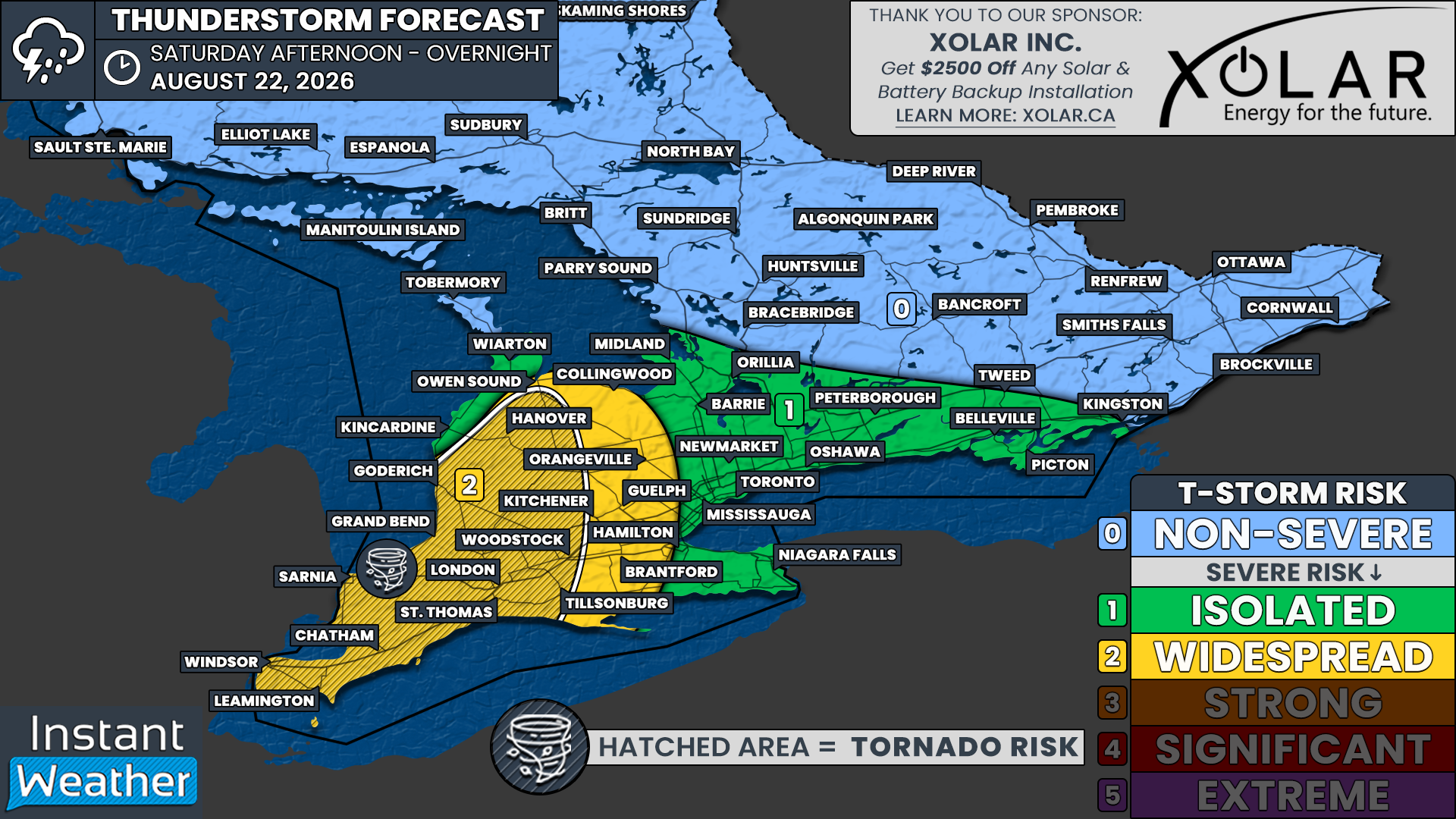
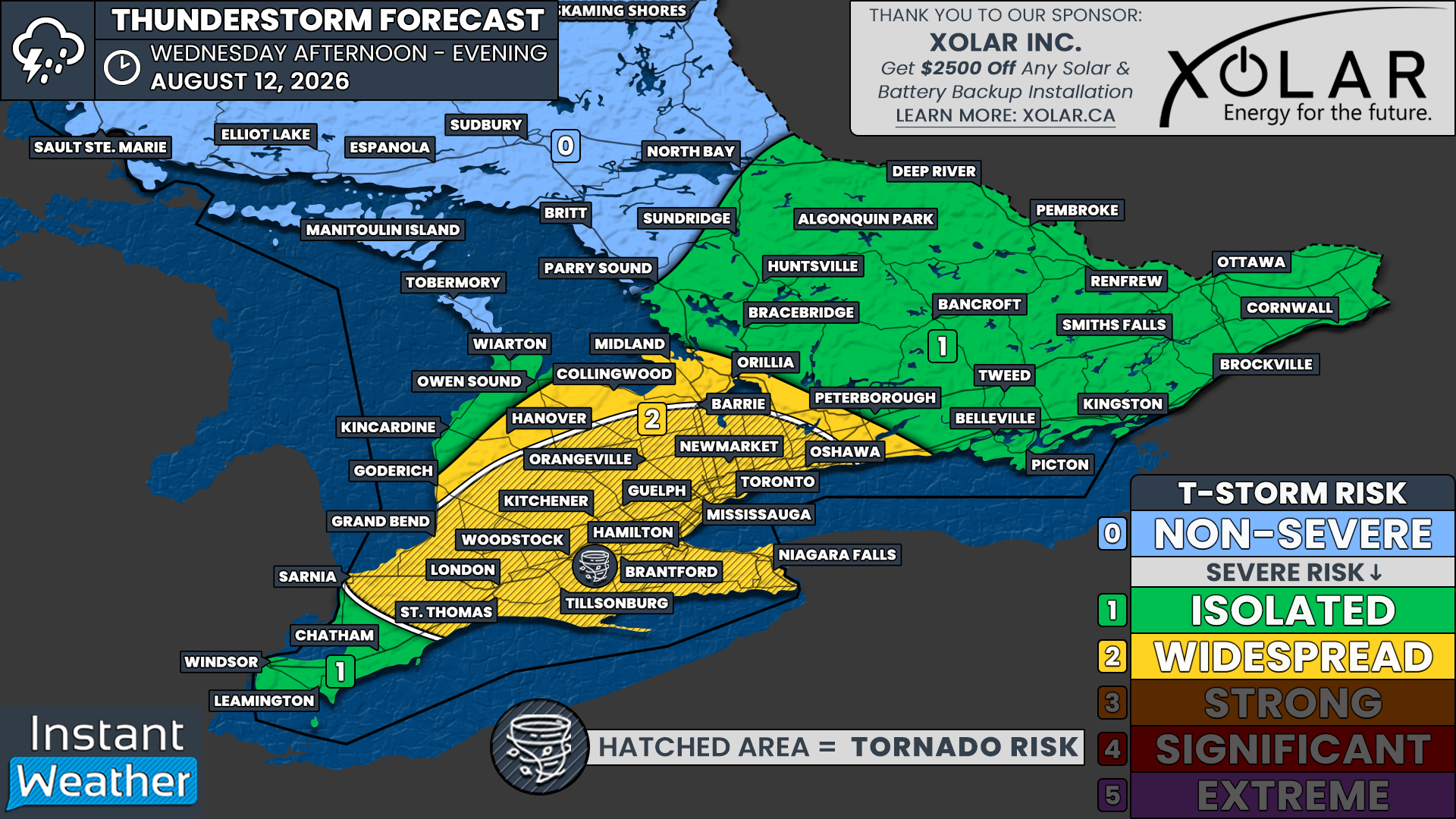
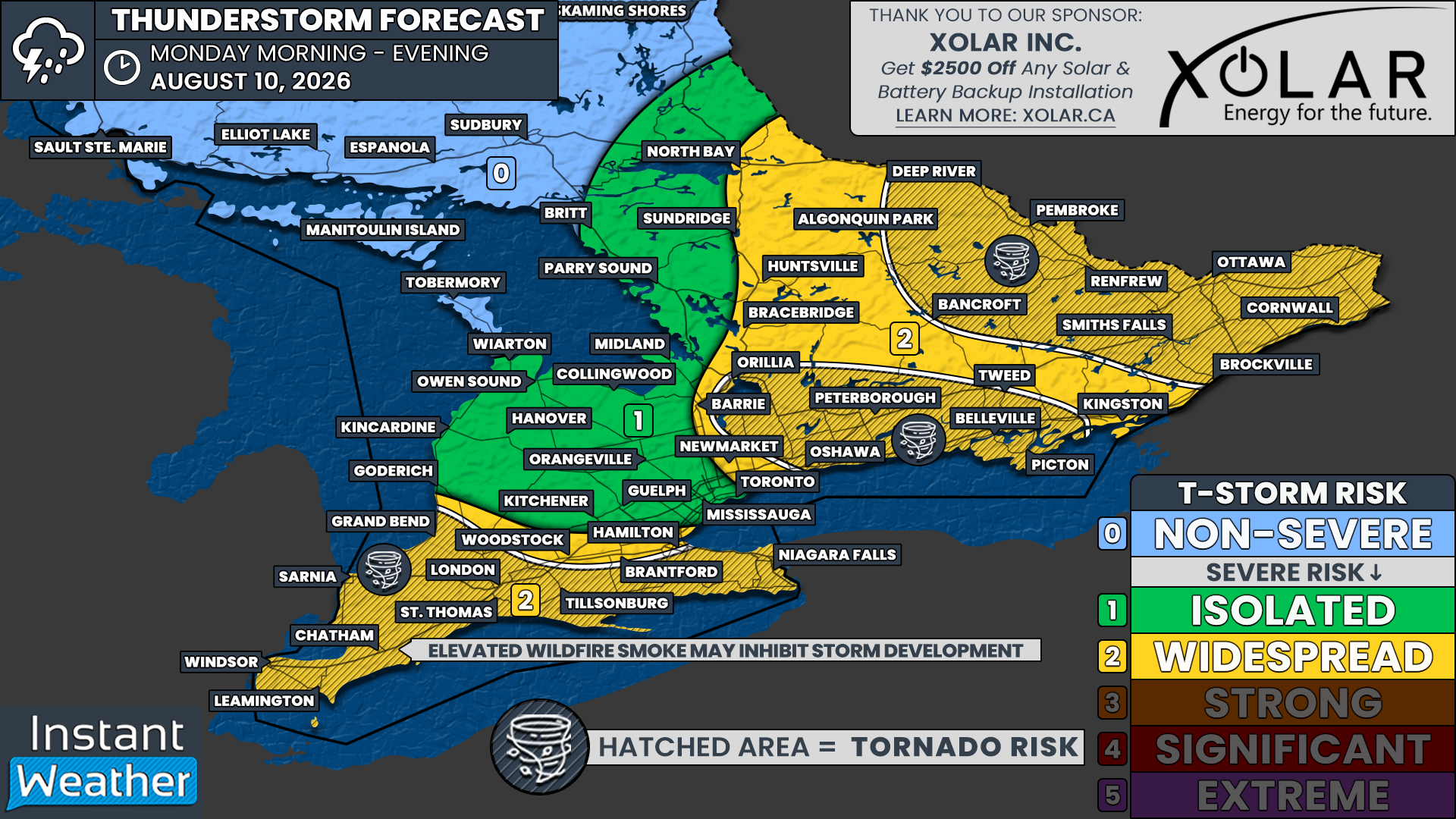
The first significant opportunity arrives on Thursday, when portions of Southwestern Ontario could see a widespread severe thunderstorm risk. An isolated severe threat may also extend farther east into parts of the Golden Horseshoe and Central Ontario.

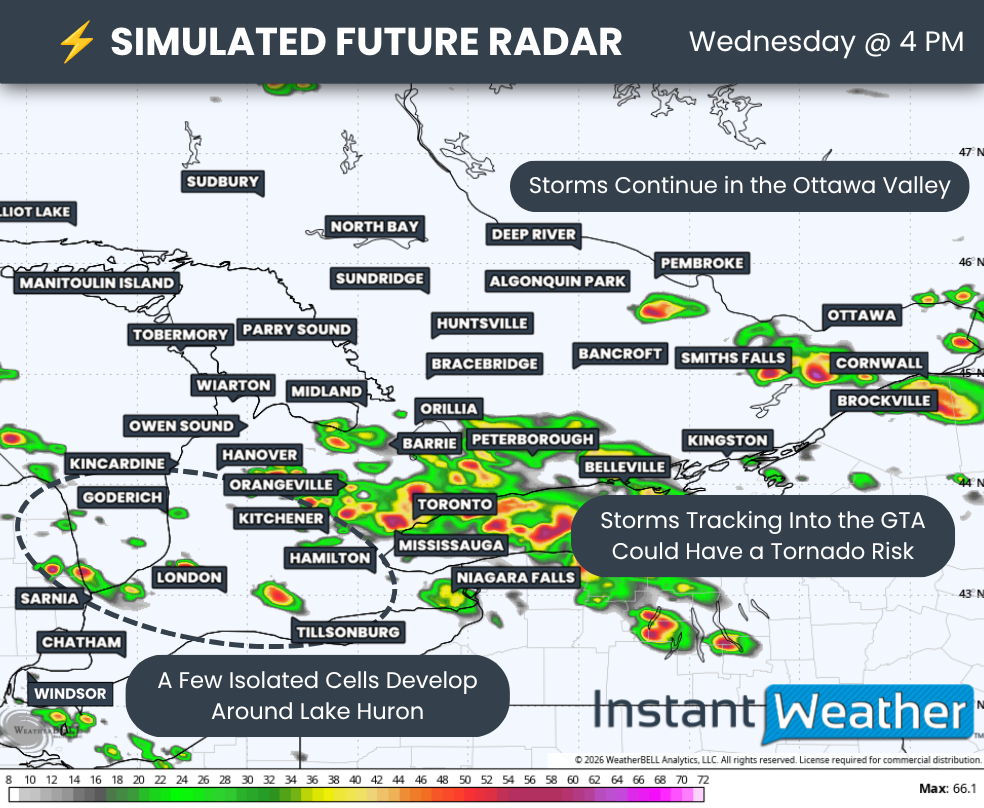
If thunderstorms are able to develop during the afternoon and early evening, they will move into a very favourable environment capable of supporting supercell thunderstorms. These storms could produce all modes of severe weather, including toonie-sized hail or larger, damaging wind gusts in excess of 100 km/h, torrential rainfall and even a few isolated tornadoes.

The most favourable environment currently appears to be across areas including Sarnia, Chatham, Grand Bend, Goderich and London. However, isolated thunderstorms could also develop as far north as the Bruce Peninsula, east toward Lake Simcoe, and south into portions of the Greater Toronto Area. While the tornado threat decreases farther away from Lake Huron, it cannot be completely ruled out as far east as Kitchener, Hamilton and portions of the southern Georgian Bay shoreline.


Join Us on YouTube for Storm Coverage:

We'll be providing comprehensive live coverage of any storms that develop on Thursday afternoon on our YouTube channel. Our team will be tracking storms in real time with live radar analysis, warnings, storm reports and chaser coverage, so if severe weather threatens your area, be sure to join us live to help stay informed.


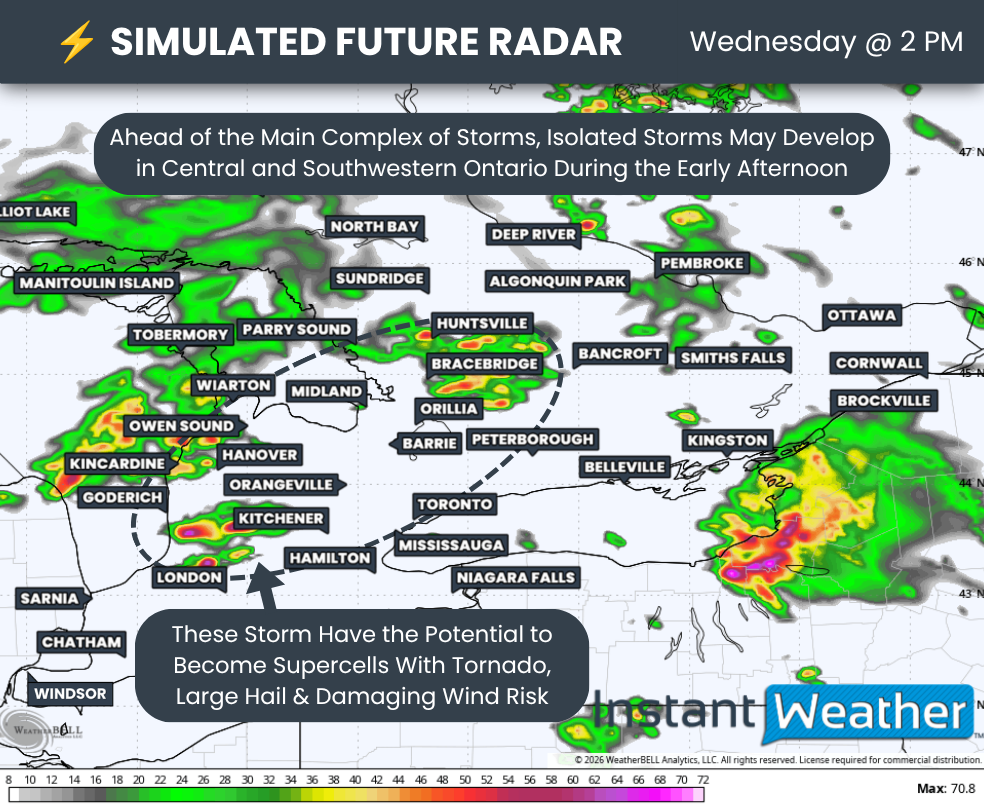
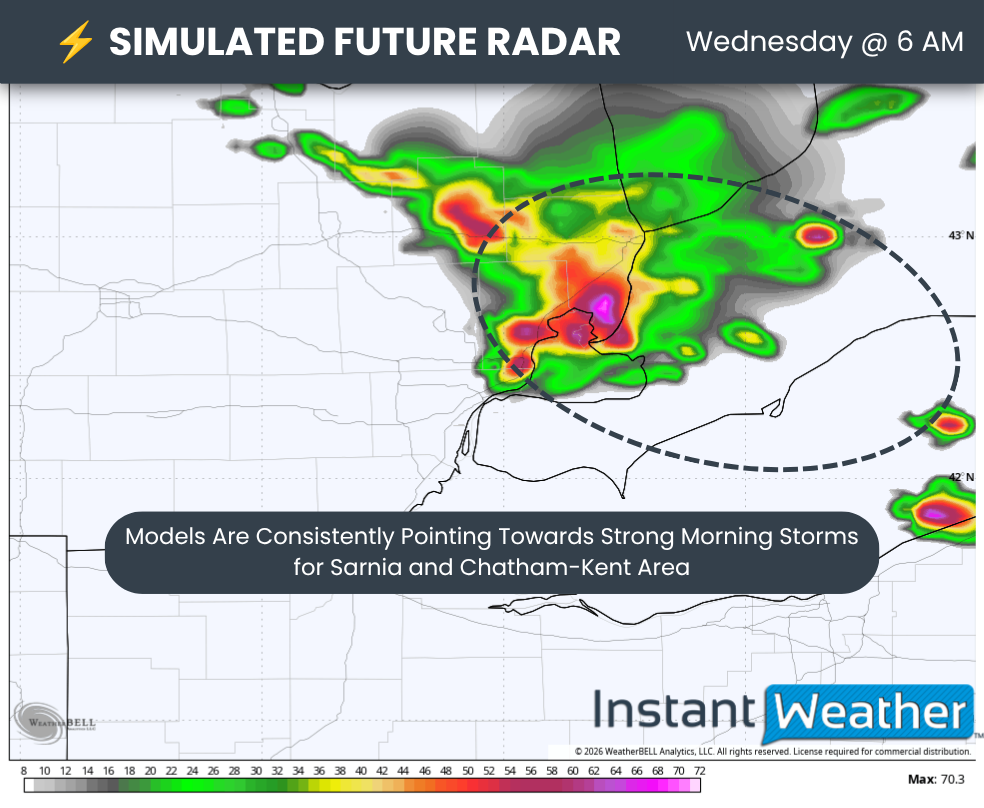
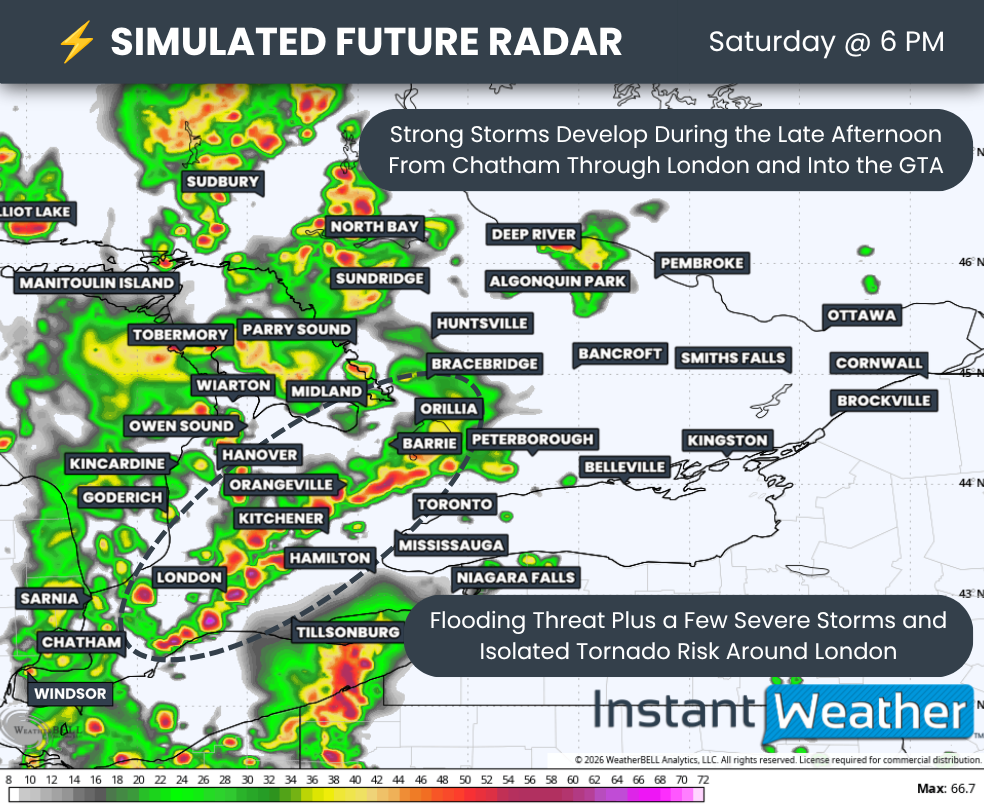
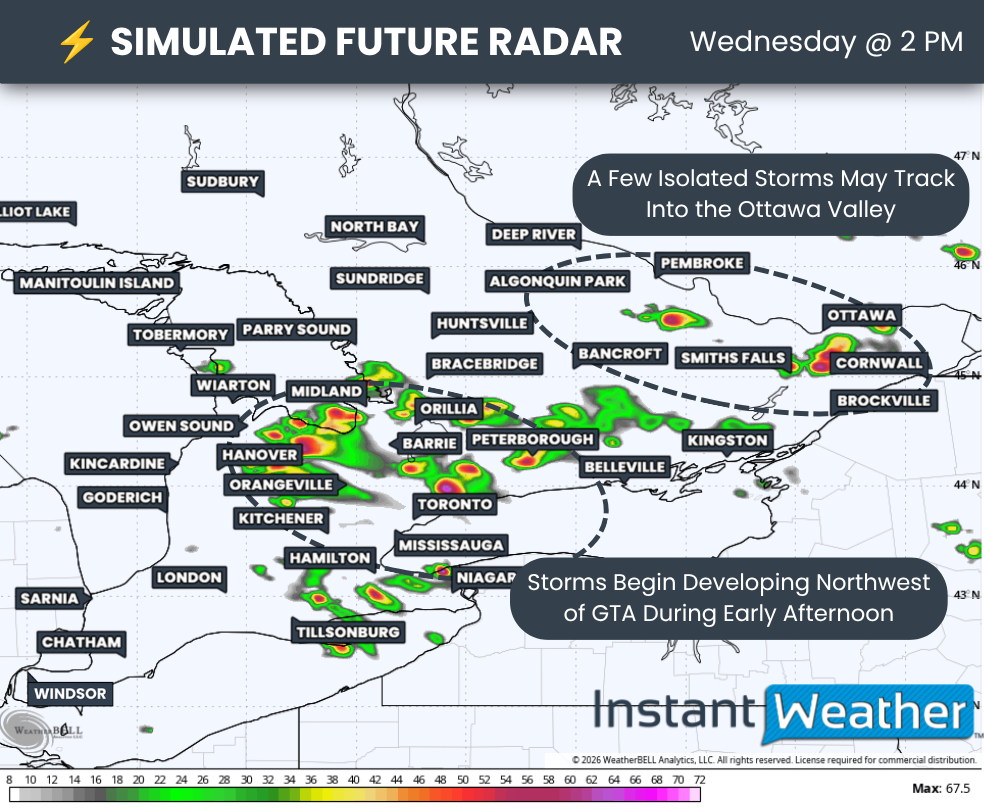
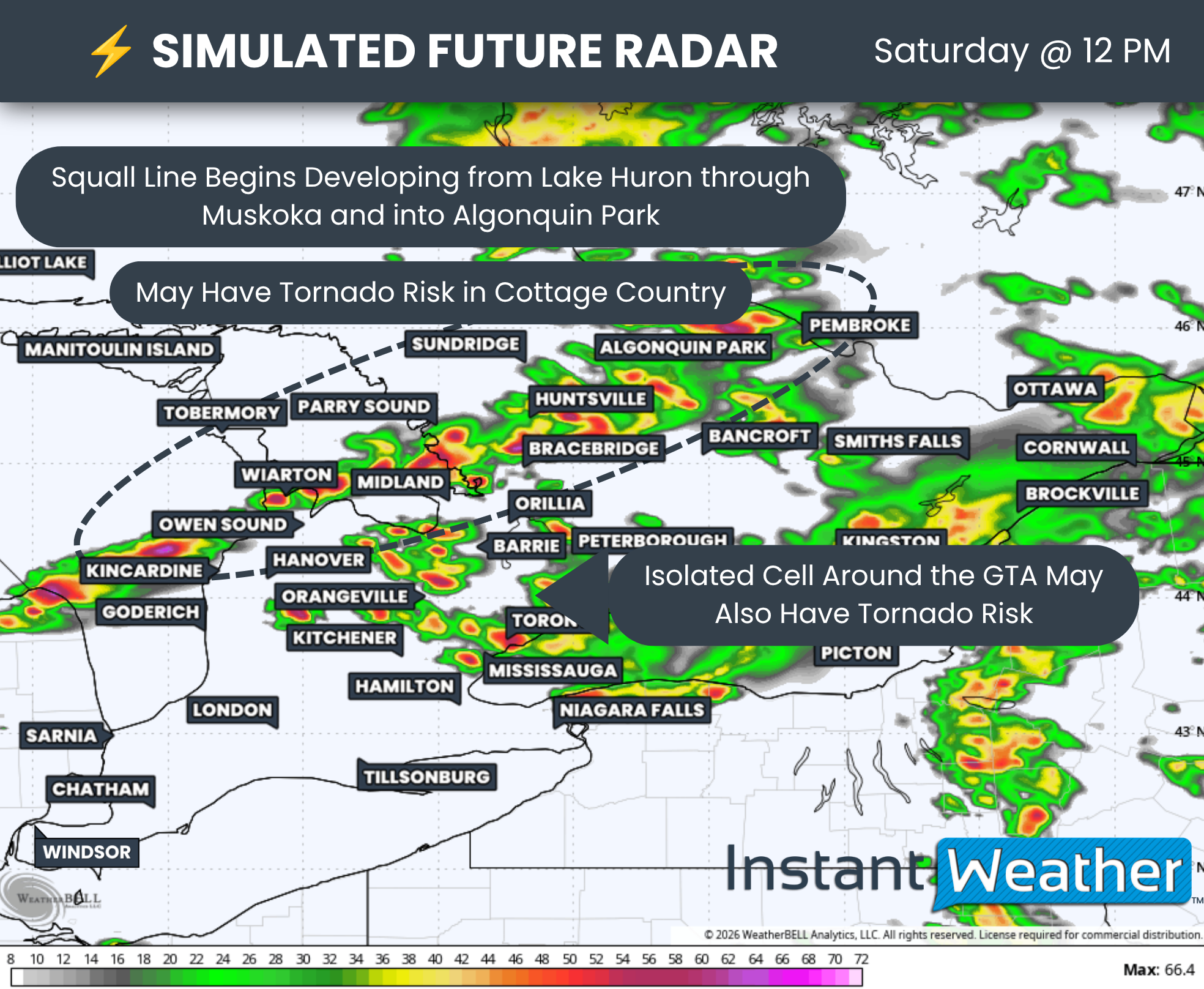
SIMULATED RADAR - MAP FROM WEATHERBELL

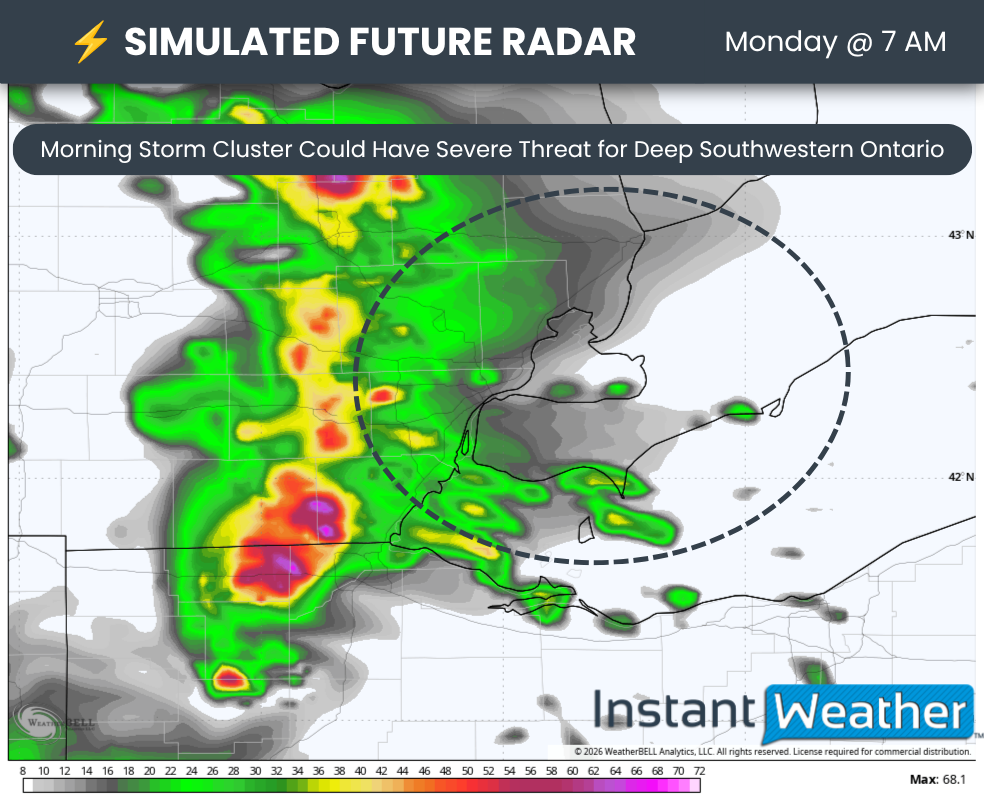
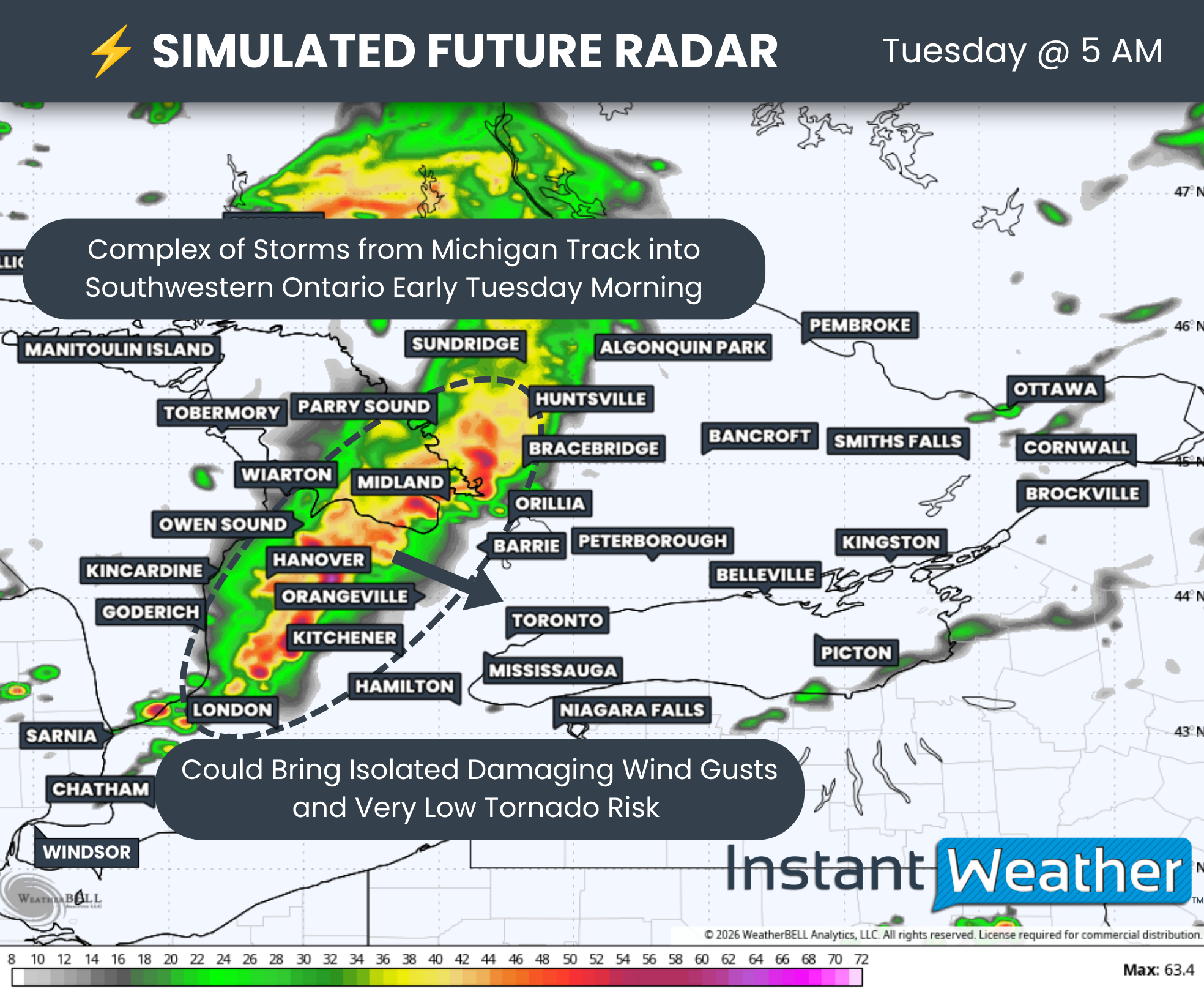
Thursday's forecast does come with one important complication. Morning showers and non-severe thunderstorms are expected to move through Southwestern Ontario before spreading into Central and Eastern Ontario during the day.

As we've seen many times before, morning convection can make or break an afternoon severe weather event. If clouds and showers linger too long, they can prevent the atmosphere from recovering enough to support stronger storms later in the day.

On the other hand, if skies clear by around the noon hour, as many of the latest models suggest, there should be several hours available for temperatures and instability to quickly rebound.

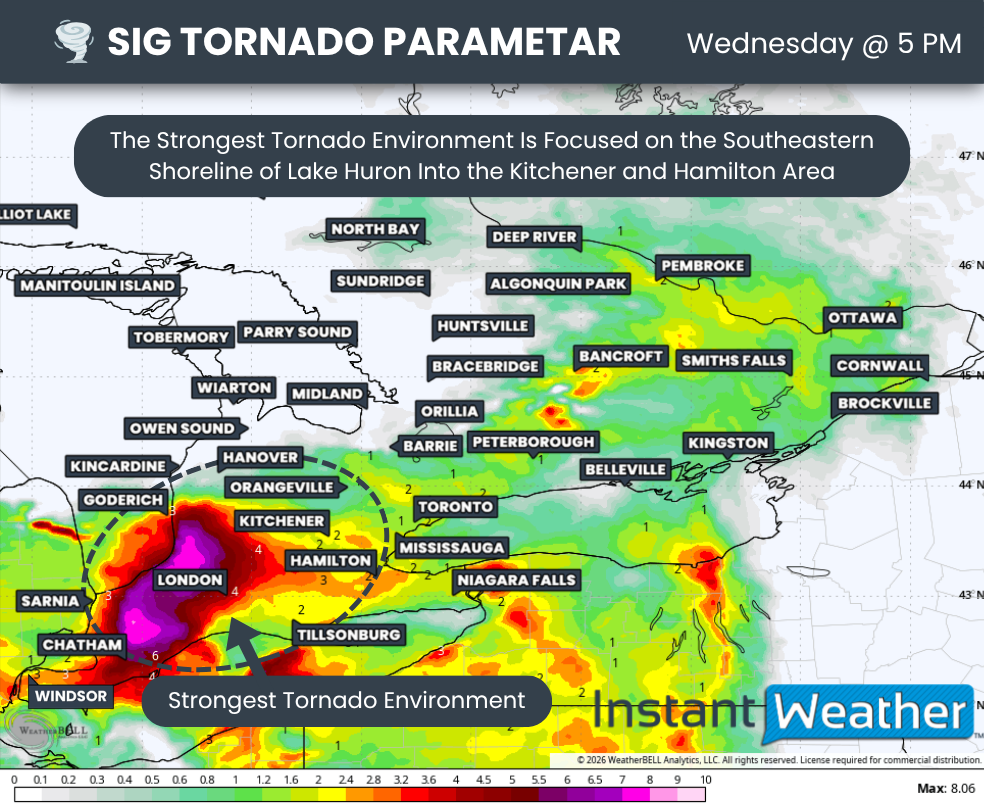
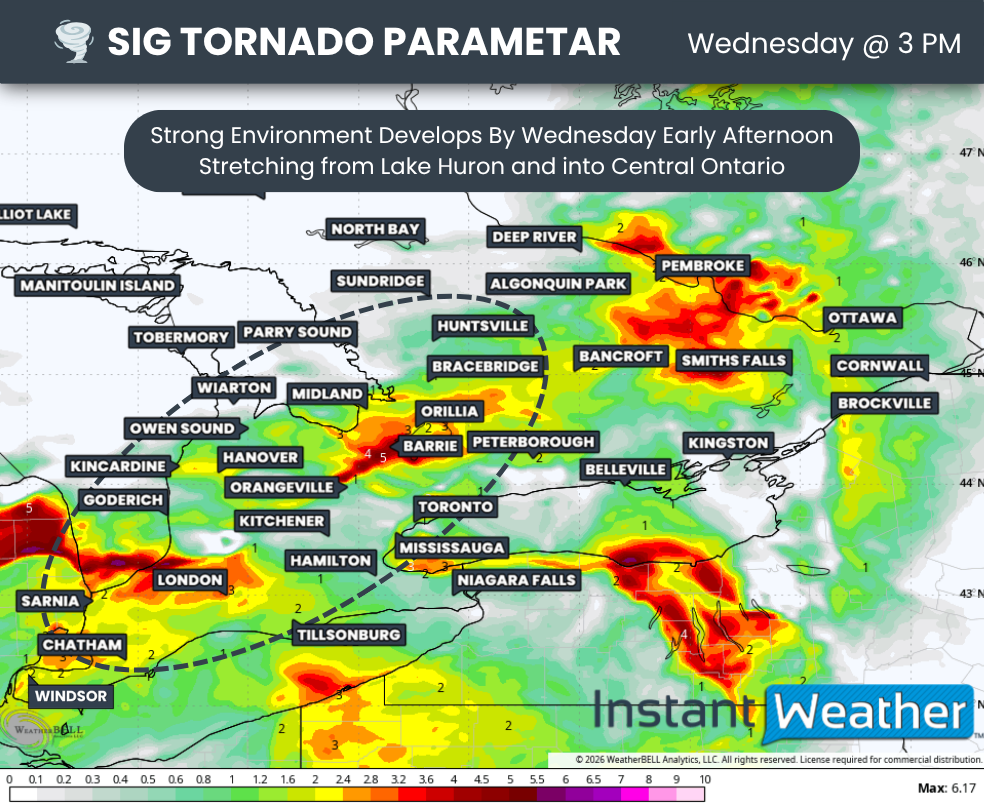
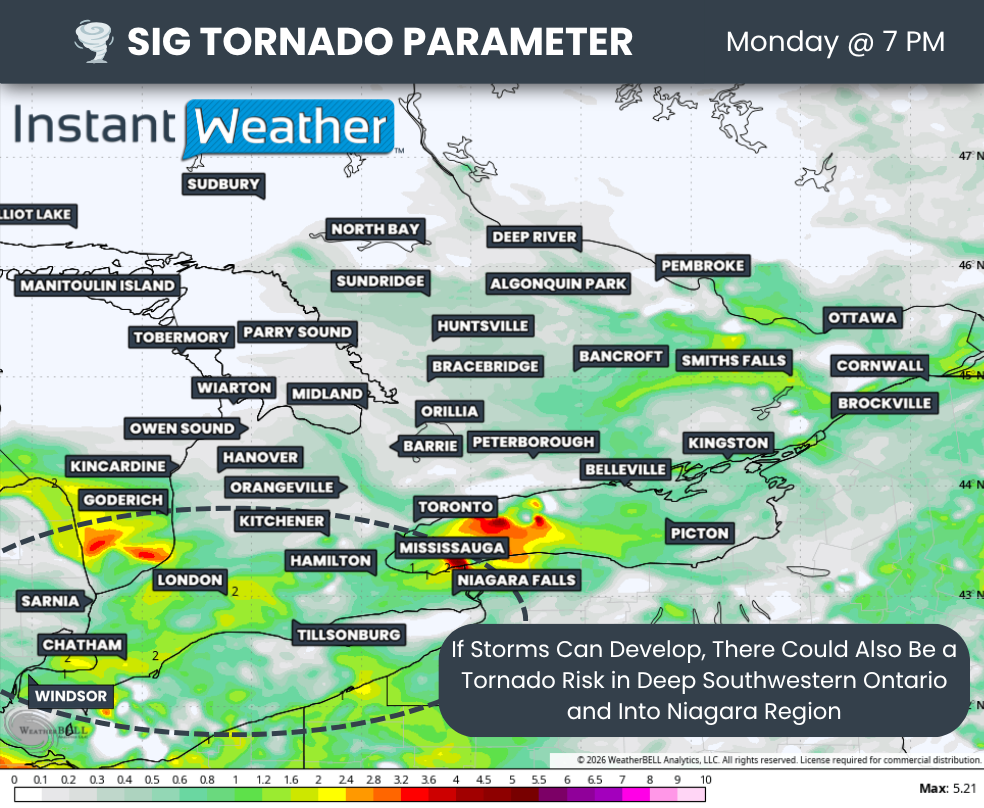
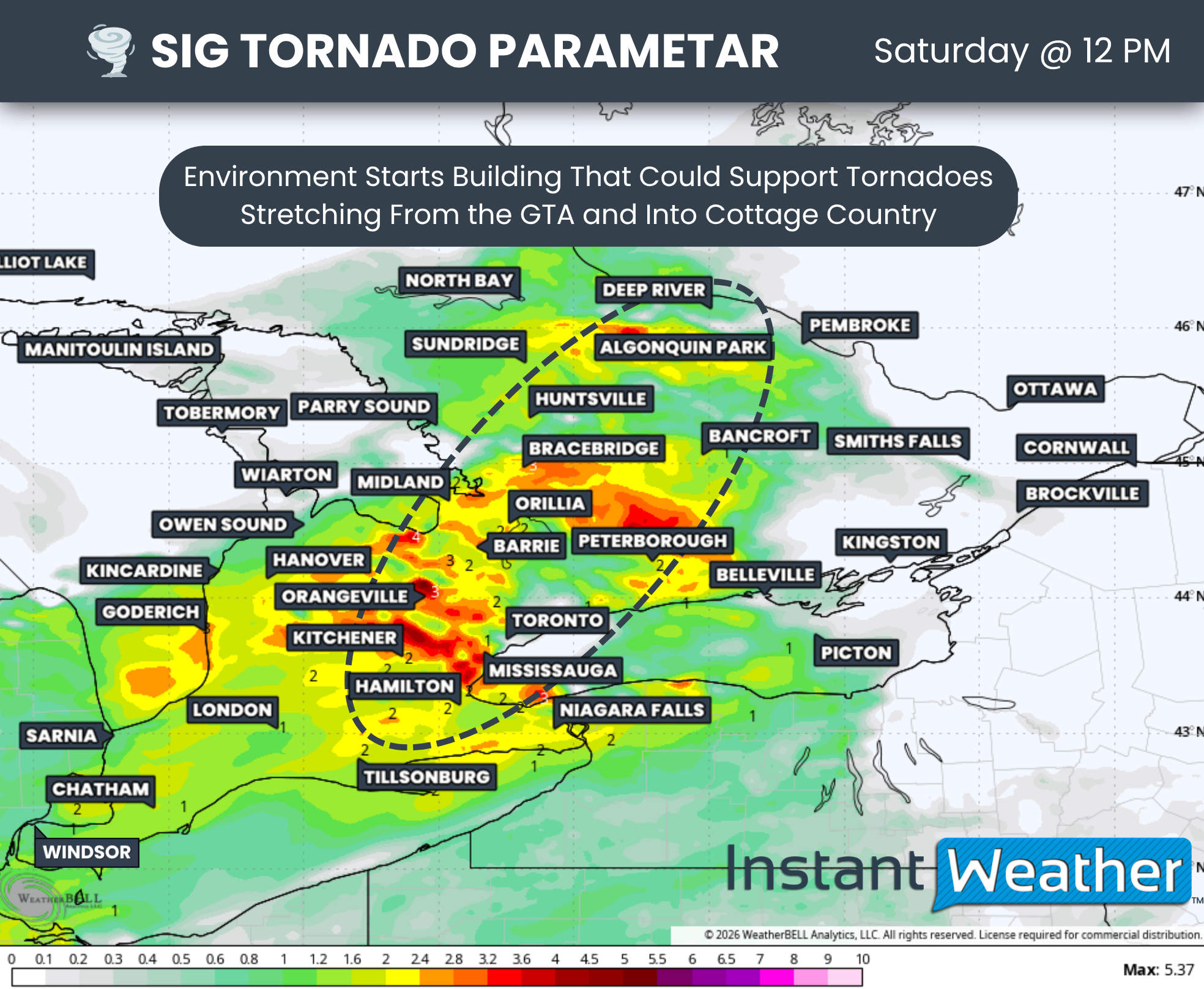
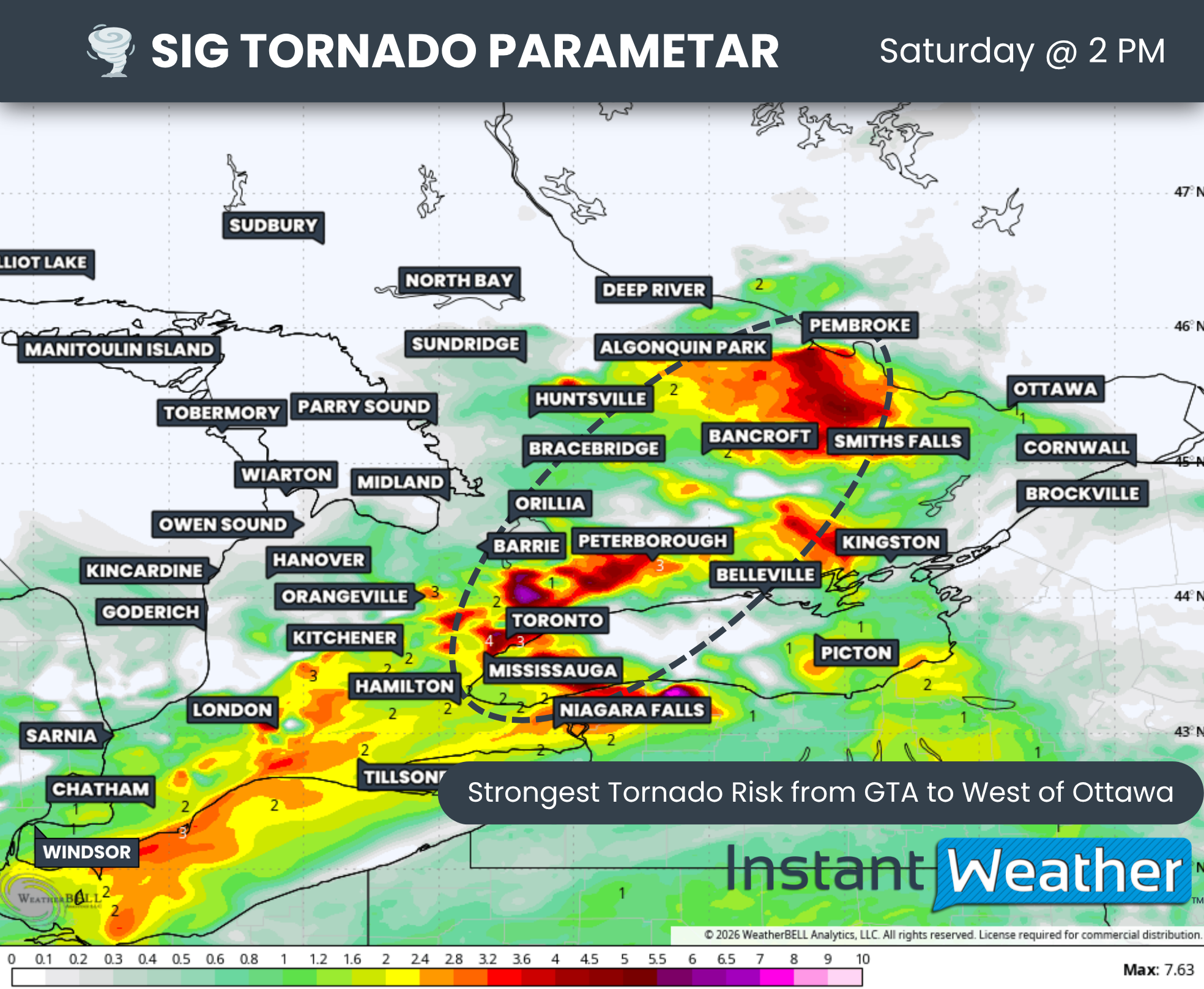
Significant Tornado Parameter - MAP FROM WEATHERBELL

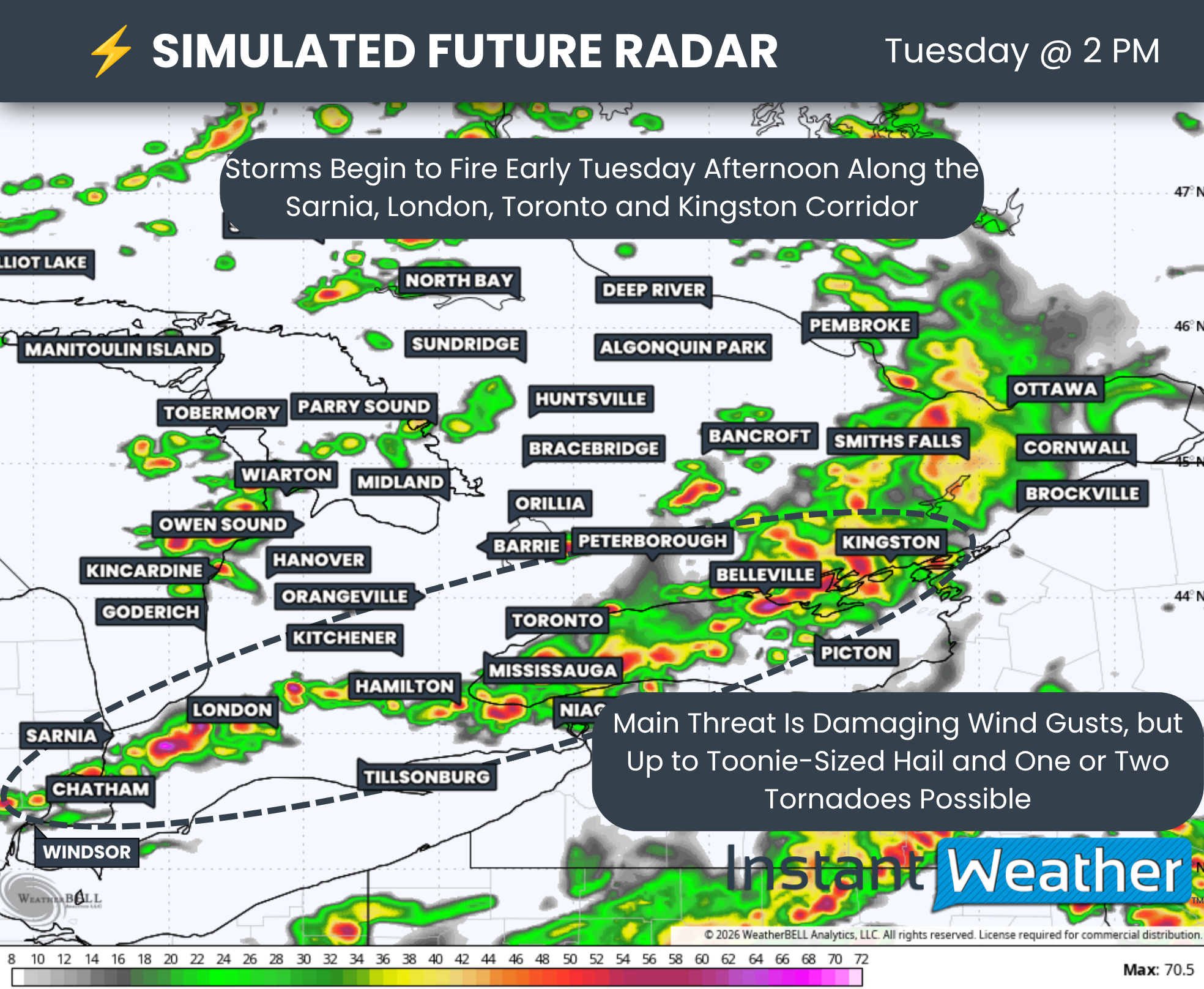
By the mid-afternoon, the atmosphere is expected to become increasingly supportive of severe thunderstorms, with the highest risk developing between roughly 2 PM and 6 PM. The strongest combination of instability and wind shear currently appears to be centred near the Lake Huron shoreline, extending into Sarnia and Chatham.

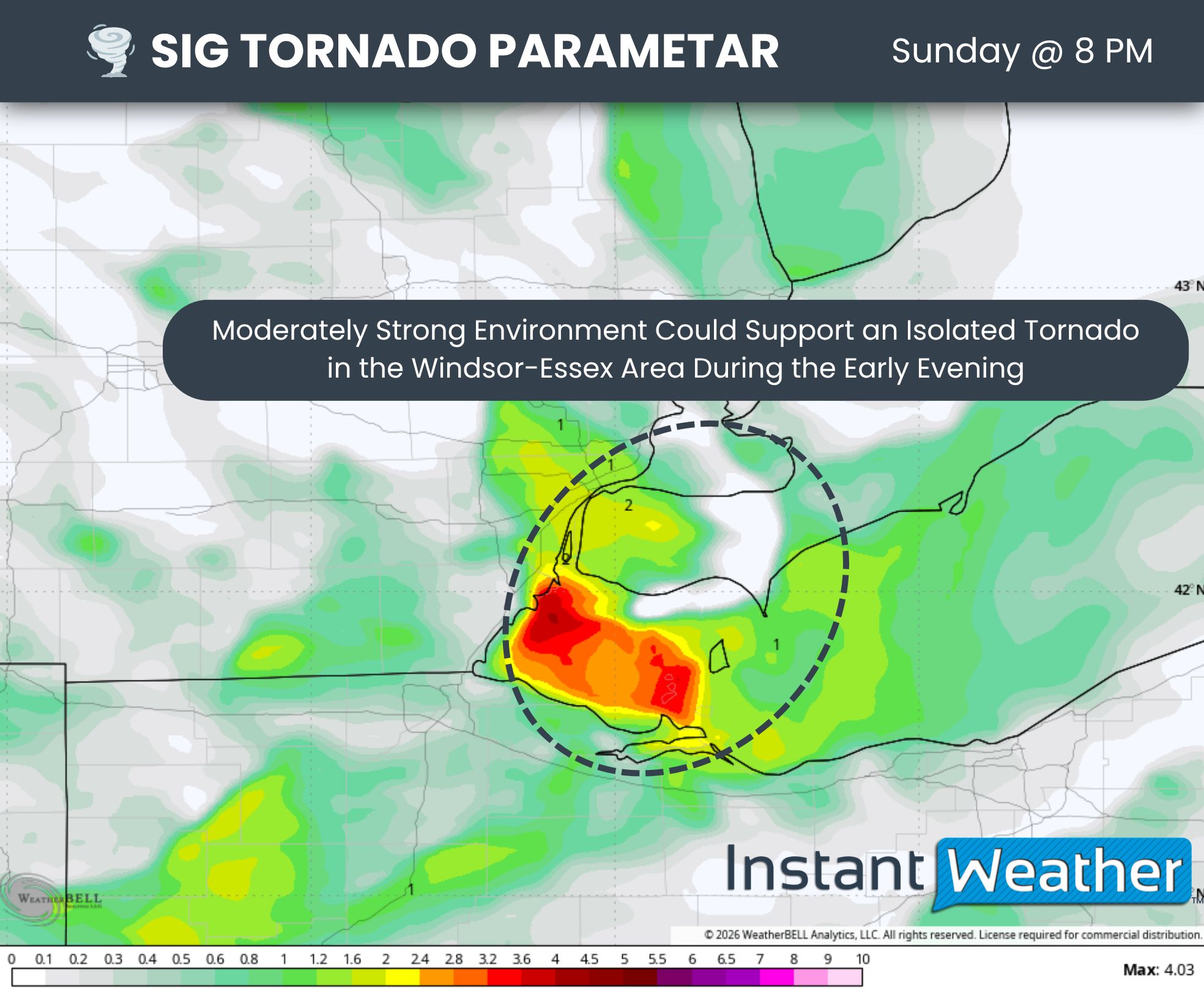
The latest Significant Tornado Parameter (STP) data also highlights an enhanced corridor stretching from the Michigan border across Lake Huron into Southwestern Ontario. Should storms form within this corridor, they could rapidly intensify into rotating supercells capable of producing very large hail, damaging winds and isolated tornadoes.

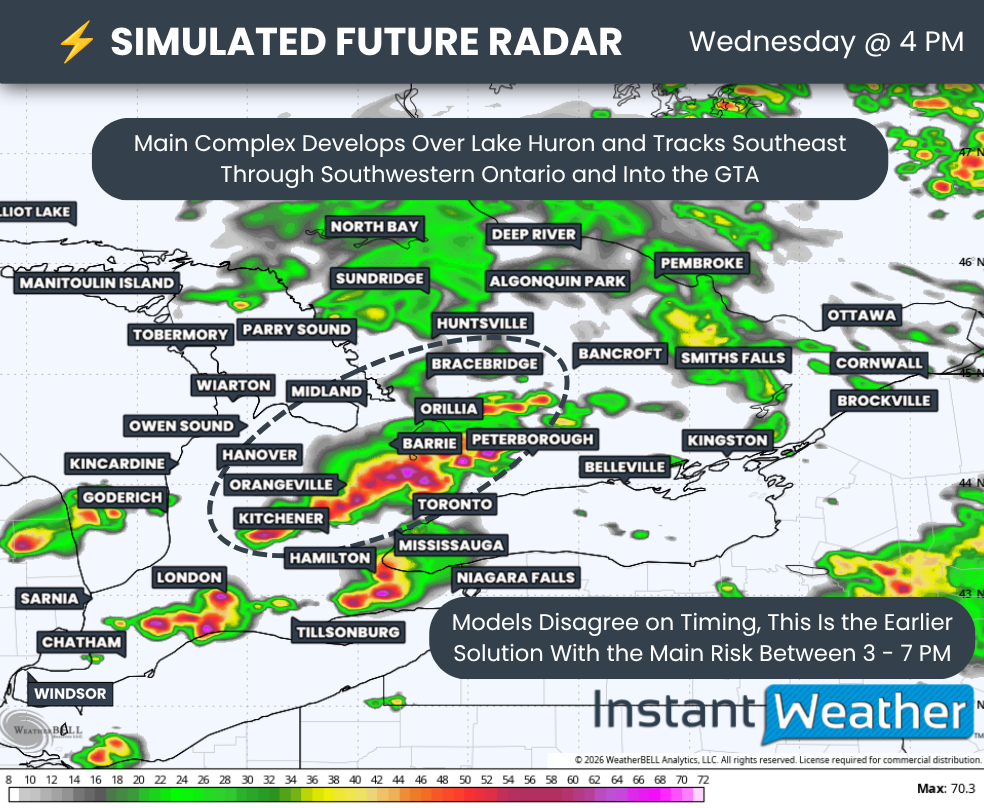
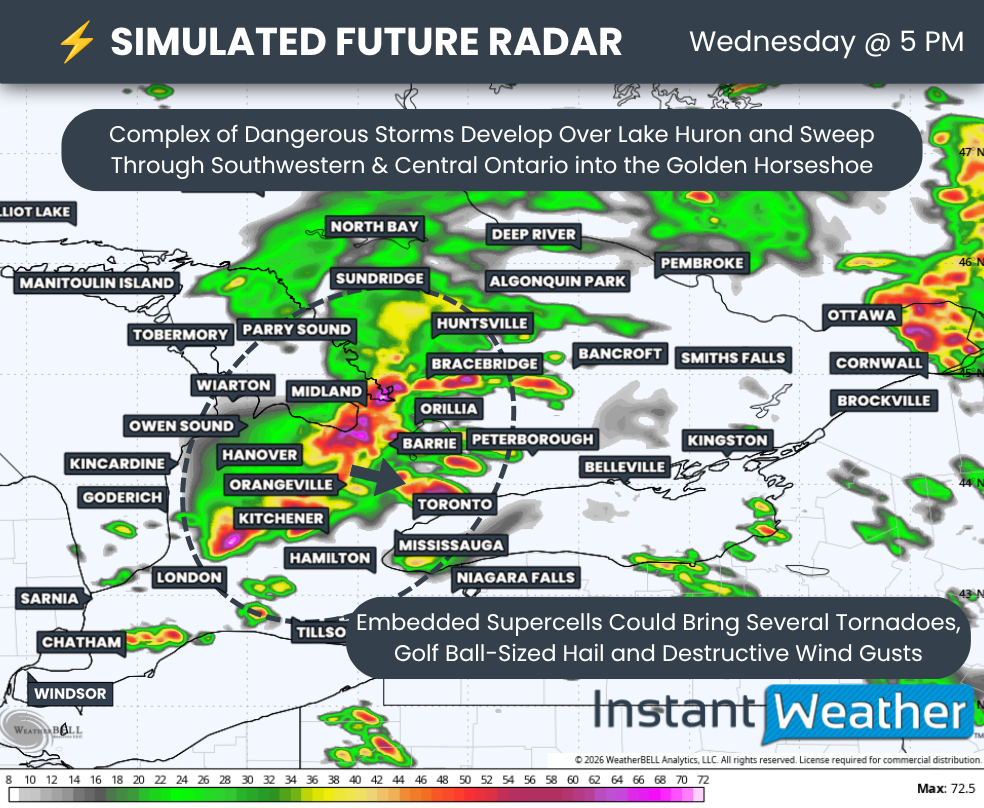
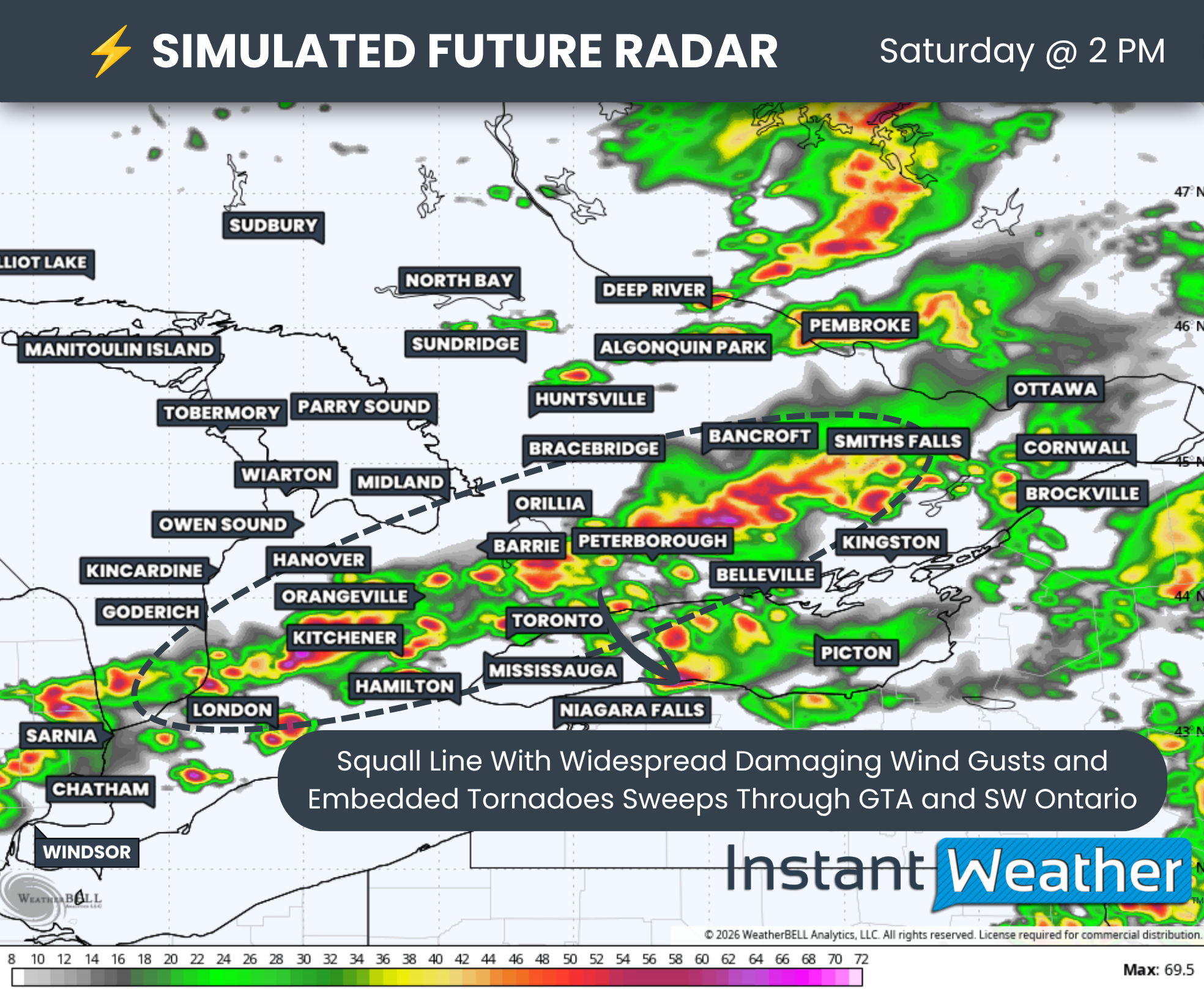
SIMULATED RADAR - MAP FROM WEATHERBELL

THIS FORECAST IS SPONSORED BY:

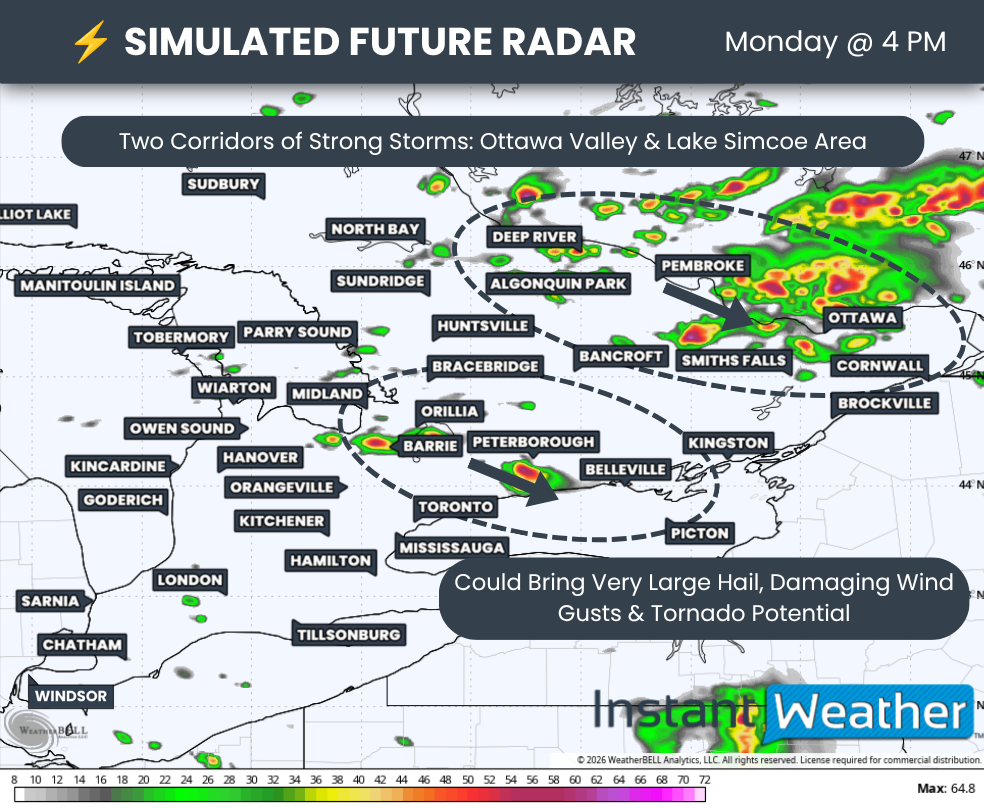
There remains some disagreement among the forecast models regarding exactly where storms will first develop.

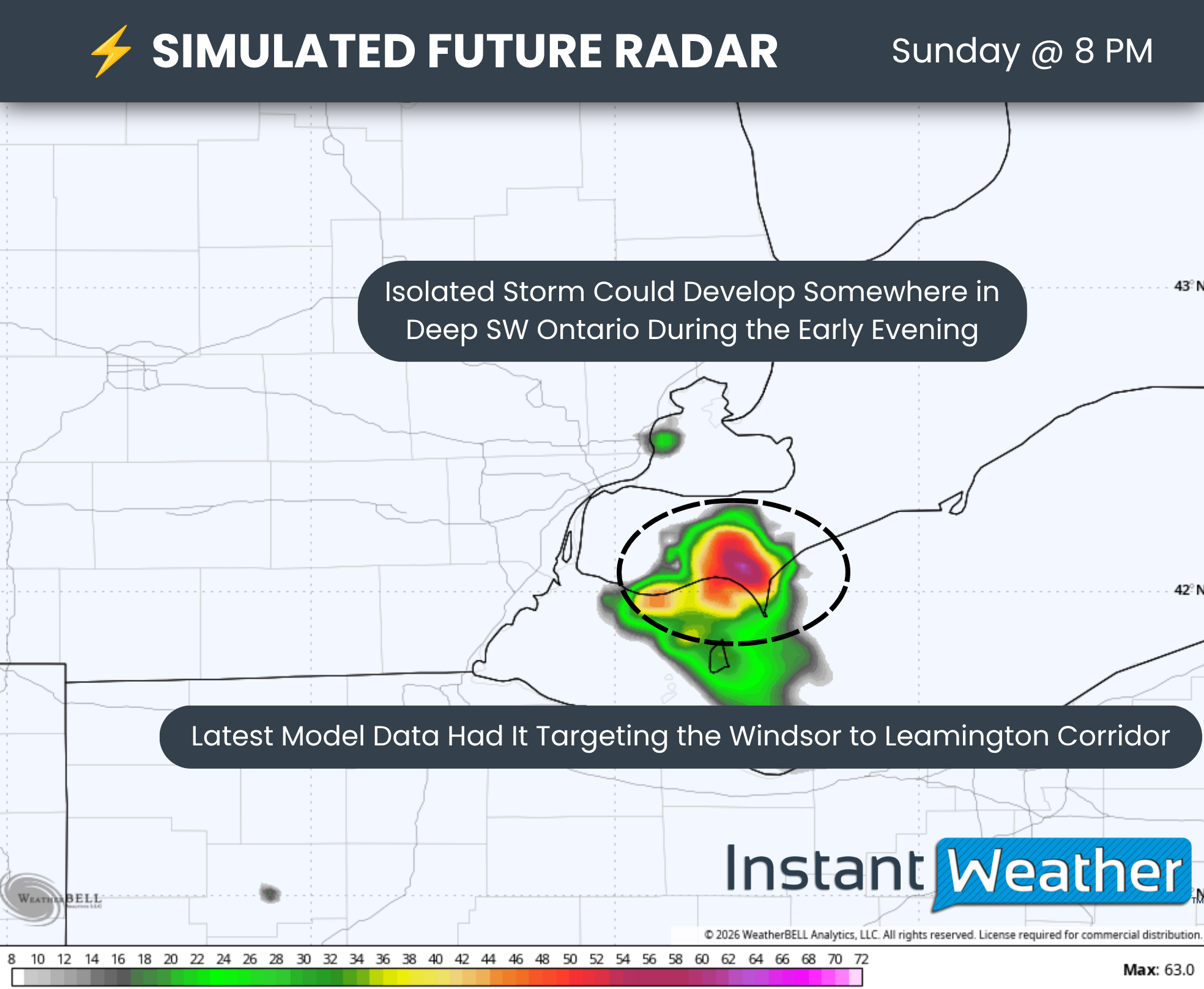
Some models initiates storms as early as 3 PM across Michigan before they quickly cross into Deep Southwestern Ontario. This scenario would place communities such as Sarnia, Grand Bend, Goderich and London at the greatest risk.

Other models delay development until later in the afternoon or early evening, with storms forming closer to the Hanover to Grand Bend corridor before tracking southeast toward London, Kitchener and possibly Hamilton. Regardless of which solution verifies, the greatest tornado potential continues to favour areas along and just inland from the southeastern Lake Huron shoreline.

Additional isolated thunderstorms may also develop around Lake Simcoe and into the Greater Toronto Area during the late afternoon and early evening. While the environment in these areas appears less favourable for widespread severe weather, a few stronger storms cannot be ruled out. The primary threats would be hail up to quarter size along with isolated damaging wind gusts.

As the sun sets Thursday evening, the severe weather threat should gradually diminish as daytime heating is lost. However, scattered non-severe showers and thunderstorms may continue well into the overnight hours, particularly across Central and Eastern Ontario.

TEMP ANOMALY - MAP FROM WEATHERBELL

Looking beyond Thursday, the severe weather threat briefly settles down. Friday may bring a very isolated thunderstorm risk across Eastern Ontario, particularly near the Ottawa Valley, while much of the weekend currently appears relatively quiet from a severe weather perspective.

The bigger story heading into next week will likely be the return of significant heat.

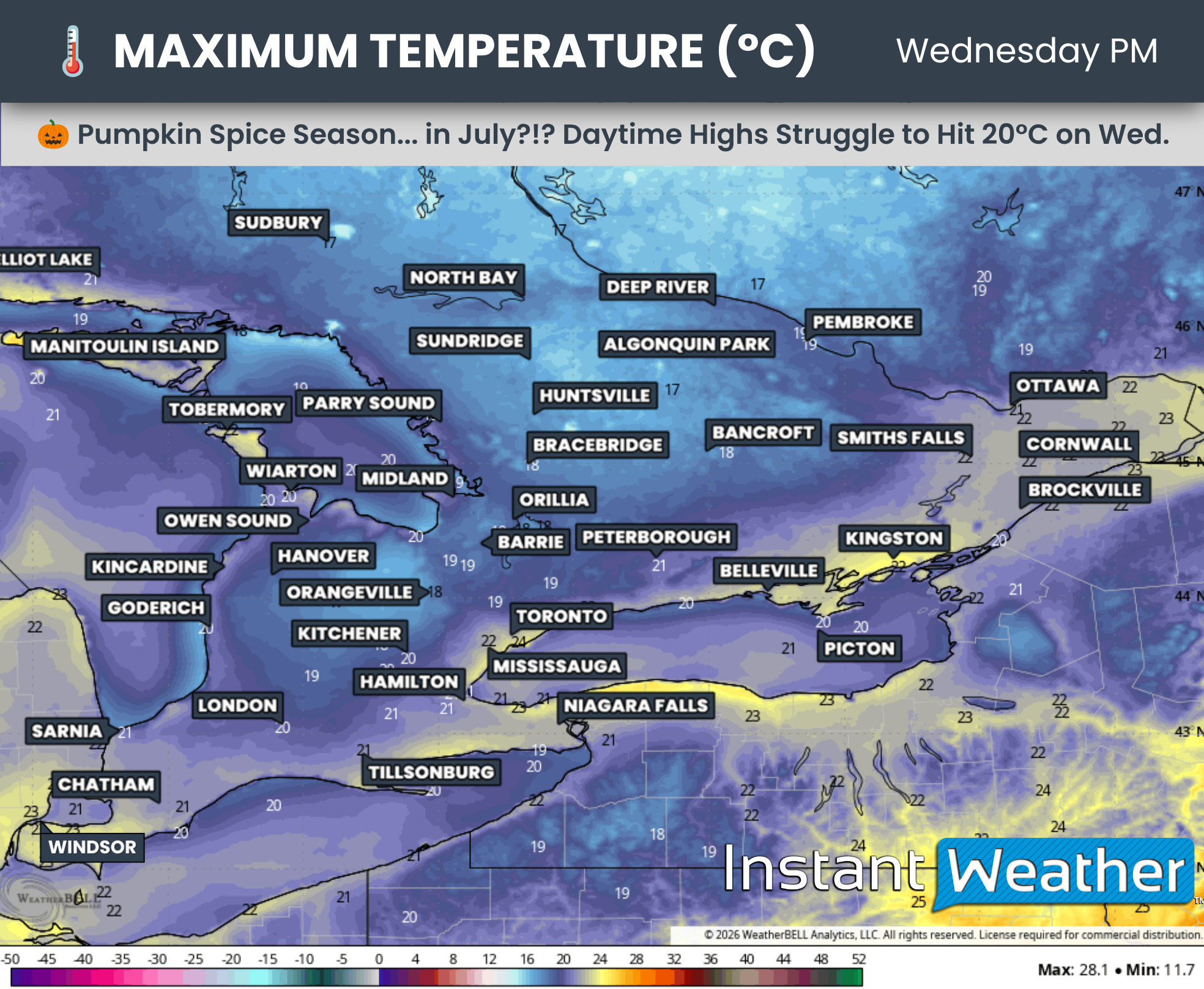
Temperatures are expected to steadily climb through the weekend, with many areas approaching or exceeding 30°C by Monday. Current medium-range guidance suggests the heat could continue to intensify into the middle of next week, potentially peaking around Canada Day.

Some forecast models are indicating temperatures running between 5 and 10°C above seasonal averages, with localized anomalies approaching 15°C in parts of Ontario on Canada Day. If those projections verify, daytime highs could reach the low to mid 30s across portions of both Southern and Northern Ontario.

When combined with increasing humidity, it may feel close to 40°C in many communities.

This surge of heat and humidity will also provide plenty of fuel for additional thunderstorm development. While it is still too early to determine exactly which days will carry the greatest severe weather risk, there are increasing signs that we could be entering a much more active pattern over the next one to two weeks. Exactly when storms develop will depend on the arrival of cold fronts and other triggering mechanisms, something that will become much clearer once higher resolution models come into range.

We'll continue monitoring both Thursday's severe weather potential and the possible prolonged heat event expected next week. Stay tuned for forecast updates throughout the coming days as confidence continues to increase.

Widespread Severe Thunderstorms Possible Across Southern Alberta and into Southwestern Saskatchewan Today with Slight Risk of a Tornado

NOTE: YOU CAN CLICK ON THE MAP TO OPEN A ZOOMABLE IMAGE

Severe thunderstorms are going to be likely across Southern Alberta and into parts of Central Alberta and Southwestern Saskatchewan today. A cold front associated with the low pressure system that’s responsible for the heavy rainfall in Central Alberta will be the trigger for thunderstorm development this afternoon and evening.

Temperatures are expected to climb into the low to mid-20s, but dewpoints are expected to be fairly low, barely reaching mid-teens for most of Southern Alberta and Southwestern Saskatchewan. This lack of moisture could hamper thunderstorm development, however some moisture from the north could make its way into the region later today, which would make up for the lower dewpoints.

Simulated reflectivity at 3pm MDT, courtesy of weatherbell.

Thunderstorms are expected to develop early this afternoon in the Foothills as individual cells. These storms will likely be severe for most of the region, but there is a more isolated severe risk closer to the low pressure center, in the Edmonton area and westward.

As the storms progress eastward through the afternoon and evening, they are expected to eventually merge into a line. This transition to a linear storm mode will bring a more widespread severe risk across Southeastern Alberta and eventually into Southwestern Saskatchewan later in the evening (around 8-10pm).

The severe risk does not extend too far eastward into Saskatchewan because the storms will weaken later in the evening. This will lead to a more isolated threat into the Swift Current area by around midnight before it’s expected that the storms become non-severe for the rest of the overnight period.

Simulated reflectivity at 9pm MDT, courtesy of weatherbell.

Across most of Southern Alberta and stretching into parts of Central Alberta, including Red Deer, and Southwestern Saskatchewan is where there is the greatest risk for widespread severe thunderstorms today. In this region, the main severe weather threats will be strong wind gusts above 100km/h and large hail that could be as big as ping pong balls. There is also a small risk of a tornado today, but that will be very conditional on there being enough moisture moving into this area from the north ahead of the thunderstorm development.


Strong Winds and Timbit Sized Hail Possible with Widespread Risk of Severe Thunderstorms in Southern Alberta & Saskatchewan Tuesday

NOTE: YOU CAN CLICK ON THE MAP TO OPEN A ZOOMABLE IMAGE

It’s looking like it’ll be an active day for some parts of Alberta and Saskatchewan today. A low pressure system from Southern British Columbia will track southeastward through Southern Alberta and Saskatchewan today, which will trigger the development of thunderstorms across the region.

Temperatures are expected to climb into the low to mid-20s, with dewpoints possibly into the mid-teens, across Southern Alberta and Saskatchewan, which should help fuel thunderstorm development. There will be a modest amount of CAPE in the region, with weather models showing upwards of 1000J/kg for some areas. While this is not a great deal of instability, the combination of shear and a mechanism for lift will be enough for scattered thunderstorms to develop across the region.

Simulated reflectivity at 2pm, courtesy of weatherbell.

Non-severe thunderstorms have already developed this morning in Central Alberta. As the low continues tracking southeast into Southern Alberta, so too will the thunderstorms and starting in the early afternoon, it’s likely that the storms that develop will become severe.

The bulk of the thunderstorm activity is expected to make its way into Southern Saskatchewan later in the afternoon, around 3-5pm. Behind the initial cluster of storms in this area, additional storms are expected to develop to the west, in Southern Alberta. Most of these storms will likely be severe, but there is a more isolated severe risk that will extend eastward across much of the rest of Southern Saskatchewan.

The thunderstorms will gradually weaken through the evening as they continue tracking into Montana and most of the storms should cross the international border by midnight. However, there is a chance that some storms could linger in Southern Saskatchewan into the early morning hours.

Simulated reflectivity at 6pm, courtesy of weatherbell.

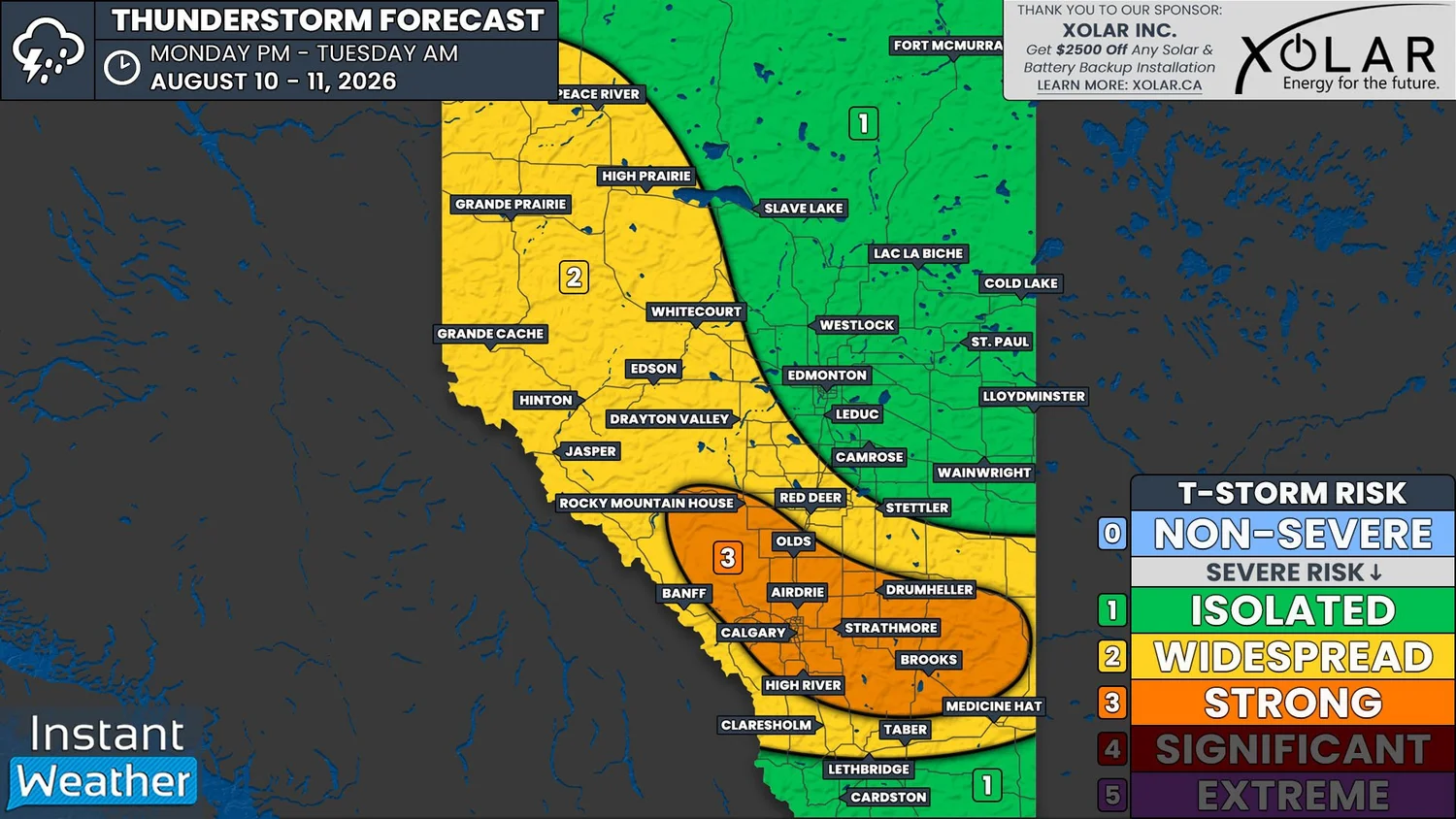
An area that stretches from northwest of Calgary southeastward into Southwestern Saskatchewan, shown in yellow on our forecast map, is where there is the greatest risk for widespread severe thunderstorms today. Across this region, the main threat from thunderstorms today will be strong wind gusts in excess of 100km/h, however there is also the threat that these storms could produce large hail that could be as large as Timbits and maybe even as large as golf balls. Given that at least one tornado is confirmed to have touched down in Northern Alberta from this system last night, the possibility of additional tornadoes today can not be ruled out.


Potential Derecho Combined with Threat of Baseball Hail and Tornadoes Marks the Return of Extreme Risk in Saskatchewan and Manitoba Tuesday

NOTE: YOU CAN CLICK ON THE MAP TO OPEN A ZOOMABLE IMAGE

It was a very busy weekend for severe weather in Southeastern Saskatchewan and Southwestern Manitoba. From the two day span, there have been countless reports of massive hail, wind damage, flooding from across the region, as well as a few tornado reports that are awaiting confirmation. Unfortunately, the calmer conditions we saw on Monday will come to an end when strong severe thunderstorms once again impact Southern Saskatchewan and Manitoba today.

Through the day, a low pressure system will strengthen as it moves from Southeastern Montana into Western North Dakota and then into Southeastern Saskatchewan and Southwestern Manitoba by later this afternoon. A warm front will extend eastward from the low pressure center, which will help draw lots of heat and moisture northward into Southern Saskatchewan and Manitoba.

Future Surface weather map with the positions of highs, lows, and fronts displayed for 12pm cst/1pm CDT on Tuesday, courtesy of the national weather service.

Temperatures are slated to climb into upper 20s and low 30s across the region this afternoon and with dewpoints expected to be in the upper teens, there will be plenty of fuel for thunderstorm development. Weather models are showing upwards of 4000J/kg of CAPE in some areas, which will support the development of supercell thunderstorms. Veering winds will also create a significant amount of shear to maintain large supercell thunderstorms and support tornado potential.

Through the morning, there is a chance that some thunderstorms could develop in Southeastern Saskatchewan which would track northeastward into Southwestern Manitoba during the early afternoon. These storms could possibly become severe and produce some small hail and strong winds, but they won’t be as strong as the storms expected later in the day.

Simulated reflectivity at 3pm CST/4pm CDT, courtesy of weatherbell.

Severe thunderstorms could start to fire up in the early afternoon, particularly in Southwestern and West Central Saskatchewan. However, we will gradually see more organized development of stronger thunderstorms occur across Southern Saskatchewan and into Southwestern Manitoba as we get later in the afternoon, around 3-6pm, depending on the time zone.

Similar to what we saw on the weekend, the thunderstorms are expected to grow exponentially into large supercells which will track mostly northeastward through the evening and overnight.

Simulated reflectivity at 7pm CST/8pm CDT, courtesy of weatherbell.

Even more thunderstorms are expected develop during the evening and storms will also move into the region from south of the border. As with the situation on both Saturday and Sunday, there is the likelihood that these additional storms will end up merging into a large line of thunderstorms. These thunderstorms will continue to be quite strong for a few hours after they transition into a linear storm mode.

As the hours tick on and it gets closer to midnight, it’s likely that the storms will begin to gradually weaken. This is also around the time that the severe line will make its way into the Winnipeg area so it’s possible that the city could avoid the greatest severe hazards of the day.

Simulated reflectivity at 11pm CST/12am CDT, courtesy of weatherbell.

The risk of strong severe thunderstorms extends across much of Southern Saskatchewan and Manitoba today. Across much of the region, there will be the possibility for storms to produce ping pong ball hail, damaging wind gusts up to 100km/h, and heavy rains that will likely result in localized flooding.

However, the greatest threat of severe weather will once again be in Southeastern Saskatchewan, into Southwestern Manitoba and extending eastward into the Interlake Region and approaching the Red River Valley. This region, highlighted in red and purple on our forecast map, could see some exceptionally strong thunderstorms this evening that will originate from Montana.

The main threat from the thunderstorms that move through this region is expected be widespread destructive wind gusts upwards of 130km/h and this could very likely end up being considered a derecho. On top of this, the storms will also have torrential downpours that could further exacerbate the flooding issues being faced by some communities and they may produce hail that could be as large as baseballs, which could be extremely dangerous if it’s being driven by winds up to 130km/h. As if this wasn’t enough, there is also a tornado risk across this region.

The major hindrance to tornado development over the weekend was that a lack of moisture ended up keeping the cloud bases high, until they were able to lower later in the evening on Sunday. This could end up being the case today, but this still has the potential to be a life-threatening situation.

Even without the tornado risk, today’s severe weather threat is very serious. If you live in the area that we’ve highlighted in either red or purple on our map, PLEASE be prepared for the likelihood that threatening weather could impact your area today. Make sure you have your phones charged and you have multiple ways to receive weather alerts. It’s also a good idea to have a plan in place in the event that you need to take shelter.


Threat of Large Hail, Damaging Winds and Tornadoes Returns to Saskatchewan and Manitoba on Tuesday

NOTE: YOU CAN CLICK ON THE MAP TO OPEN A ZOOMABLE IMAGE

It was a very busy weekend for severe weather in Southeastern Saskatchewan and Southwestern Manitoba. From the two day span, there have been countless reports of massive hail, wind damage, flooding from across the region, as well as a few tornado reports that are awaiting confirmation. Unfortunately, Monday’s calmer conditions won’t last because strong severe thunderstorms are once again expected to impact Southern Saskatchewan and Manitoba on Tuesday.

Early Tuesday, a low pressure system will move into Southeastern Montana and from there, it will strengthen as it tracks into Western North Dakota through the morning hours and into the afternoon. A warm front will extend eastward from the low pressure center, which will help draw lots of heat and moisture northward into Southern Saskatchewan and Manitoba.

Future Surface weather map with the positions of highs, lows, and fronts displayed for 12pm cst/1pm CDT on Tuesday, courtesy of the national weather service.

Temperatures are slated to climb into upper 20s and low 30s across the region in the afternoon and with dewpoints expected to be in the upper teens, there will be plenty of fuel for thunderstorm development. Some models are showing upwards of 4000J/kg of CAPE in some areas, which will support the development of supercell thunderstorms.

Veering winds will also create a significant amount of shear to maintain large supercell thunderstorms and support tornado potential. Overall, this is looking like a fairly similar environmental setup to Sunday.

During the late morning, there is a chance that some thunderstorms could develop in Southeastern Saskatchewan which would track northeastward into Southwestern Manitoba into the early afternoon hours. These storms will likely become severe and produce some small hail and strong winds, but they won’t be as strong as the storms expected later in the day. However, if these storms manage to persist across the Interlake Region, they could end up re-intensifying through the late afternoon and evening.

Simulated reflectivity at 4pm CST/5pm CDT, courtesy of weatherbell.

The strong severe thunderstorms could start to fire up in the early afternoon, particularly in Southwestern and West Central Saskatchewan. However, we will gradually see more organized development occur across Southern Saskatchewan and into Southwestern Manitoba as we get later in the afternoon, around 3-6pm, depending on the time zone.

Similar to what we saw on the weekend, the thunderstorms are expected to grow exponentially into large supercells which will track mostly northeastward through the evening and overnight.

Simulated reflectivity at 8pm CST/9pm CDT, courtesy of weatherbell.

More thunderstorms are expected develop during the evening and storms will also move into the region from south of the border. As with the situation on both Saturday and Sunday, there is the likelihood that these additional storms will end up merging into a large line of thunderstorms. These thunderstorms will continue to be quite strong for a few hours after they transition into a linear storm mode.

As the hours tick on and it gets closer to midnight, it’s likely that the storms will begin to gradually weaken. This is also around the time that the severe line will make its way into the Winnipeg area so it’s possible that the city could avoid the greatest severe hazards of the day.

Simulated reflectivity at 11pm CST/12am CDT, courtesy of weatherbell.

The risk of strong severe thunderstorms on Tuesday extends across much of Southern Saskatchewan and Manitoba. Throughout this region, the severe thunderstorms could end up producing hail that’s larger than golf balls, widespread damaging wind gusts up to 130km/h, and torrential downpours that could exacerbate the flooding issues some communities are already dealing with.

There is also the potential for tornadoes to form from these thunderstorms. The major hindrance to tornado development over the weekend was that a lack of moisture ended up keeping the cloud bases high until they were able to lower later in the evening on Sunday. This could end up being the case on Tuesday, given the similar environmental setup, but the risk is certainly still in place.

Please keep in mind that this is a preliminary forecast and could differ from our final forecast as more data comes in overnight and tomorrow morning.


Widespread Tornado Threat and Softball-Sized Hail Possible with Extreme Thunderstorm Risk on Sunday as Severe Weather Outbreak Enters its Second Day

NOTE: YOU CAN CLICK ON THE MAP TO OPEN A ZOOMABLE IMAGE

After a busy day yesterday, that saw severe thunderstorms dropping massive baseball-sized hail over parts of Southeastern Saskatchewan and Southern Manitoba, we have the chance to do it all again today. It’s likely that today could be an even greater severe risk day than yesterday, with an extreme risk posed by the possibility of gigantic hail and multiple tornadoes. However, there has been a little bit of uncertainty surrounding how thunderstorms may end up developing this afternoon and evening.

Like yesterday, today’s severe thunderstorm threat will be triggered by a cold front that is currently oriented on a north-south axis and it located just west of the Saskatchewan/Manitoba border. This is a bit further west than originally anticipated when we issued our preliminary forecast on Friday, due in part to the front becoming stationary for a period of time yesterday. As a result, the severe risk today will cover more of Southeastern Saskatchewan and won’t extend as far east across Southern Manitoba.

To the east of the cold front, temperatures will once again climb into the low 30s this afternoon and it’s expected to be much more humid today, with dew points approaching the 20°C mark. The lack of moisture yesterday kept the cloud bases high, which greatly reduced the tornado risk, but it doesn’t look like that will be the case today.

The heat and humidity will lead to high levels of instability and upwards of 3000J/kg of CAPE to fuel thunderstorm development again today. Veering winds will also create a significant amount of shear to maintain large supercell thunderstorms.

Surface weather map with the positions of highs, lows, and fronts displayed as of 6am cst this morning, courtesy of the national weather service.

As we’ve mentioned in this forecast already, and in our forecast from yesterday, there was uncertainty with today’s severe thunderstorm risk. There have been some mostly non-severe thunderstorms that have tracked through Southern Manitoba already this morning and it is possible these could hinder additional development later today.

The storms have weakened over the past couple of hours and the thought was that if they manage to clear early enough, that will allow for there to be ample surface heating needed for the additional explosive development later. However, if the storms stuck around into the afternoon, the severe thunderstorm risk would be greatly reduced. With the clearing of these morning storms already occurring, it seems likely the severe threat will not be diminished.

The significant severe thunderstorms could develop in the late afternoon and into the early evening, around 4-6pm in Southeastern Saskatchewan and extending northeastward into Southern and Central Manitoba. These storms could once again explode into massive and dangerous supercell thunderstorms that would track roughly northeastward through the evening.

Simulated reflectivity at 4pm CST/5pm CDT, courtesy of weatherbell.

The area highlighted on our map in red, that covers a large portion of Southeastern Saskatchewan and Southwestern Manitoba, will be at a very high risk for dangerous severe thunderstorms. The area highlighted in purple, however, is where the strongest environment is expected to be and where there is an extreme risk for incredibly dangerous and life-threatening thunderstorms.

Throughout this region, the severe thunderstorms could end up producing absolutely massive, and maybe record-breaking, softball-sized hail, damaging wind gusts up to 120km/h, and very heavy rainfall that could lead to localized flooding. If we end up seeing the moisture that we were lacking yesterday, and the storm bases are lower, it is entirely possible that we could be looking at a tornado outbreak.

Simulated reflectivity at 8pm CST/9pm CDT, courtesy of weatherbell.

As we progress through the evening, more thunderstorms are expected develop and storms will also move into the region from south of the border. Once again, there is the likelihood that these additional storms will end up merging into a large line of storms which could impact a wide area into the overnight hours.

By the time we see a more linear storm mode, it’s likely that the storms will have weakened from their greatest strength, but they are still expected to be very strong and capable of producing very large hail, damaging wind gusts, and torrential rain.

The tornado threat should also decrease as we get later in the evening and into the overnight hours, but with how strong these thunderstorms could be today, there will still be a slight risk until the storms move into Northern Manitoba during the early morning.

Today’s severe weather threat is very serious. If you live in the area that we’ve highlighted in either red or purple on our map, PLEASE be prepared for the possibility of threatening weather to impact your area today. Make sure you have your phones charged and you have multiple ways to receive weather alerts. It’s also a good idea to have a plan in place in the event that you need to take shelter.

Once again, we will absolutely be live-streaming later so please join us while we monitor and track today’s severe weather. We hope everyone is able to stay safe today!